01Facts
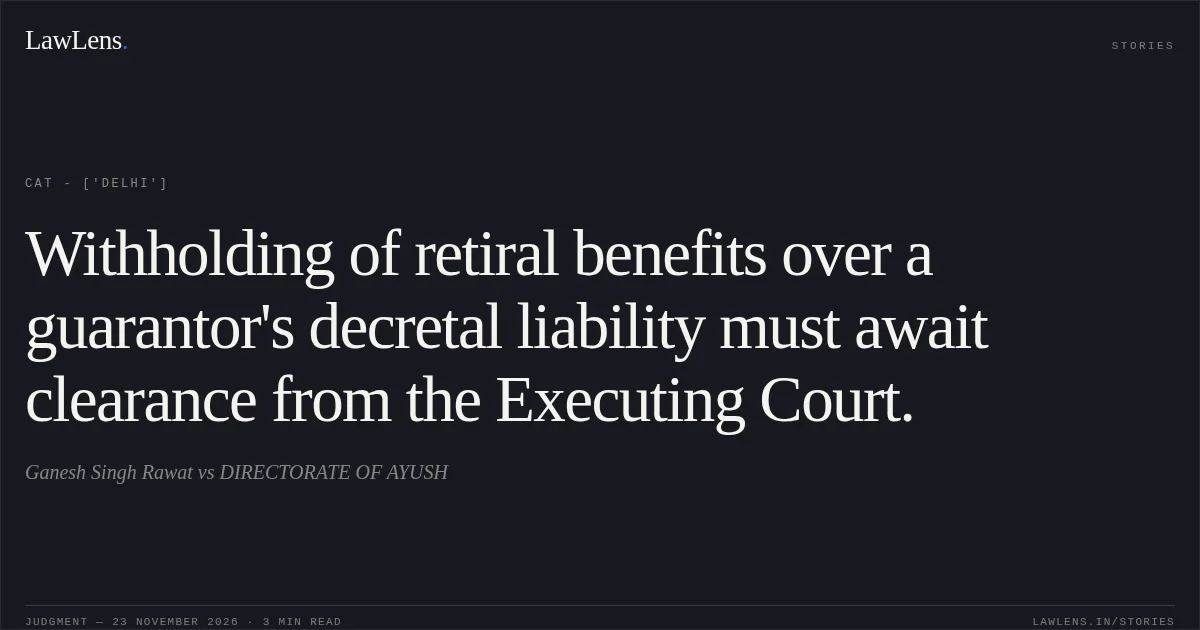
The applicant served the respondent Board as Registrar and superannuated on 31.08.2019, after a three-month consultancy that he discontinued on 15.11.2019.
¶ 1In 1997 he stood as guarantor for a loan taken by Sh. Chaman Lal from Delhi SC/ST/OBC/Minorities & Handicapped Financial & Development Corporation Ltd. (respondent No. 2, "the Corporation") to purchase an RTV vehicle.
¶ 2After default, the Corporation obtained a decree in Suit No. 114/2009 and filed Execution Petition Ex/20/14. The Executing Court attached the applicant's salary on 06.11.2015, but after a 29.01.2016 "go slow policy" decision, the execution was adjourned sine die and the attachment withdrawn on 07.04.2016.
¶ 3, 25By letter dated 24.09.2019, the Corporation asked the Board to recover from guarantor-employees' salaries; as the applicant had retired, the Board withheld his retiral dues, including Rs. 10,00,000 gratuity and Rs. 56,159 leave encashment, by order dated 26.11.2019.
¶ 4, 8On 28.02.2022 the Board resolved to release dues only on an NOC from the Corporation, which the applicant could not obtain.
¶ 5His civil suit (CS SCJ No. 1506/2023) was dismissed for lack of jurisdiction on 29.05.2024.
¶ 6His earlier OA No. 941/2025 was dismissed on 12.03.2025 with liberty to implead the Corporation in a fresh OA.
¶ 7The Board raised preliminary objections of maintainability, res judicata/constructive res judicata, and non-joinder of the Corporation.
¶ 13–1702Issues
i.1. Whether the Board was justified in indefinitely withholding the applicant's gratuity and leave encashment on the basis of the Corporation's recovery request, where no subsisting attachment order or specific direction from the Executing Court existed.
¶ 24 · ¶ 26ii.2. Whether the issue of the applicant's liability under the decretal amount, and whether the decree-holder may proceed against retiral benefits, is to be determined by this Tribunal or by the Executing Court.
¶ 27 · ¶ 2803Law Applied
The Tribunal did not expressly decide any legal question on the merits. It proceeded on the principle that issues arising from a decree of a competent civil court, including recovery of decretal amounts and their effect on retiral benefits, are appropriately determined by the Executing Court.
¶ 27The applicant relied on Rule 9 of the CCS (Pension) Rules, 1972, D.S. Nakara v. Union of India (pension as a valuable right), Jarnail Singh v. Union of India (gratuity not to be withheld arbitrarily), and Radhey Shyam Gupta v. Punjab National Bank (gratuity protected under Section 60 CPC and Section 13 of the Payment of Gratuity Act, 1972).
¶ 9–11The respondents relied on Section 11 CPC (Explanation IV) on res judicata and on Supreme Court authorities on necessary parties (J.N. Real Estate, Gangubai Raghunath Ayare, Pappammal).
¶ 15, 17The Tribunal did not adopt or decide the authorities relied upon by the applicant or the respondents.
Provisions in the judgment · 3 · Linked ones open on LawLens
Code of Civil Procedure, 1908 Section 60Section 11
Administrative Tribunals Act, 1985 Section 19
04Reasoning
The Tribunal treated the controversy as one arising from a decree in a civil recovery suit in which the applicant was a judgment-debtor.
¶ 27Since the attachment order had been withdrawn and execution adjourned sine die, the Board's withholding rested solely on the Corporation's 2019 request.
¶ 25 · ¶ 26The Tribunal declined to decide the applicant's liability under the decree or whether the decree-holder could reach retiral benefits, holding that these questions belonged to the Executing Court.
¶ 27–28To avoid conflicting determinations, it made the release of dues conditional on the Executing Court's clearance or order, while not expressly ruling on the applicant's rights under Rule 9, Nakara, Jarnail Singh, or the CPC/Gratuity Act protections.
¶ 28–29The preliminary objections (maintainability, res judicata, non-joinder) were noted but were not separately adjudicated in the operative reasoning.
¶ 13–22 · no citation for a finding05Holding
The Tribunal did not answer the merits question whether the withholding was unjustified.
¶ 28It held that the determination of the applicant's decretal liability and of the decree-holder's right against retiral benefits lies with the Executing Court.
¶ 27–28The OA is disposed of with liberty to the applicant to approach the Executing Court for clarification or clearance on release of retiral benefits. Upon production of such clearance or an appropriate Executing Court order, the Board must release admissible retiral dues, including gratuity and leave encashment, in accordance with the rules and subject to the Executing Court's final orders.
¶ 28 · ¶ 29Pending M.A.s stand disposed of, and no order as to costs is made.
¶ 30Original Court PDF
Ganesh Singh RawatvsDIRECTORATE OF AYUSH
Click to open original judgment
Original judgment, available to read, download and summarize on LawLens.in