Facts
The claimant sustained multiple injuries in a road accident on 11 September 2016 involving a lorry owned by the first respondent and insured by the second respondent.
Source reference: p. 2–5The Tribunal found the lorry driver negligent and awarded compensation of ₹11,39,274, including ₹2,25,000 for 45% permanent disability calculated at ₹5,000 per percentage point.
Source reference: p. 2–5The claimant appealed under Section 173 of the Motor Vehicles Act, 1988, seeking enhancement, including adoption of the multiplier method for alleged loss of earning capacity.
Source reference: p. 2–5On appeal, a Medical Board assessed his disability at 51%; its certificate was marked as Ex.C1.
Source reference: p. 7Issues
1. Whether the Tribunal erred in using the percentage method, rather than the multiplier method, to compensate the claimant for permanent disability and alleged loss of earning capacity
Source reference: p. 5–82. Whether the compensation under permanent disability, loss of income, and the other non-medical heads required enhancement
Source reference: p. 8–11Law Applied
The claim arose under Section 166 of the Motor Vehicles Act, 1988, and the appeal was brought under Section 173.
Source reference: p. 2, p. 1As explained in Rajkumar v. Ajaykumar, 2010 (2) TNMAC 581 (SC), medical disability and loss of earning capacity are distinct: loss of earning capacity must be assessed by the Tribunal from the evidence as a whole, having regard to the claimant’s occupation, age, education, and other relevant factors; the medical percentage does not automatically establish an equivalent economic loss.
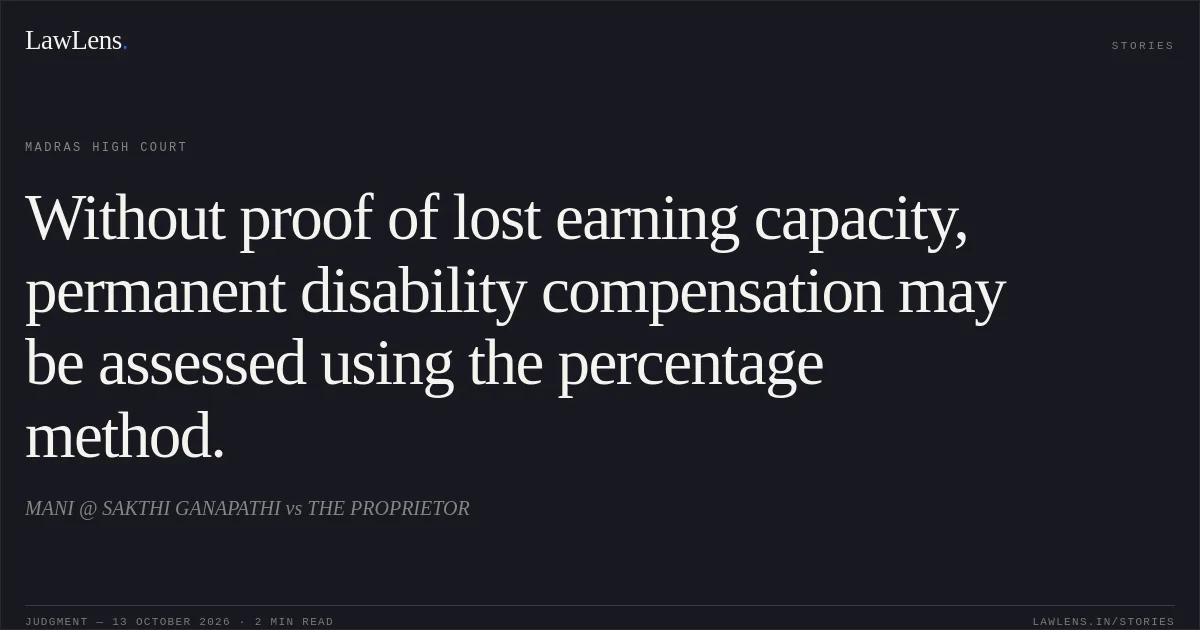
Source reference: p. 6Where loss of earning capacity is not proved, compensation may be assessed by the percentage method.
Source reference: p. 8Reasoning
The Court found no sufficient proof that the claimant’s disability prevented him from performing employment-related activities or established a corresponding loss of earning capacity. It therefore upheld the Tribunal’s use of the percentage method rather than the multiplier method.
Source reference: p. 8However, because the Medical Board assessed disability at 51%, the Court used that figure instead of the Tribunal’s 45% and awarded ₹2,55,000 for permanent disability.
Source reference: p. 8It also found the income and recovery-period assessment inadequate in light of the claimant’s age, occupation, multiple hospital admissions, and surgeries, and increased monthly income to ₹15,000 and the compensable period to seven months.
Source reference: p. 9–10Considering the injuries and treatment, it enhanced the awards for pain and suffering, transportation, extra nourishment, attendant charges, and loss of amenities.
Source reference: p. 10Holding
The appeal was allowed in part. The total compensation was enhanced from ₹11,39,274 to ₹13,69,274, with interest at 7.5% per annum from the date of the claim petition until deposit, subject to the exclusion of interest for the 493-day delay period specified in the Court’s earlier order.
The insurer was directed to deposit the amount, less any sum already deposited, within four weeks; the claimant was permitted to withdraw it in accordance with the Tribunal’s directions.
Source reference: p. 11–12Acts & Sections Cited
2 provisions across 1 statute referred to in this judgment. Each provision opens on LawLens.
Motor Vehicles Act, 19882
Original Court PDF
MANI @ SAKTHI GANAPATHIvsTHE PROPRIETOR
Click to open original judgment
Original judgment, available to read, download and summarize on LawLens.in