Facts
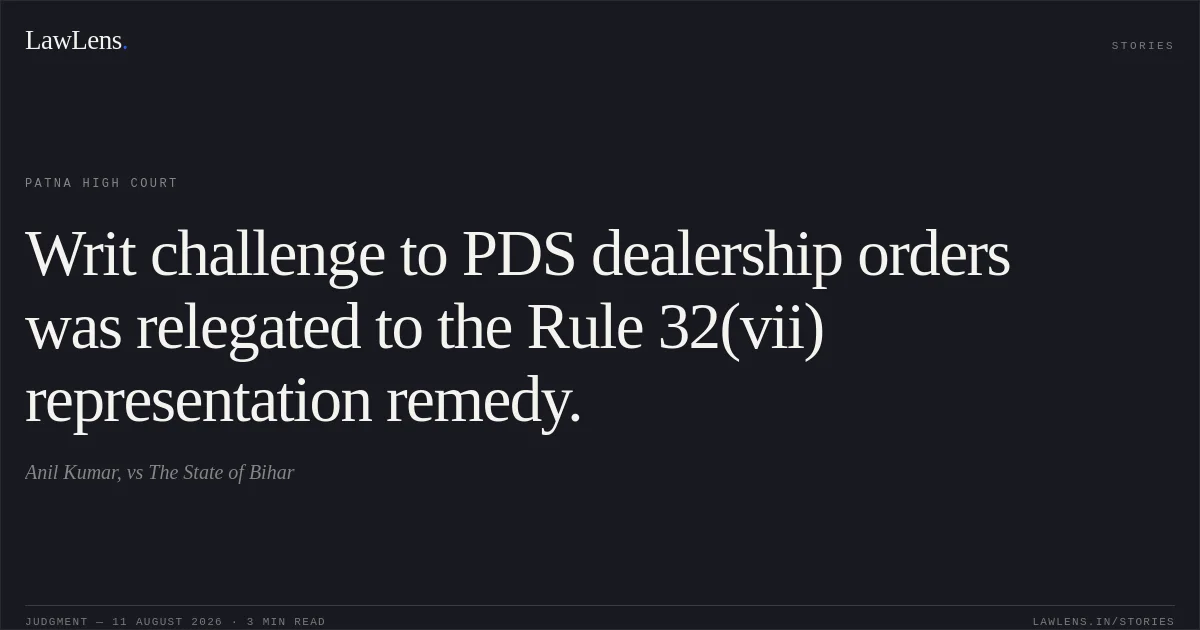
The petitioner, Anil Kumar, challenged the order dated 8 August 2023 passed by the Divisional Commissioner, Koshi Range, Saharsa, in Supply Revision Case No. 19 of 2023.
Source reference: pp. 1–2, para. 1By that order, the Commissioner cancelled the petitioner’s selection as a Public Distribution System (“PDS”) dealer for Ward No. 7 within Bhelwa Panchayat, Madhepura, and declared Respondent No. 8 selected for the dealership.
Source reference: pp. 1–2, para. 1During the hearing, the petitioner relied upon Rule 32(vii) of the Bihar Targeted Public Distribution System (Control) Order, 2016, which empowers the Principal Secretary to call for records and exercise supervisory powers over orders passed by specified authorities.
Source reference: p. 2, paras. 2–3The petitioner sought quashing of the Commissioner’s order and restoration of his selection.
Source reference: pp. 1–2, para. 1Issues
Whether the writ petition challenging the Commissioner’s order cancelling the petitioner’s PDS dealership selection was maintainable when the petitioner had an alternative remedy of filing a representation before the Principal Secretary under Rule 32(vii) of the Bihar Targeted Public Distribution System (Control) Order, 2016.
Source reference: p. 3, para. 5Whether the Principal Secretary should examine the legality of the Commissioner’s order and the consequential cancellation of the petitioner’s selection after giving the petitioner notice and an opportunity of hearing.
Source reference: pp. 3–4, paras. 5–7Law Applied
The Court applied Rule 32(vii) of the Bihar Targeted Public Distribution System (Control) Order, 2016, which authorises the Principal Secretary, either suo motu or on a representation, to call for records relating to orders passed by the Divisional Commissioner, District Officer, licensing authority, or Sub-Divisional Officer.
Source reference: pp. 2–3, para. 3The Principal Secretary may grant appropriate relief where the concerned authority has exercised powers not vested in it, exercised its powers illegally without considering the facts, or failed to exercise its jurisdiction.
Source reference: pp. 2–3, para. 3The Court also applied the principle that a writ petition may ordinarily be declined where an alternative and efficacious statutory remedy is available.
Source reference: p. 3, para. 5Before an adverse administrative order is passed, the affected party must receive notice and a meaningful opportunity of hearing.
Source reference: p. 4, para. 7Reasoning
The Court did not examine the merits of the petitioner’s challenge to the cancellation of his selection or the declaration of Respondent No. 8 as the selected dealer.
Source reference: p. 3, para. 5It held that Rule 32(vii) provided the petitioner with an alternative and efficacious remedy before the Principal Secretary, who was competent to examine the legality of the orders passed by the subordinate authorities.
Source reference: p. 3, para. 5Consequently, instead of exercising writ jurisdiction at that stage, the Court granted liberty to the petitioner to invoke the statutory remedy by filing a representation challenging both the revisional/appellate order and the cancellation order.
Source reference: pp. 3–4, paras. 5–7The Court further directed that the Principal Secretary must consider the representation in accordance with law, after issuing notice and providing an opportunity of hearing.
Source reference: pp. 3–4, paras. 5–7Holding
The writ petition was disposed of without adjudication on the merits.
The petitioner was granted liberty to file a representation before the Principal Secretary under Rule 32(vii) within one month from receipt of the Court’s order, challenging the Commissioner’s order and the cancellation of his selection.
Source reference: p. 3, para. 5The Principal Secretary was directed to pass an appropriate order within three months of receiving the representation, after giving the petitioner notice and an opportunity of hearing, and to communicate the decision to the concerned parties.
Source reference: pp. 3–4, paras. 5–7Any delay in filing the representation was to be liberally construed because the petitioner had approached the High Court within time.
Source reference: p. 4, para. 6All pending interlocutory applications, if any, were also disposed of.
Source reference: p. 4, paras. 8–9Original Court PDF
Anil Kumar,vsThe State of Bihar
Click to open original judgment
Original judgment, available to read, download and summarize on LawLens.in