Facts
During a temple festival on 29.04.2013, four villagers (including minors and a young mother) drowned in the Cauvery river while taking a holy bath.
Source reference: para. 4The writ petitioners (respondents herein) alleged the deaths resulted from "quicksand" created by illegal sand quarrying and sought compensation from the State.
Source reference: para. 4The State (appellants) contested liability, arguing the deaths were an "Act of God" or due to the victims' own negligence ("Volenti non fit injuria") as they ignored local warnings.
Source reference: paras. 5, 22The Single Judge, relying on a previous Division Bench holding involving illegal mining, directed the State to pay compensation using the multiplier method.
Source reference: paras. 6, 8The State appealed this common order.
Source reference: para. 9Issues
1. Whether the State can be held liable for negligence under Article 226 when the cause of death and allegations of illegal quarrying are disputed facts.
Source reference: paras. 16, 212. Whether the "multiplier method" used in Motor Vehicles Act cases is applicable to drowning incidents where contributory negligence is alleged.
Source reference: paras. 12, 18, 213. Whether the State is obligated to install caution boards across the entire 200km stretch of the river.
Source reference: paras. 17, 26Law Applied
The Court primarily applied the principle of Volenti non fit injuria regarding self-assumed risks.
Source reference: para. 22It relied on the precedent set by the Hon'ble Supreme Court in Chairman, Grid Corporation of Orissa Ltd. v. Sukamani Das (1999) 7 SCC 298, which established that a Writ Court should not entertain claims for compensation under Article 226 when the underlying facts regarding negligence and liability are highly disputed.
Source reference: paras. 13, 22The Court also distinguished the present case from the "Multiplier Method" application used in the previous Division Bench judgment in WP(MD)No.4251 of 2017, noting that the latter involved proven, rampant illegal mining with State connivance.
Source reference: paras. 18-21Reasoning
The Court found that unlike the previous precedent involving 40-foot deep man-made pits, the present case involved disputed facts regarding the formation of natural quicksand via sediment transport.
Source reference: paras. 18, 21The Court noted the victims entered the river of their own volition for a religious event without notifying the authorities.
Source reference: paras. 16, 21It observed that it is "virtually impossible" for the State to predict shifting quicksand or place caution boards across a 200km river stretch.
Source reference: paras. 17, 26Therefore, the Single Judge erred in fixing liability without a trial. However, the Court took note of an affidavit filed by the Executive Engineer (8th respondent) expressing a "sympathetic and humanitarian approach" and a willingness to pay "reasonable compensation" as a Welfare State.
Source reference: paras. 24, 28This admission, while not an admission of legal negligence, allowed the Court to grant relief on humanitarian grounds rather than as a strict legal liability.
Source reference: paras. 25, 28Holding
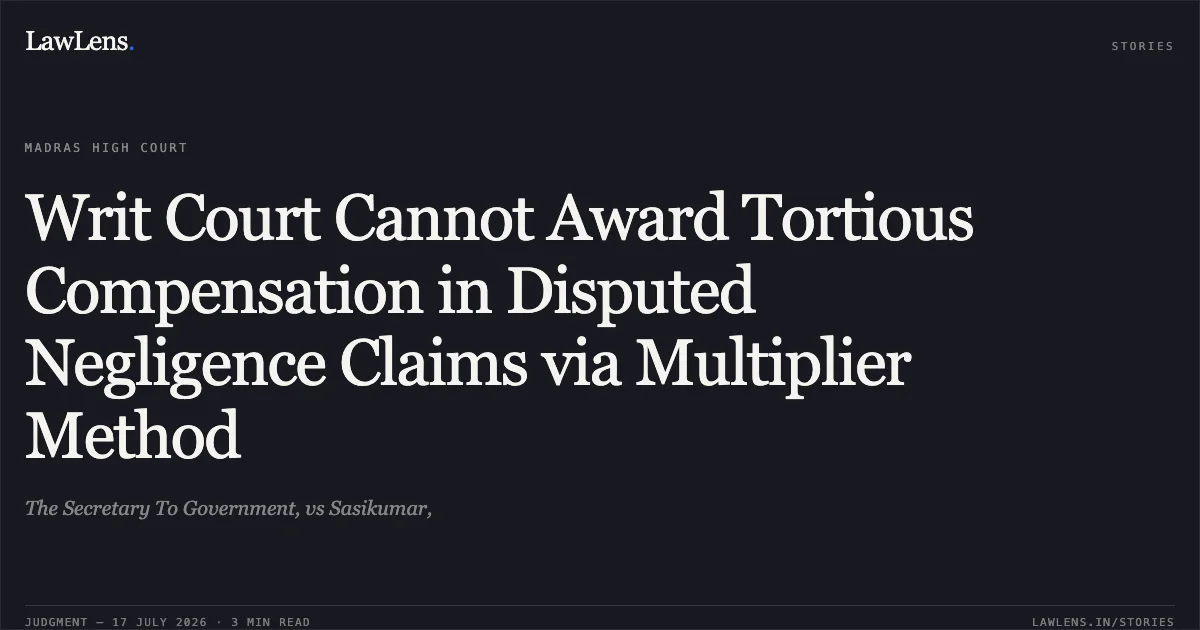
The Court partly allowed the Writ Appeals, setting aside the Single Judge's "multiplier method" calculation.
On purely humanitarian grounds and based on the State's own offer of "reasonable compensation," the Court ordered ex-gratia payments of ₹10,00,000 for the loss of a wife and child, and ₹5,00,000 each to the other two petitioners.
Source reference: para. 27The Court clarified that if the petitioners are dissatisfied with this quantum, they are at liberty to file a civil suit to prove negligence, with a direction that the Civil Court shall waive limitation periods due to the 12-year pendency of the writ proceedings.
Source reference: para. 29Acts & Sections Cited
1 provisions across 1 statute referred to in this judgment. Linked provisions open on LawLens.
Letters Patent (Madras)1
Original Court PDF
The Secretary To Government,vsSasikumar,
Click to open original judgment
Original judgment, available to read, download and summarize on LawLens.in