01Facts
The petitioner claims Khata No. 410, Khesra No. 956, measuring 66 decimals at Mauza Makhmilpur, P.S. Paliganj, Patna, was settled in favour of him or his ancestor by the ex-landlord in 1940 through a registered deed of settlement.
¶ 3He asserts uninterrupted possession for about 86 years, with revenue recorded under Jamabandi No. 140 and rent paid up to 2023–24 (Annexure P/2).
¶ 2, 3He alleges that the State officials, at the instance of private respondent No. 8 (the Mukhiya of Panchayat Madhwan Makhmilpur), excavated part of the land and disturbed his possession.
¶ 2, 3He submitted representations to various authorities, including the District Magistrate, Patna (Annexure-5), without action.
¶ 3He sought (i) mandamus to restore the excavated portion and restrain further interference, (ii) mandamus to protect his peaceful possession, and (iii) other appropriate relief.
¶ 2The State sought a short adjournment to file a counter affidavit.
¶ 402Issues
i.1. Whether a counter affidavit was required before the Court could adjudicate the writ petition, or whether calling for it would be futile.
¶ 5ii.2. Whether the petitioner's unanswered representation (Annexure-5) warranted a direction to the competent revenue authority to decide it in accordance with law, after hearing all concerned, including private respondent No. 8.
¶ 3, 503Law Applied
The judgment cites no statute, rule, or precedent.
The Court's reasoning rests on the procedural principle that a writ court may dispose of a petition without a counter affidavit where calling for one would be futile.
¶ 5Where a representation remains undecided, the writ court may direct the competent authority to decide it within a fixed period, in accordance with law and after affording a hearing to affected parties.
¶ 5, 6The Court's power to issue such a direction is not expressly grounded in any cited provision.
04Reasoning
The Court dispensed with a counter affidavit, holding that it would serve no useful purpose.
¶ 5It did not examine the petitioner's claims of settlement, title, or 86-year possession, nor the allegations of excavation and instigation by respondent No. 8, as these are disputed questions of fact and title better determined by the revenue authority after hearing the parties.
¶ 3, 5Because the petitioner's grievance was that his representation had not been acted upon, the Court directed a time-bound decision on that representation rather than granting the substantive mandamus sought.
¶ 3, 5The direction to hear all concerned, including respondent No. 8, safeguards natural justice to the private party whose alleged conduct is at issue.
¶ 5The 90-day period was linked to the completion of appearances of respondent Nos. 6 and 8, so that the limitation does not run before the necessary parties are heard.
¶ 505Holding
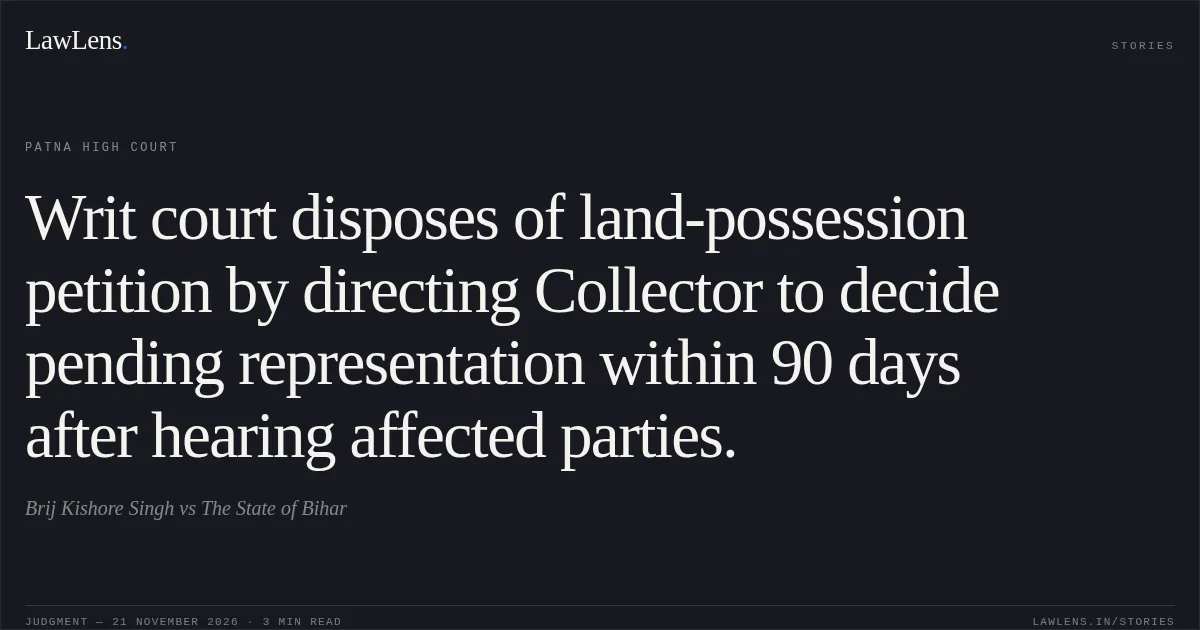
The Court held that a counter affidavit was unnecessary and disposed of the writ petition without adjudicating the merits of the petitioner's title, possession, or the alleged excavation.
¶ 5, 6It directed the Collector, Patna, to consider and decide the petitioner's representation (Annexure-5) in accordance with law within 90 days from receipt or production of a copy of the order, after hearing all concerned, including respondent No. 8.
¶ 5The 90-day period runs from the date appearances of respondent Nos. 6 and 8 are completed before the Collector.
¶ 5The petition stands disposed of accordingly.
¶ 6The specific reliefs (restoration of land, restraint on interference, and protection of possession) were not granted.
¶ 2, 6The judgment directs the Collector, while the representation was addressed to the District Magistrate; this discrepancy is not explained.
¶ 3, 5Original Court PDF
Brij Kishore SinghvsThe State of Bihar
Click to open original judgment
Original judgment, available to read, download and summarize on LawLens.in