Facts
Petitioner Ashok Pandey claimed ownership of 12 Katha of land in Plot No. 31, Khata No. 03, Mauza Thawe, based on a 1958 registered deed and a 1968 sale deed executed by the heirs of the ex-landlord (Maharaja of Hathwa)
Source reference: para. 1-3He alleged that while he was in possession, the Forest Department obstructed his construction activities, claiming the land was transferred for an Eco Park
Source reference: para. 5-6The State respondents contended that the land was recorded as Gairmajaruwa malik jungle and had vested in the State under the Bihar Land Reforms Act, 1950; consequently, the ex-landlord had no authority to execute deeds post-vesting
Source reference: para. 9The State further alleged that the petitioner's rent receipts were fabricated
Source reference: para. 9Simultaneously, a public interest writ was filed regarding encroachments on the same land
Source reference: para. 15Issues
1. Whether the High Court can adjudicate complex disputes involving title, possession, and the validity of sale deeds under its writ jurisdiction when material facts are contested by the State
Source reference: para. 10-112. Whether the authorities should be directed to expedite pending encroachment proceedings under the Bihar Public Land Encroachment Act, 1956
Source reference: para. 16Law Applied
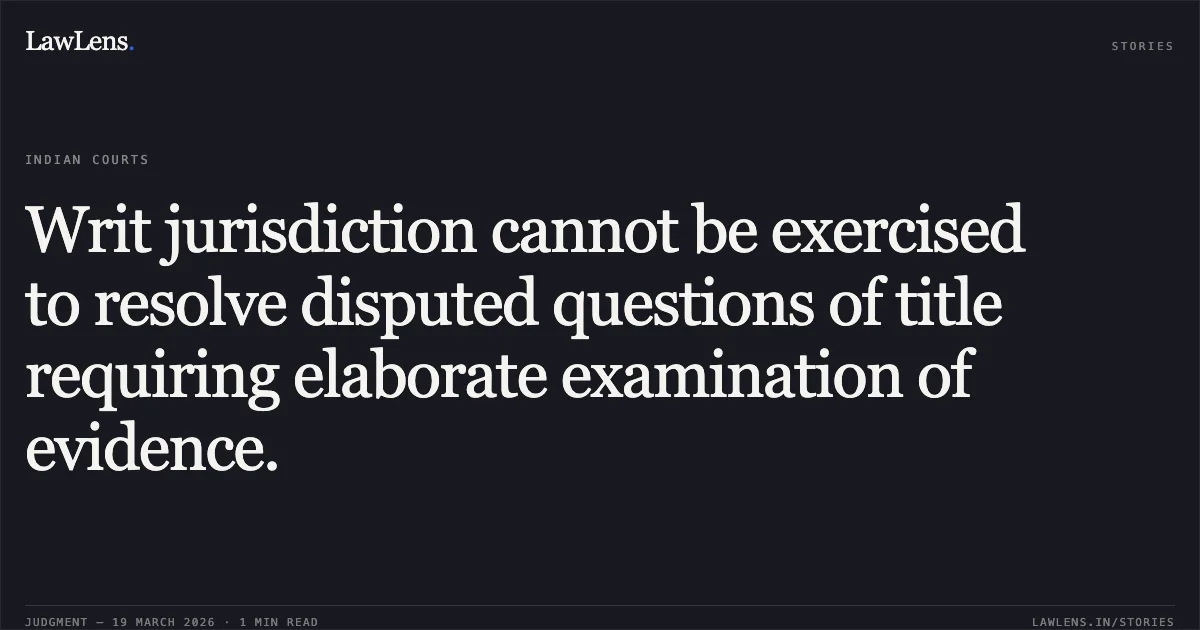
The Court primarily applied the principle that writ jurisdiction under Article 226 is not the appropriate forum for determining disputed questions of fact regarding title
Source reference: para. 11It relied on Union of India v. Ghaus Mohammad (AIR 1961 SC 1526), which established that disputed facts must be resolved through a regular civil suit
Source reference: para. 12It further cited State of Rajasthan v. Bhawani Singh (1993 Supp (1) SCC 306), holding that ownership disputes cannot be satisfactorily adjudicated in writ proceedings
Source reference: para. 12The procedural framework of the Bihar Public Land Encroachment Act, 1956, was also noted regarding the removal of unauthorized occupants
Source reference: para. 15Reasoning
The Court observed that the case involved "disputed questions of fact" as the State had explicitly challenged the legality of the petitioner’s title deeds and the authenticity of the rent receipts
Source reference: para. 10Since the State claimed the land was Gairmajaruwa malik jungle that vested in the government in 1950, the petitioner’s claim of title via post-1950 deeds required an elaborate examination of oral and documentary evidence
Source reference: para. 10-11The Court reasoned that such an evidentiary inquiry is outside the scope of writ jurisdiction
Source reference: para. 11Regarding the second writ, the Court noted that an encroachment case (Case No. 14/2017-18) had been pending for eight years and required administrative resolution rather than judicial interference on merits
Source reference: para. 15-16Holding
The Court declined to grant the relief sought in CWJC No. 6430/2022, holding that the petitioner must seek a remedy before a Civil Court to establish title and possession
CWJC No. 5159/2025 was disposed of with a direction to the concerned authorities to expedite the disposal of Encroachment Case No. 14/2017-18 in accordance with the Bihar Public Land Encroachment Act, 1956, preferably within three months
Source reference: para. 16-17The Court clarified it expressed no opinion on the merits of the title dispute
Source reference: para. 14Acts & Sections Cited
1 provisions across 1 statute referred to in this judgment. Each provision opens on LawLens.
Code of Criminal Procedure, 19731
Original Court PDF
Ashok PandeyvsState of Bihar
Click to open original judgment
Original judgment, available to read, download and summarize on LawLens.in