Facts
The petitioners challenged SARFAESI proceedings initiated by the respondent bank before the Debts Recovery Tribunal-III (DRT), Chennai
Source reference: p.2On 24.12.2025, the DRT granted a conditional stay on physical possession provided the petitioners paid ₹6.00 lakhs by 20.01.2026
Source reference: p.3The petitioners alleged they attempted payment via RTGS and Demand Draft, but the respondent bank refused acceptance and subsequently took physical possession of the property on 25.01.2026
Source reference: p.4The petitioners moved the High Court under Article 226, claiming that the DRT’s written docket orders were "misconceived" and differed from oral observations made in open court
Source reference: p.6Issues
1. Whether the High Court should exercise its writ jurisdiction under Article 226 to quash SARFAESI proceedings when a statutory remedy is available under the Act
Source reference: p.82. Whether the allegation of discrepancies in a Tribunal’s docket orders constitutes an "exceptional case" justifying the bypass of the statutory appellate route
Source reference: p.8/p.10Law Applied
The Court applied Section 18 of the SARFAESI Act, 2002, which provides a mandatory statutory appeal to the Debt Recovery Appellate Tribunal (DRAT) against any order passed by the DRT
Source reference: p.8Supreme Court precedent in K. Sreedhar v. Raus Constructions (P) Ltd (2023) 11 SCC 169, which established that High Courts must not entertain writ petitions that circumvent the pre-deposit requirements and statutory framework of the SARFAESI Act
Source reference: p.9The SARFAESI Act is a "comprehensive and complete code" requiring judicial restraint by Constitutional courts
Source reference: p.8Reasoning
The Court reasoned that the grievance regarding incorrect recording of proceedings in the DRT’s docket (Issue 2) is a purely factual dispute.
Source reference: p.10Under the established legal framework, the DRAT is the competent and efficacious forum to evaluate such factual allegations and grant consequential relief.
Source reference: p.10The Court observed that the petitioners failed to establish any "exceptional circumstances," such as total lack of jurisdiction or violation of natural justice, that would warrant a departure from the rule of alternative remedy.
Source reference: p.11Allowing the writ would permit the borrowers to evade the mandatory pre-deposit of debt due (typically 25-50%) required for an appeal under Section 18, thereby rendering the statutory intent of the Act nugatory.
Source reference: p.10Holding
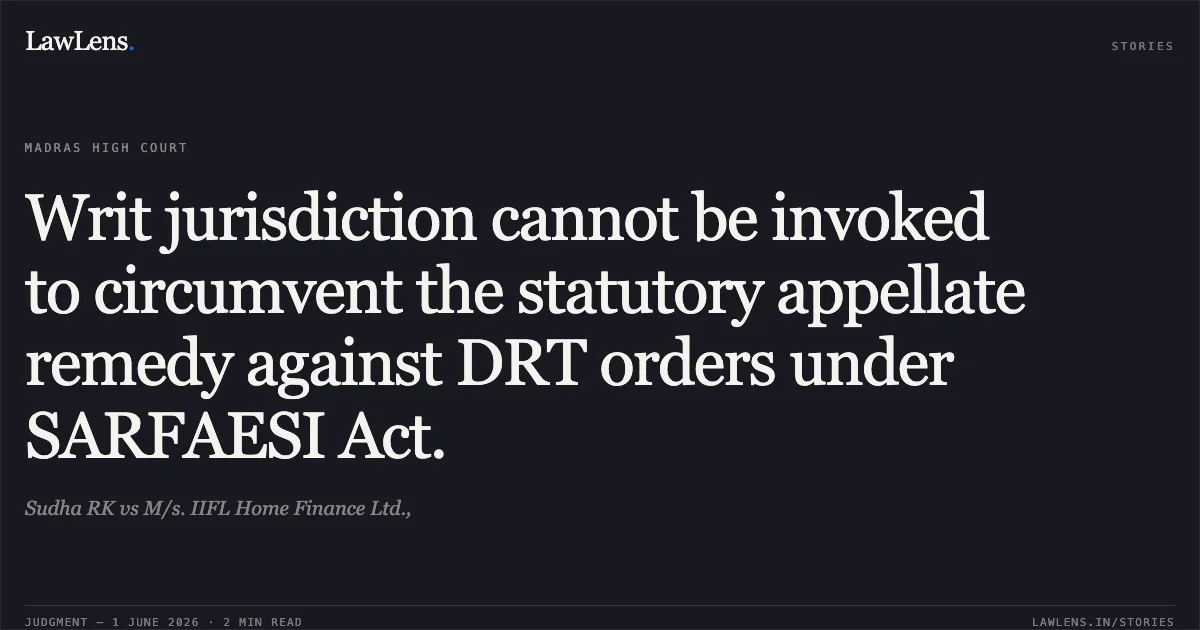
The Court held that the writ petition is not maintainable due to the availability of an alternative, efficacious statutory remedy.
The petition was dismissed without costs. However, the Court granted liberty to the petitioners to approach the DRAT under Section 18 of the SARFAESI Act within two weeks, directing the Appellate Tribunal to consider the matter on its merits subject to compliance with statutory conditions.
Source reference: p.11/p.12Acts & Sections Cited
3 provisions across 1 statute referred to in this judgment. Each provision opens on LawLens.
Securitisation and Reconstruction of Financial Assets and Enforcement of Security Interest Act, 20023
Original Court PDF
Sudha RKvsM/s. IIFL Home Finance Ltd.,
Click to open original judgment
Original judgment, available to read, download and summarize on LawLens.in