Facts
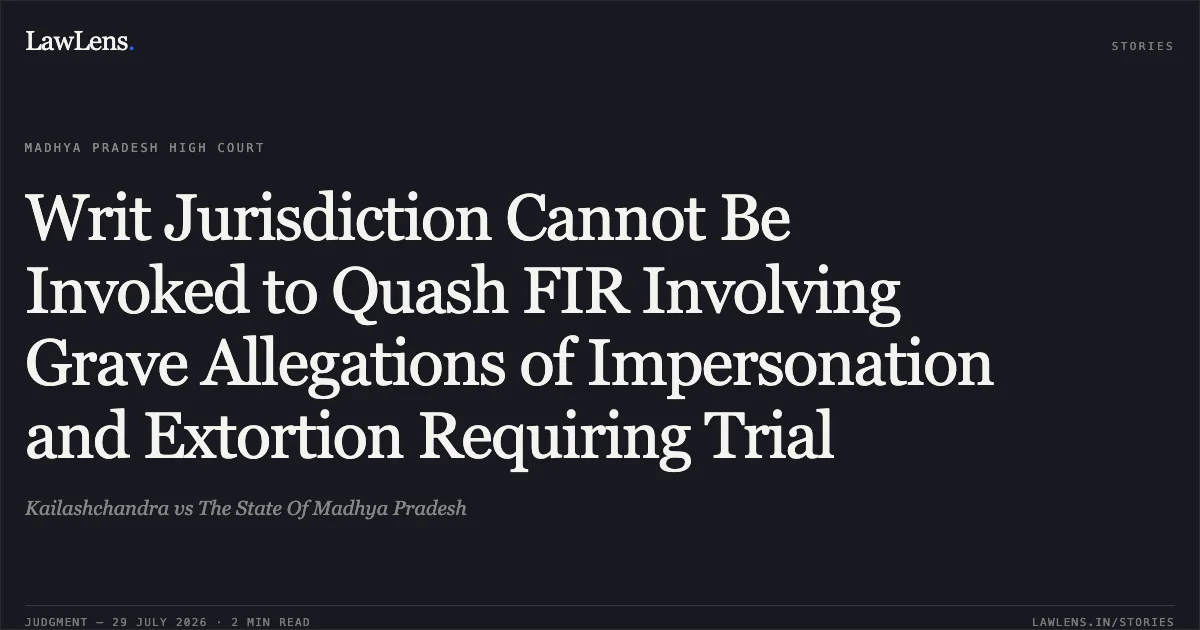
The petitioner, a retired Deputy Superintendent of Police, approached the High Court seeking to quash an FIR registered under various sections of the Bharatiya Nyaya Sanhita (BNS).
Source reference: para. 1The FIR, lodged by the prosecutrix, alleged a syndicate involved in serial sexual exploitation, gang rape, and extortion.
Source reference: para. 2Although the petitioner was not named by his full name in the FIR, police suspected him to be the individual identified as "Chouhan Sir" based on witness statements and his acquaintance with the primary accused.
Source reference: para. 2The petitioner contended the FIR was filed with a delay of over two years and failed to disclose any specific criminal act against him, characterizing the matter as a civil dispute.
Source reference: paras. 4–5Issues
1. Whether the High Court should exercise its inherent jurisdiction under Article 226 to quash the FIR on the grounds that it fails to prima facie disclose a cognizable offence against the petitioner.
Source reference: para. 82. Whether the disputed identity of the accused and the alleged delay in filing the FIR warrant the dismissal of criminal proceedings at the investigation stage.
Source reference: para. 14Law Applied
The power to quash an FIR under Article 226 or Section 528 of the BNSS (formerly Section 482 CrPC) must be used sparingly and only in "rarest of rare cases" where allegations, taken at face value, do not constitute an offence.
Source reference: para. 8Courts cannot conduct a "mini-trial" or evaluate the reliability of evidence at the threshold stage.
Source reference: para. 8Various provisions of the Bharatiya Nyaya Sanhita (BNS), including Section 318(4) regarding cheating/impersonation and provisions related to extortion and wrongful restraint.
Source reference: para. 1, 9–12Reasoning
The court found that the FIR detailed a specific sequence of events where an individual named "Chauhan" actively participated in the crime.
Source reference: para. 9This individual allegedly impersonated a high-ranking police official, intercepted the prosecutrix, confiscated mobile phones, and facilitated the extortion of ₹6,00,000.
Source reference: paras. 9–12The court reasoned that these allegations constitute grave cognizable offences that involve active participation rather than mere presence.
Source reference: para. 13Regarding the petitioner's argument on identity and lack of specific naming, the court determined that whether the petitioner is indeed the "Chauhan" mentioned is a subject for investigation and trial, not a writ proceeding.
Source reference: para. 14The court refused to interfere because the allegations, if true, established a prima case of impersonation and coercion.
Source reference: para. 13Holding
The Court answered the issues in the negative, holding that there was no justification to interfere with the statutory investigation.
The Writ Petition was dismissed, and no costs were ordered.
Source reference: para. 15Acts & Sections Cited
8 provisions across 2 statutes referred to in this judgment. Each provision opens on LawLens.
Bharatiya Nyaya Sanhita, 20237
Bharatiya Nagarik Suraksha Sanhita, 20231
Original Court PDF
KailashchandravsThe State Of Madhya Pradesh
Click to open original judgment
Original judgment, available to read, download and summarize on LawLens.in