Facts
The eleven petitioners, members of the same family residing at Village Kupotimari, Morigaon, claimed ownership and possession of land in the village.
Source reference: p. 6, para. 2On 17 August 2025, while petitioner no. 3 was ploughing the family land, an armed group allegedly trespassed onto the property and assaulted members of the family, resulting in serious injuries and the death of Ibrahim Ali in hospital.
Source reference: p. 6, para. 2An FIR was lodged on 18 August 2025 as Bhuragaon P.S. Case No. 49/2025 under Sections 61(2), 103(1), 118(2) and 109 of the Bharatiya Nyaya Sanhita, 2023, naming twenty-four accused persons, including several of the present petitioners.
Source reference: p. 6, para. 2Seven petitioners surrendered and were taken into custody during the investigation.
Source reference: p. 6, para. 2The petitioners thereafter approached the High Court seeking directions for registration and investigation of the alleged offences, including investigation by the CBI or a Special Task Force, and police protection for petitioner nos. 1 to 7.
Source reference: p. 7, para. 5Issues
Whether the writ petition under Article 226 of the Constitution seeking registration and investigation of FIRs was maintainable when the petitioners had not approached the jurisdictional Magistrate under Sections 173(4) and 175(3) of the BNSS?
Source reference: pp. 15–16, paras. 15–16Whether the petitioners had established grounds for directions for investigation by the CBI or a Special Task Force and for police protection?
Source reference: p. 16, para. 15Law Applied
Section 173(4) of the BNSS provides that an aggrieved person whose information is not recorded by the officer-in-charge may approach the Superintendent of Police, and, if the grievance remains unresolved, apply to the Magistrate; Section 175(3) empowers the Magistrate, upon considering an application supported by an affidavit and conducting such inquiry as necessary, to order an investigation.
Source reference: p. 13, para. 12Relying on Sakiri Vasu v. State of Uttar Pradesh, (2008) 2 SCC 409, the Court held that the Magistrate possesses wide powers to direct registration of an FIR, order proper investigation and monitor the investigation, and that the High Court should ordinarily decline writ jurisdiction where such alternative remedies exist.
Source reference: pp. 8–11, paras. 7–9The same principle was reiterated in Sudhir Bhaskarrao Tambe v. Hemant Yashwant Dhage, (2016) 6 SCC 277.
Source reference: pp. 11–12, para. 10The Court also relied on Sujal Viswas Attavar v. State of Maharashtra, (2026) 5 SCR 273, which held that Article 226 should not ordinarily be invoked in the first instance for non-registration or improper investigation of an FIR when efficacious statutory remedies under the BNSS are available, unless special circumstances or urgent threats to life or liberty are shown.
Source reference: pp. 14–16, paras. 13–14Reasoning
The Court found that, although the petitioners had allegedly approached the police authorities and senior police officers, they had not approached the jurisdictional Magistrate for relief under Sections 173(4) read with 175(3) of the BNSS.
Source reference: p. 15, para. 15Applying the principles in Sakiri Vasu, Sudhir Bhaskarrao Tambe and Sujal Viswas Attavar, the Court held that the statutory remedy was an efficacious and structured mechanism for seeking registration of the FIR and proper investigation.
Source reference: pp. 15–16, paras. 15–16Direct invocation of Article 226 therefore bypassed the statutory scheme and rendered the writ petition premature.
Source reference: pp. 15–16, paras. 15–16The Court further held that the materials on record did not establish a prima facie basis for directing investigation by the CBI or a Special Task Force, or for granting police protection to petitioner nos. 1 to 7.
Source reference: p. 16, para. 15Holding
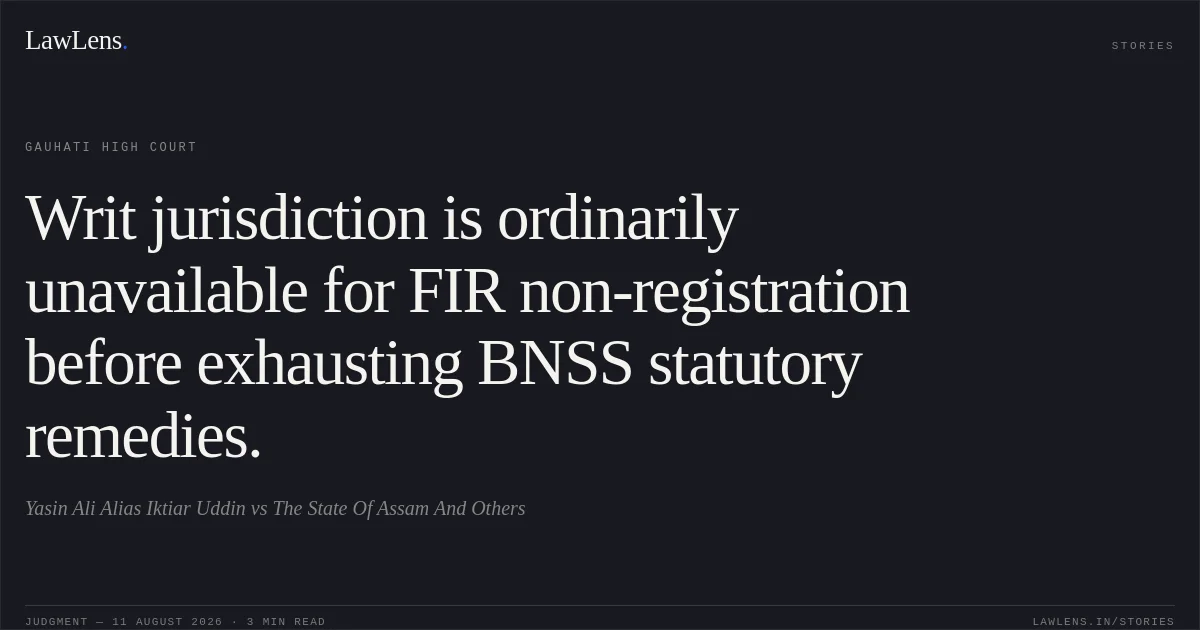
The High Court declined to entertain the writ petition as premature because the petitioners had not exhausted the statutory remedies under Sections 173(4) and 175(3) of the BNSS.
The petitioners were granted liberty to approach the jurisdictional Magistrate in accordance with law and prescribed procedure.
Source reference: p. 16, para. 16Their prayers for CBI/Special Task Force investigation and police protection were not granted.
Source reference: p. 16, para. 15The Court clarified that its observations were confined to maintainability and did not constitute any opinion on the merits of the allegations or on whether the alleged facts disclosed any criminal offence.
Source reference: p. 17, paras. 16–17Acts & Sections Cited
19 provisions across 3 statutes referred to in this judgment. Each provision opens on LawLens.
Bharatiya Nyaya Sanhita, 2023
Code of Criminal Procedure, 19735
Bharatiya Nagarik Suraksha Sanhita, 20233
Original Court PDF
Yasin Ali Alias Iktiar UddinvsThe State Of Assam And Others
Click to open original judgment
Original judgment, available to read, download and summarize on LawLens.in