Facts
The petitioner claimed that his late father owned land covered by Dag No. 564 and Periodic Patta No. 71 at Dadara, Kamrup, Assam, on which four residential houses had been constructed.
Source reference: paras. 2–2.1, pp. 3–4Two houses were allegedly allotted to the petitioner and two to his brother, respondent no. 7, with both residing separately on the property since their father’s death in 2004.
Source reference: paras. 2–2.1, pp. 3–4The petitioner alleged that in May 2026 respondent no. 7 demolished his two houses without notice and removed movable property valued at approximately ₹5,00,000.
Source reference: para. 2.2, p. 4The petitioner submitted an FIR to the Dadara Police Outpost on 20 May 2026, which was allegedly not registered. He thereafter submitted a representation to the Senior Superintendent of Police on 16 June 2026, but claimed that no action followed.
Source reference: para. 2.2, p. 4He consequently invoked Article 226 seeking directions for registration of the FIR and investigation against respondent no. 7.
Source reference: para. 2.2, p. 4Issues
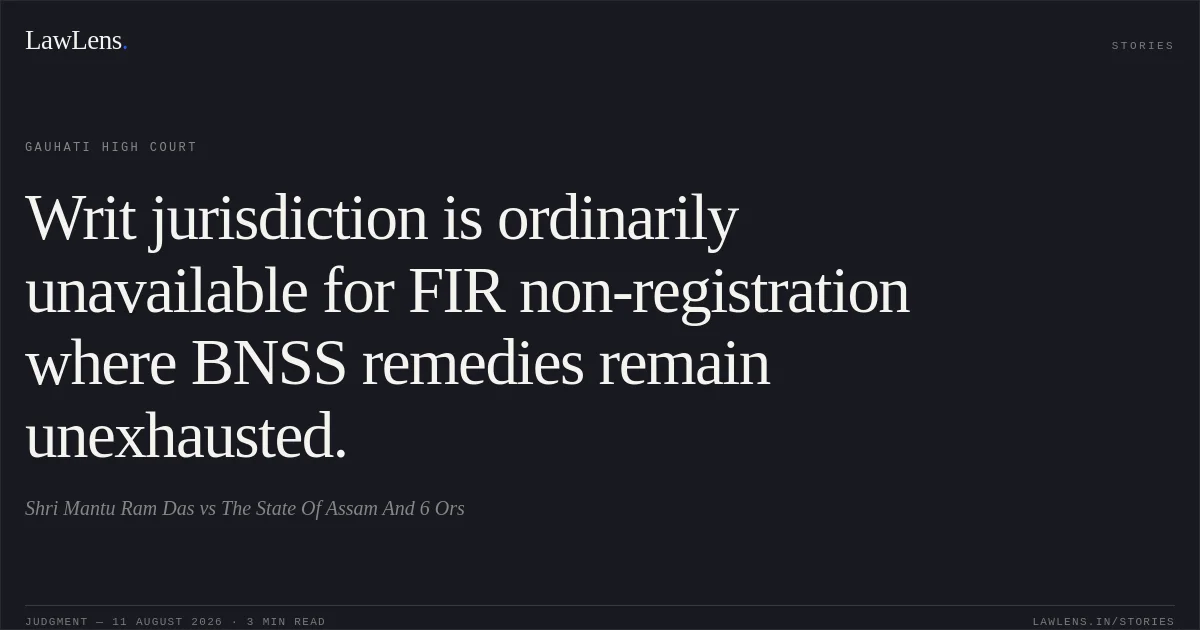
Whether a writ petition under Article 226 seeking registration of an FIR is maintainable when the petitioner has not availed the statutory remedy before the jurisdictional Magistrate under Section 175(3) of the Bharatiya Nagarik Suraksha Sanhita, 2023 (“BNSS”).
Source reference: paras. 3, 8–12, pp. 4, 9–14Whether, on the facts presented, the petitioner had established any exceptional circumstance warranting direct exercise of the High Court’s writ jurisdiction despite the availability of an efficacious statutory remedy.
Source reference: para. 11, pp. 11–13Law Applied
Section 173(1) and (4), BNSS provides the sequential remedy for reporting a cognizable offence, including approaching the Superintendent of Police upon refusal by the officer in charge to register the information.
Source reference: paras. 8–9, pp. 9–10Section 175(3), BNSS empowers the jurisdictional Magistrate, upon consideration of the application and supporting affidavit and after such inquiry as considered necessary, to order investigation.
Source reference: paras. 8–9, pp. 9–10Relying on Sakiri Vasu v. State of Uttar Pradesh, (2008) 2 SCC 409, and Sudhir Bhaskarrao Tambe v. Hemant Yashwant Dhage, (2016) 6 SCC 277, the Court held that a complainant aggrieved by non-registration or defective investigation should ordinarily approach the Magistrate rather than directly invoke Article 226.
Source reference: paras. 4–7, pp. 4–9The Court also applied Sujal Viswas Attavar v. State of Maharashtra, (2026) 5 SCR 273, which reaffirmed that writ jurisdiction should not ordinarily be invoked before exhausting the sequential remedies under the BNSS, absent special circumstances such as an urgent threat to life or liberty.
Source reference: paras. 10–11, pp. 10–13Reasoning
The petitioner had approached the police outpost and thereafter the Senior Superintendent of Police, but there was no assertion or material showing that he had approached the jurisdictional Magistrate under Section 175(3), BNSS.
Source reference: para. 12, pp. 13–14Since that provision supplied an efficacious statutory mechanism for seeking an order directing investigation, the High Court held that entertaining the writ petition would improperly make it a court of first instance and bypass the statutory scheme.
Source reference: paras. 11–12, pp. 12–14No exceptional circumstance, including any imminent threat to life or liberty, was shown to justify departure from the normal rule requiring exhaustion of the alternative remedy.
Source reference: para. 11, pp. 11–13The Court therefore declined to examine whether the allegations actually disclosed a criminal offence, expressly leaving the merits open.
Source reference: para. 14, p. 14Holding
The writ petition was held to be premature and was not entertained because the petitioner had failed to avail the alternative statutory remedy under Section 175(3), BNSS.
The petitioner was granted liberty to approach the jurisdictional Magistrate under that provision in accordance with law and applicable procedural requirements.
Source reference: paras. 13–14, p. 14The Court clarified that its observations would not be treated as an opinion on the merits of the allegations or on whether any criminal offence had been committed.
Source reference: paras. 13–14, p. 14Acts & Sections Cited
8 provisions across 2 statutes referred to in this judgment. Each provision opens on LawLens.
Code of Criminal Procedure, 19735
Bharatiya Nagarik Suraksha Sanhita, 20233
Original Court PDF
Shri Mantu Ram DasvsThe State Of Assam And 6 Ors
Click to open original judgment
Original judgment, available to read, download and summarize on LawLens.in