Facts
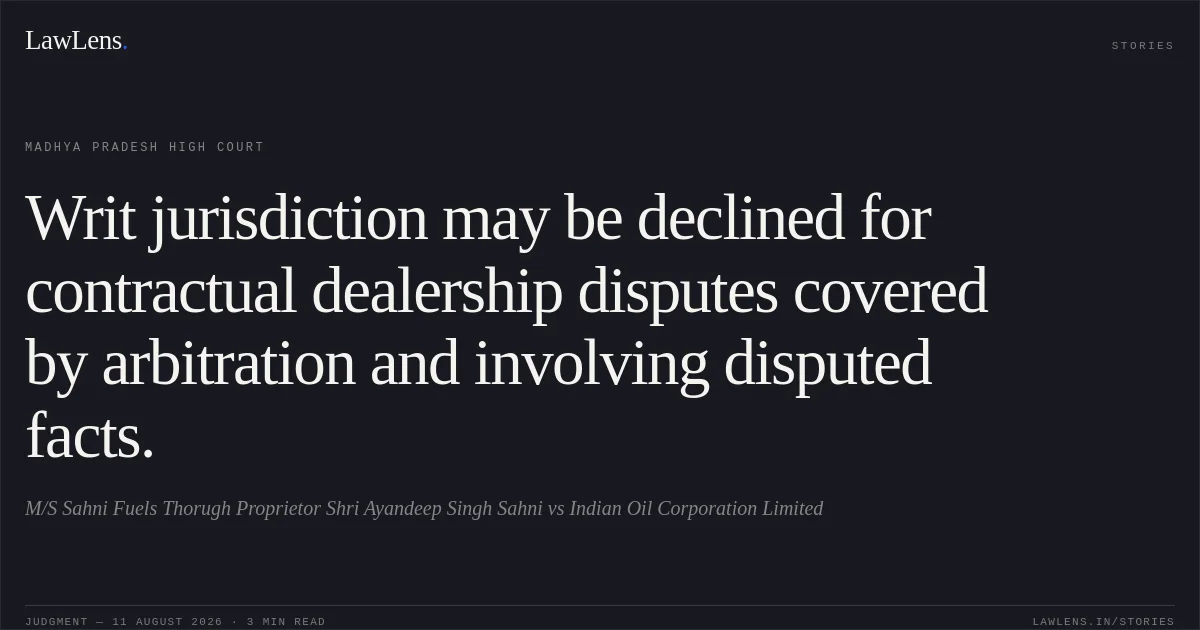
The appellant-dealer, whose dealership was granted by Indian Oil Corporation Limited in 2022, challenged proceedings initiated by the Corporation proposing termination of the dealership on the basis of alleged irregularities detected during inspection, including deficiencies in display boards, cleanliness, employees’ uniforms, refusal to permit measurement through calibrated equipment, obstruction, verbal abuse and non-cooperation.
Source reference: paras. 4–8The appellant alleged violation of natural justice, the Marketing Discipline Guidelines, 2012, and arbitrariness in the Corporation’s action.
Source reference: paras. 4–8The learned Single Judge disposed of the writ petition by granting liberty to the appellant to pursue arbitration under the dealership agreement.
Source reference: para. 3The appellant preferred the present intra-court appeal under Section 2(1) of the Madhya Pradesh Uchcha Nyayalay (Khand Nyay Peeth Ko Appeal) Adhiniyam, 2005, contending that the existence of an arbitration clause did not bar exercise of jurisdiction under Article 226 of the Constitution.
Source reference: paras. 3–12The dealership agreement contained a comprehensive arbitration clause in Clause 62(a), covering disputes or claims arising out of or relating to the agreement.
Source reference: para. 17Issues
Whether the learned Single Judge erred in declining to exercise jurisdiction under Article 226 merely because the dealership agreement contained an arbitration clause.
Source reference: paras. 4, 9–12Whether disputes concerning the legality of the proposed termination, alleged violations of the Marketing Discipline Guidelines, compliance with natural justice, and the factual allegations arising from inspection were required to be adjudicated through the agreed arbitral mechanism.
Source reference: paras. 16–23Whether the appellant established exceptional circumstances—such as patent lack of jurisdiction, manifest illegality, or an ineffective alternative remedy—justifying bypass of arbitration and interference in writ jurisdiction.
Source reference: paras. 20–23Law Applied
The Court applied the principle that writ jurisdiction under Article 226 is discretionary and may ordinarily be declined where the dispute arises from a contractual relationship and an effective alternative remedy, including arbitration, is available.
Source reference: paras. 18, 23Clause 62(a) of the dealership agreement was construed broadly to cover “any dispute or difference of any nature whatsoever” arising out of or relating to the agreement.
Source reference: para. 17Relying on Rashtriya Ispat Nigam Ltd. v. Verma Transport Co., AIR 2006 SC 2800, the Court held that disputes concerning termination of a contract and rights and liabilities flowing from it fall within the scope of a broad arbitration clause.
Source reference: para. 19The Court distinguished M/s Kamal Kant Automobiles v. Hindustan Petroleum Corporation Ltd., Writ-C No. 25127 of 2018, observing that the issue there concerned the consequences of an already effected termination, whereas the present case involved a show-cause notice and disputed factual issues preceding any final determination.
Source reference: para. 20A show-cause notice is not ordinarily a final adjudication of rights, and disputed factual matters should not generally be examined in writ proceedings.
Source reference: para. 22Reasoning
The Court found that the appellant’s challenge was intrinsically connected with the dealership agreement and required determination of disputed facts, including whether the inspection irregularities occurred, whether they constituted contractual or guideline violations, whether the appellant’s explanation was satisfactory, and whether the Corporation’s evidence established misconduct.
Source reference: paras. 18, 21Since Clause 62(a) expressly covered disputes arising out of or relating to the dealership agreement, the contractual arbitration mechanism was applicable.
Source reference: paras. 17–19The allegations of arbitrariness and breach of natural justice did not, by themselves, justify writ intervention because their determination depended upon examination of evidence and factual controversies arising from the contract.
Source reference: para. 23The appellant also failed to demonstrate any patent lack of jurisdiction, manifest illegality, or other exceptional circumstance warranting bypass of arbitration.
Source reference: para. 22The reliance on Kamal Kant Automobiles was held misplaced because that case concerned restoration after an already completed termination, whereas the present proceedings related to a show-cause notice proposing action.
Source reference: para. 20Holding
The Division Bench held that the learned Single Judge correctly relegated the appellant to the agreed remedy of arbitration.
No infirmity, illegality, or jurisdictional error was found in the impugned order, and the Court declined to undertake a merits-based examination of the disputed allegations in writ appellate jurisdiction.
Source reference: paras. 23–24The writ appeal was accordingly dismissed.
Source reference: para. 25Acts & Sections Cited
1 provisions across 1 statute referred to in this judgment. Linked provisions open on LawLens.
M.P. Uchcha Nyayalaya (Khand Nyayapeeth Ko Appeal) Adhiniyam, 20051
Original Court PDF
M/S Sahni Fuels Thorugh Proprietor Shri Ayandeep Singh SahnivsIndian Oil Corporation Limited
Click to open original judgment
Original judgment, available to read, download and summarize on LawLens.in