01Facts
Zenlayer Networks India Pvt. Ltd. imported servers, routers, switches, optical modules and other networking equipment for its cloud and edge-networking business.
¶ 7–8The investigation resulted in three Show Cause Notices: (i) SCN dated 02.01.2023 concerning four live consignments and proposing confiscation, differential duty and penalties; (ii) SCN dated 20.11.2023 concerning 74 Bills of Entry for cleared consignments and proposing recovery under Section 28(4) of the Customs Act; and (iii) SCN dated 21.11.2023 concerning equipment found at various data centres for which lawful import documentation was allegedly unavailable.
¶ 8Zenlayer sought appointment of a Common Adjudicating Authority (“CAA”) for all three SCNs.
¶ 9–11Nevertheless, the first two SCNs were adjudicated by the New Delhi customs authority, resulting in Orders-in-Original dated 14.11.2025 confirming demands and imposing penalties.
¶ 13–1402Issues
i.1. Whether Zenlayer was entitled to a direction for appointment of a CAA for adjudication of all three SCNs arising from the DRI investigation?
¶ 28(i)ii.2. Whether the pendency of W.P.(C.) No. 7091/2025 and the order dated 19.08.2025 rendered the subsequent adjudication of the first two SCNs without jurisdiction?
¶ 28(ii)iii.3. Whether the Orders-in-Original dated 14.11.2025 were liable to be set aside insofar as Zenlayer and Amit Singh were concerned for denial of an effective opportunity of hearing?
¶ 28(iii)iv.4. Whether the Orders-in-Original were liable to be set aside insofar as Rahi Systems was concerned for non-service of subsequent hearing notices?
¶ 28(iv)v.5. Whether the writ petitions challenging the Orders-in-Original should be entertained notwithstanding the statutory appellate remedy under Section 128 of the Customs Act?
¶ 28(v)03Law Applied
The Court applied the principle that common adjudication may be appropriate where connected SCNs arise from substantially common evidence and separate proceedings may produce inconsistent findings, as recognised in Star Delta Exim (P) Ltd. v. Union of India, 2019 (37) E.L.T. 133 (Raj.), affirmed in Union of India v. Star Delta Exim (P) Ltd., 2022 (380) E.L.T. 398 (S.C.).
¶ 32However, that principle does not mandate that every SCN arising from a common investigation must be adjudicated by one authority, particularly where the notices concern distinct transactions, goods and statutory consequences.
¶ 32The Court further applied the rule that availability of an alternative statutory remedy under Section 128 of the Customs Act is not an absolute bar to Article 226 jurisdiction, but writ jurisdiction is ordinarily declined where the challenge involves disputed facts, examination of the adjudication record or appreciation of evidence.
¶ 38–40The principles of natural justice require a real and effective opportunity of hearing, but whether such opportunity was denied depends on the facts and service record in each case.
¶ 49The Court also considered CBIC Circular No. 30/2015 dated 04.12.2015 concerning appointment of a CAA in cases involving aggregate customs duty demands of Rs. 5 crore or more and identical issues.
¶ 24.2Provisions in the judgment · 5 · Linked ones open on LawLens
Customs Act,1962 Section 28Section 111Section 112Section 114Section 128
04Reasoning
The Court held that although the three SCNs originated from one DRI investigation and substantially overlapped in evidence, they addressed materially different matters: live consignments, previously cleared consignments and equipment allegedly lacking lawful import documentation.
¶ 30–32The order dated 19.08.2025 was interlocutory and directed only adjournment of the hearing before the Mumbai Commissioner; it did not expressly stay adjudication of the first two SCNs before the New Delhi authority.
¶ 34–35Their adjudication was therefore not without jurisdiction merely because W.P.(C.) No. 7091/2025 was pending.
¶ 34–35After the first two SCNs had already been adjudicated, directing their transfer to a CAA would serve no effective purpose and would displace an adjudication whose validity was itself under challenge.
¶ 33, 36–37As to the challenges to the Orders-in-Original, the Court found that the alleged non-consideration of Amit Singh’s reply, the receipt of hearing notices and the service of notices upon Rahi Systems involved disputed questions requiring examination of the complete adjudication record.
¶ 41–44The consolidated orders concerned 23 firms and individuals, and setting them aside selectively in writ jurisdiction would be inappropriate where the alleged procedural defects were fact-dependent.
¶ 45–46Since no inherent lack of jurisdiction or pure question of law incapable of examination by the appellate forum was shown, the Petitioners were relegated to the statutory appeal under Section 128.
¶ 48–5005Holding
The Court dismissed W.P.(C.) No. 7091/2025 and declined to direct appointment of a CAA for all three SCNs.
¶ 52(I)It held that the pendency of that petition and the order dated 19.08.2025 did not invalidate the adjudication of the first two SCNs.
¶ 52(I)W.P.(C.) Nos. 1407/2026, 1374/2026 and 5470/2026 were also dismissed without examination of the merits.
¶ 52(II)–(V)Zenlayer, Amit Singh and Rahi Systems were left free to pursue the statutory appellate remedy under Section 128 and to raise all substantive and procedural grounds, including limitation, the effect of the Court’s earlier order, non-consideration of Amit Singh’s reply, and non-service of hearing notices upon Rahi Systems.
¶ 52(II)–(V)No opinion was expressed on the merits of the allegations, duty or penalty liability, limitation, or the individual natural-justice objections.
¶ 51Original Court PDF
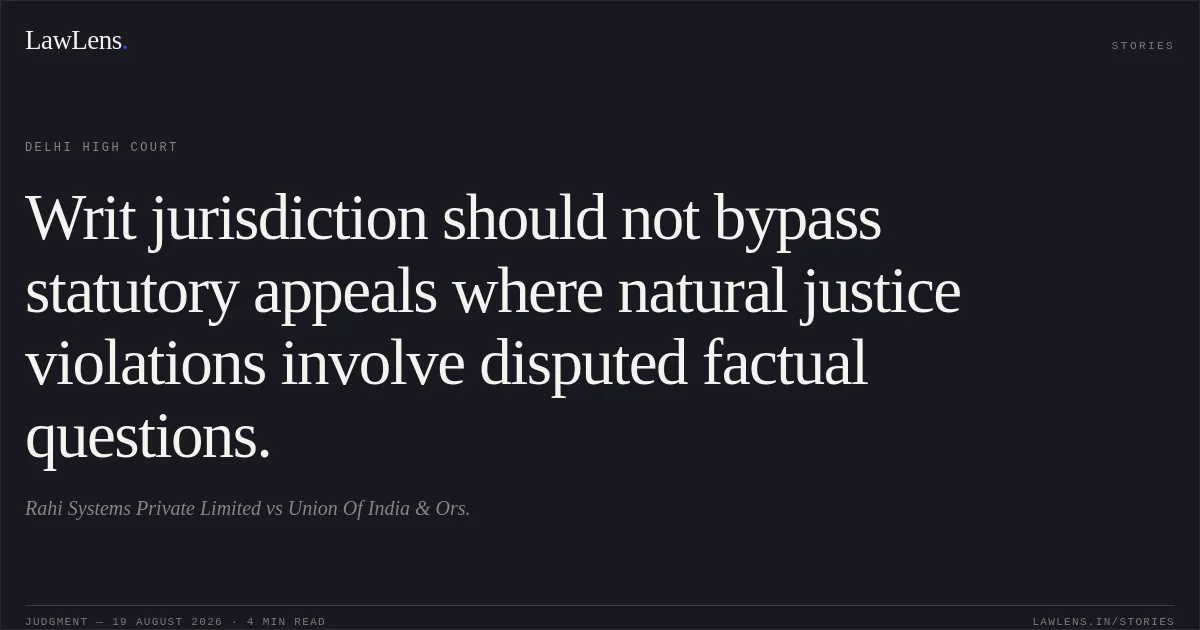
Rahi Systems Private LimitedvsUnion Of India & Ors.
Click to open original judgment
Original judgment, available to read, download and summarize on LawLens.in