Facts
The appellant, an Inspector in the Central Industrial Security Force (CISF), was deputed as an Intelligence Officer to the Narcotics Control Bureau, Mumbai, from 2019 to 2022.
Source reference: para. 2Following alleged misconduct and irregularities during a search and seizure operation connected with NCB Crime No. 91 of 2021, the CISF issued him a charge memorandum under Rule 36 of the CISF Rules, 2001, containing four charges.
Source reference: para. 2After considering his explanations, the disciplinary authority appointed an Enquiry Officer.
Source reference: para. 2The appellant participated in the enquiry, and the Enquiry Officer found the charges proved.
Source reference: para. 2The disciplinary authority thereafter passed an order dated 21 May 2026 imposing compulsory retirement with full pensionary benefits.
Source reference: para. 2The order provided a statutory appeal to the Inspector General of CISF, and the appellant filed that appeal on 16 June 2026.
Source reference: para. 2Before the statutory appeal was decided, he filed W.P. No. 22248 of 2026 challenging the punishment order.
Source reference: para. 3The Single Judge directed the appellate authority to consider certain directions issued in W.A. No. 1085 of 2026 and stayed the punishment order pending disposal of the appeal.
Source reference: para. 3The appellant challenged that order in the present intra-court appeal.
Source reference: no citationIssues
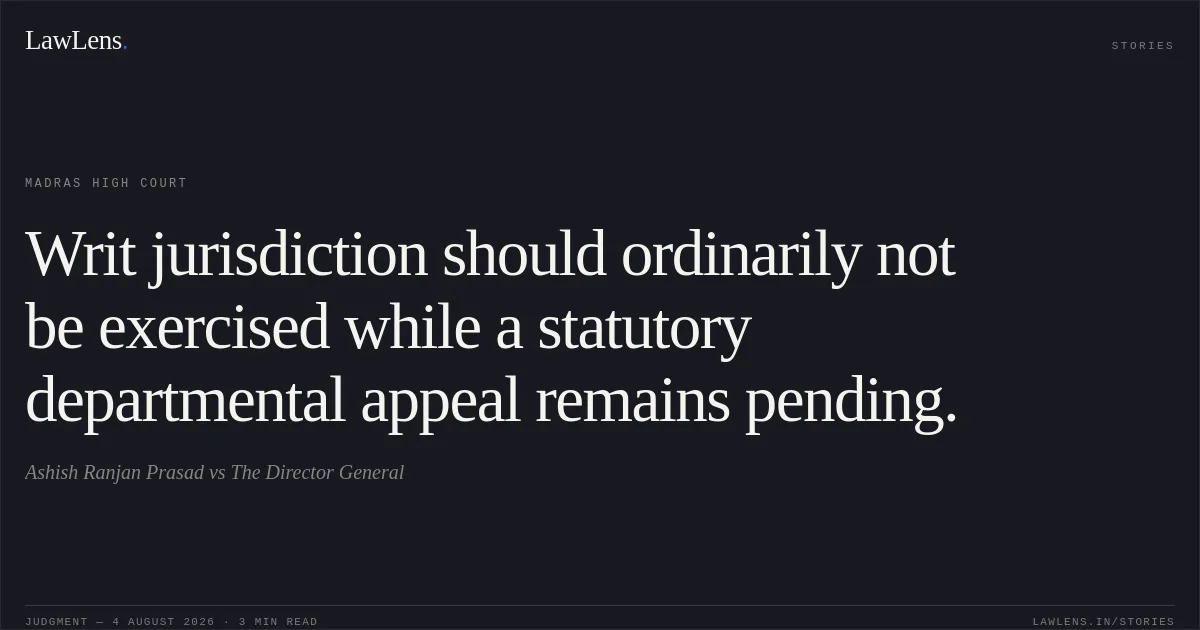
Whether the writ petition challenging the disciplinary punishment was maintainable and desirable while the appellant’s statutory departmental appeal was pending.
Source reference: paras. 9–10Whether the High Court ought to have adjudicated the appellant’s allegations concerning denial of opportunity and violation of natural justice instead of directing the appellate authority to consider the matter.
Source reference: paras. 4, 9Whether the appellate authority could be directed to consider the earlier order in W.A. No. 1085 of 2026 while deciding the appeal against the subsequent final punishment order.
Source reference: paras. 11–12Law Applied
The Court applied Rule 36 of the CISF Rules, 2001, governing disciplinary proceedings.
Source reference: para. 2Judicial review in disciplinary matters is confined to examining whether natural justice was followed, whether the finding of misconduct is supported by some evidence, whether the applicable statutory rules were observed, whether the decision is perverse, and whether the penalty is disproportionate to the proved misconduct.
Source reference: para. 7The High Court reviews the decision-making process and not the merits of the decision itself, and ordinarily does not adjudicate disputed facts in place of the disciplinary or appellate authorities.
Source reference: para. 8The statutory alternative remedy provided under the service rules should ordinarily be exhausted, particularly where the appellate authority is competent to examine the factual and legal grounds, the original records, and the quantum of punishment.
Source reference: para. 10Reasoning
The Court found that the disciplinary authority had considered the four charges, the appellant’s explanations, the evidence of the prosecution and defence, the Enquiry Officer’s report, and the appellant’s response to that report before imposing the penalty.
Source reference: para. 9Consequently, any contention regarding denial of opportunity or breach of natural justice could be raised and examined by the appellate authority, which was already seized of the statutory appeal.
Source reference: para. 9Deciding those issues in the writ proceedings would risk prejudicing the appellate authority’s independent consideration.
Source reference: para. 9Since disputed factual and legal questions, including the proportionality of the punishment, fell within the scope of the statutory appeal, the Single Judge ought not to have effectively intervened while that remedy was pending.
Source reference: para. 10The Court further held that W.A. No. 1085 of 2026 concerned the challenge to the charge memorandum, whereas the pending appeal concerned the final punishment order issued subsequently on 21 May 2026.
Source reference: paras. 11–12The appellate authority was therefore required to decide the appeal independently on its own merits and in accordance with the Discipline and Appeal Rules.
Source reference: paras. 11–12Holding
The Court held that entertaining the writ petition during the pendency of the statutory appeal was not desirable and that the appellant’s grounds should be considered by the appellate authority in the first instance.
It further held that the direction to consider the earlier order in W.A. No. 1085 of 2026 was unnecessary and potentially inconsistent with the requirement of an independent appellate decision.
Source reference: para. 12The writ order dated 18 June 2026 in W.P. No. 22248 of 2026 was set aside, and the writ appeal was allowed.
Source reference: para. 13The pending statutory appeal was directed to be decided independently, on its own merits and in accordance with law.
Source reference: para. 13No costs were awarded, and the connected miscellaneous petition was closed.
Source reference: para. 13Original Court PDF
Ashish Ranjan PrasadvsThe Director General
Click to open original judgment
Original judgment, available to read, download and summarize on LawLens.in