Facts
The petitioner alleged that, on 05.04.2026, respondent Nos. 6 to 8 forcibly entered her house and committed gang rape, thereafter threatening her and her family. She claimed that Police Station Dharampuri, District Panna, refused to register an FIR despite her complaints and that subsequent representations to senior police authorities also yielded no action. She sought a writ of mandamus directing registration of an FIR, a fair investigation, police protection, and action against the concerned officials.
Source reference: para. 2; p. 1–2The State disputed the petitioner’s assertion that she had approached the police station immediately after the incident, relying on CCTV footage. It further stated that a preliminary enquiry was conducted and that the allegations were not substantiated on the basis of statements, call-detail records, and other material. The private respondents denied the occurrence, alleged political rivalry and monetary disputes, and relied on documentary material, including railway tickets, to support an alibi.
Source reference: paras. 4–5; p. 3–4Issues
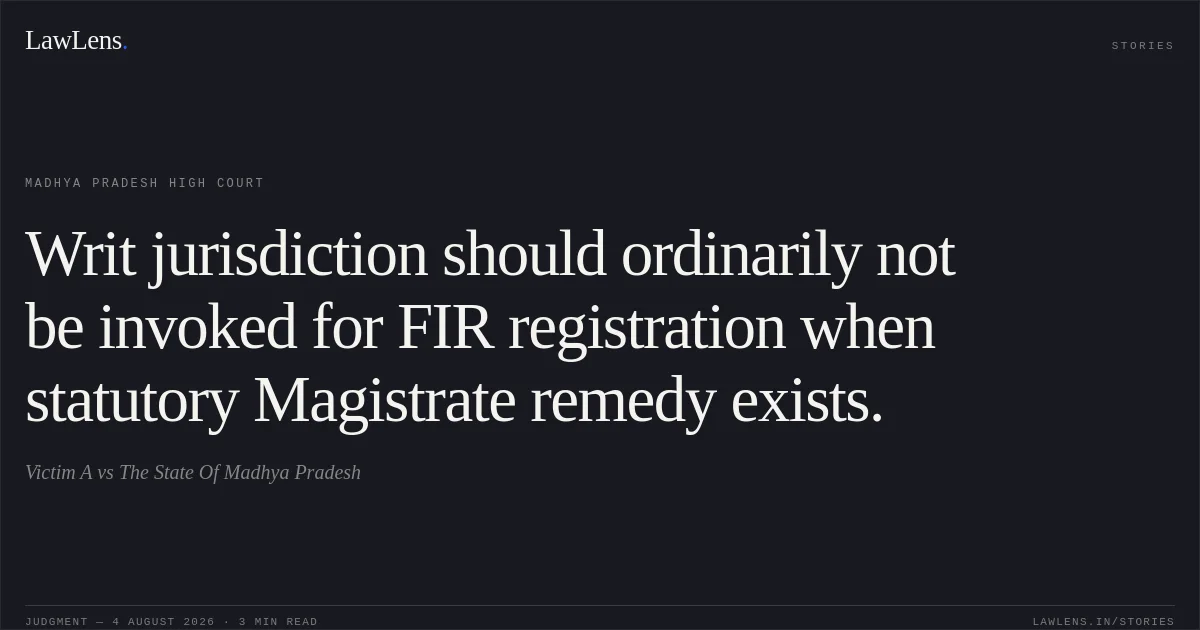
Whether the petitioner’s challenge concerning non-registration of an FIR and alleged improper investigation should be entertained directly under Article 226, when an alternative statutory remedy before the Magistrate was available under the BNSS?
Source reference: paras. 9–10; p. 5Whether the disputed allegations concerning the alleged gang rape, police inaction, prior enmity, monetary disputes, and the respondents’ alibi could be adjudicated in writ proceedings?
Source reference: paras. 7–8; p. 4Law Applied
The Court applied Article 226 of the Constitution in light of the principle that writ jurisdiction should ordinarily not be invoked where an efficacious statutory remedy is available.
Source reference: no citationRelying on Lalita Kumari v. Government of Uttar Pradesh, (2014) 2 SCC 1, the Court noted that registration of an FIR is mandatory where information discloses a cognizable offence.
Source reference: para. 3; p. 2However, relying principally on Sakiri Vasu v. State of Uttar Pradesh, (2008) 2 SCC 409, it held that a person aggrieved by non-registration of an FIR or improper investigation should ordinarily approach the competent Magistrate for appropriate directions under the criminal-law procedure, including the applicable provisions of the BNSS.
Source reference: paras. 4, 9–10; p. 3, 5The Court also applied the rule that seriously disputed questions of fact requiring appreciation of evidence are generally inappropriate for determination in proceedings under Article 226.
Source reference: para. 8; p. 4Reasoning
The Court found that the petition involved competing factual assertions: the petitioner alleged gang rape and police refusal to register an FIR, while the State relied on CCTV footage and a preliminary enquiry, and the private respondents raised pleas of political rivalry, monetary disputes, and alibi.
Source reference: paras. 7–8; p. 4Resolution of these issues would require assessment of witness statements, documentary evidence, call records, and other material, which could not appropriately be undertaken in writ jurisdiction.
Source reference: para. 8; p. 4Although the allegations disclosed serious offences and the principle in Lalita Kumari concerned mandatory FIR registration upon disclosure of a cognizable offence, the Court held that the petitioner had not shown that she had exhausted the statutory remedy before the Magistrate. In view of Sakiri Vasu, the appropriate course was to require recourse to the criminal-law machinery rather than issue a direct writ concerning FIR registration and investigation.
Source reference: paras. 9–10; p. 5Holding
The Court disposed of the writ petition by granting the petitioner liberty to pursue the appropriate statutory remedy before the jurisdictional Magistrate or any other competent forum in accordance with law.
Any proceedings so initiated were directed to be considered on their own merits and without being influenced by the observations in the order. The Court expressly clarified that it had not adjudicated the merits of either the petitioner’s allegations or the respondents’ defences.
Source reference: para. 11; p. 5–6Original Court PDF
Victim AvsThe State Of Madhya Pradesh
Click to open original judgment
Original judgment, available to read, download and summarize on LawLens.in