Facts
The petitioner challenged the Tehsildar, Prithvipur’s order dated 03.03.2022 in Case No. 47/A-68/2021-22, directing removal of his alleged encroachment from Government land bearing Khasra No. 2236/18 at Village Jer, imposing a penalty of ₹5,000, and directing registration of a criminal case.
Source reference: para. 1He also challenged FIR No. 230/2022 dated 09.04.2022 registered under Sections 447 and 448 IPC.
Source reference: para. 1The petitioner relied on an RTI response dated 15.01.2021, which allegedly did not identify him as an encroacher, and contended that his name was subsequently inserted in the revenue records in 2022.
Source reference: para. 2He further alleged that the notice dated 28.02.2022 was not served upon him and that the Tehsildar passed the order without affording a proper hearing.
Source reference: para. 2The petitioner appealed against the Tehsildar’s order, but the appellate authority dismissed the appeal on 04.05.2022.
Source reference: paras. 5–6The respondents relied on revenue records showing unauthorized occupation by the petitioner’s father and subsequently by the petitioner, and maintained that the notice had been refused by him.
Source reference: paras. 5–6Issues
1. Whether the Tehsildar’s order directing removal of encroachment, imposing penalty, and directing criminal proceedings was illegal, without jurisdiction, or violative of natural justice.
Source reference: paras. 2–4, 9–102. Whether the petitioner’s alleged occupation of Government land disclosed the ingredients of criminal trespass and house-trespass under Sections 441, 447 and 448 IPC.
Source reference: para. 4, para. 113. Whether FIR No. 230/2022 was liable to be quashed under Article 226 of the Constitution or Section 482 CrPC, particularly while the petitioner’s appeal against the revenue order was pending.
Source reference: paras. 4, 114. Whether the disputed questions concerning possession, encroachment, and the correctness of revenue entries could be adjudicated in writ jurisdiction.
Source reference: paras. 9–10Law Applied
The Court applied Article 226 of the Constitution, under which writ jurisdiction is not ordinarily exercised to determine disputed questions of fact relating to title or possession.
Source reference: paras. 9–10It relied on the provisions of the Madhya Pradesh Land Revenue Code, 1959, governing proceedings for removal of unauthorized occupation of Government land.
Source reference: para. 9Sections 441, 447 and 448 IPC concern criminal trespass, punishment for criminal trespass or house-trespass, and house-trespass respectively.
Source reference: para. 4The Court applied the principles in State of Haryana v. Bhajan Lal, 1992 Supp (1) SCC 335, that quashing of an FIR under Article 226 or Section 482 CrPC is an exceptional remedy warranted only where the allegations do not disclose any offence or the proceedings are manifestly mala fide.
Source reference: para. 11It also relied on Jagpal Singh v. State of Punjab, (2011) 11 SCC 396, which requires expeditious removal of illegal encroachments from Government and community lands and restoration of such lands for public use.
Source reference: para. 7, para. 12along with the principles reflected in Uttam Singh Yadav v. State of M.P., W.P. No. 19305/2021, and Gram Panchayat Dhooma v. State of M.P., W.P. No. 7865/2021.
Source reference: paras. 7, 12Reasoning
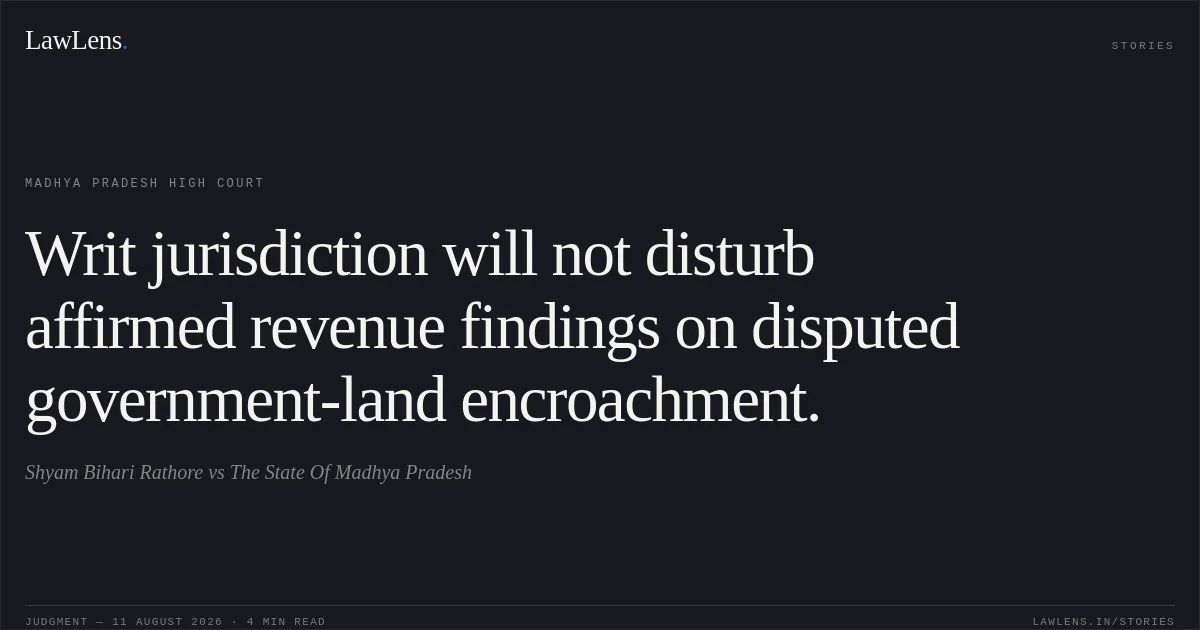
The Court held that the Tehsildar had conducted proceedings under the Madhya Pradesh Land Revenue Code and recorded a finding that the petitioner was in unauthorized occupation of Government land.
Source reference: para. 9That finding had been affirmed by the appellate authority on 04.05.2022, and therefore could not be displaced in writ jurisdiction absent a jurisdictional error, statutory violation, or perversity.
Source reference: para. 9The RTI response did not override the subsequent substantive revenue records; its omission of the petitioner’s name was plausibly explained as a clerical error, while the revenue material indicated continued occupation by the petitioner’s family.
Source reference: para. 10The Court declined to resolve the competing factual claims regarding possession and encroachment under Article 226.
Source reference: paras. 9–10As to the FIR, the allegation that the petitioner continued unauthorized occupation despite notice was sufficient at the investigation stage to disclose a prima facie case.
Source reference: para. 11Whether the statutory ingredients of Sections 447 and 448 IPC would ultimately be proved was a matter for investigation and trial, not for determination in proceedings seeking quashing of the FIR.
Source reference: para. 11The pendency of the revenue appeal did not render the FIR premature, particularly since the appeal had subsequently been dismissed and the public-interest obligation to protect Government land supported the authorities’ action.
Source reference: paras. 5, 11–12Holding
The Court answered the issues against the petitioner.
It found no jurisdictional error, violation of statutory provisions, or perversity in the Tehsildar’s order dated 03.03.2022, particularly in view of its affirmation by the appellate authority.
Source reference: para. 13It further held that FIR No. 230/2022 disclosed a prima facie case and did not fall within the exceptional categories warranting quashing under Bhajan Lal.
Source reference: para. 13The writ petition was accordingly dismissed, with no relief granted to the petitioner.
Source reference: para. 13Acts & Sections Cited
4 provisions across 2 statutes referred to in this judgment. Each provision opens on LawLens.
Indian Penal Code, 18603
Code of Criminal Procedure, 19731
Original Court PDF
Shyam Bihari RathorevsThe State Of Madhya Pradesh
Click to open original judgment
Original judgment, available to read, download and summarize on LawLens.in