01Facts
The petitioner has carried on export-import trading as "Rajeswari Traders" since 2020.
¶ 2 · p. 2A Singapore company, M/s. Solomon PTE Ltd., ordered teak wood under an invoice dated 30.11.2024. The petitioner paid an advance of ₹6,00,000 on 18.12.2024 through his HDFC Bank account. The supplier failed to deliver, and the petitioner sought repayment.
¶ 2 · p. 2On the Singapore company's instructions, M/s. SEACO Technologies, Chennai, remitted ₹3,00,000 to the petitioner's account on 16.01.2025 as partial repayment. The petitioner states he had no independent dealings with SEACO.
¶ 2 · p. 2 · ¶ 3 · pp. 2–3On 03.03.2025 he was told the account was frozen on the instructions of the first respondent, the SSP, Jammu & Kashmir, without prior notice or reasons.
¶ 3 · pp. 2–3A representation dated 23.09.2025 and several communications produced no particulars of the alleged criminal activity.
¶ 4 · p. 3The second respondent bank (HDFC) contends that it is a private company, not "State" under Article 12, and acted only on instructions from the Cyber Police Station, Srinagar, dated 05.04.2025. It admits the ₹3,00,000 credit and states it intimated the petitioner and advised him to approach the first respondent.
¶ 5 · pp. 3–402Issues
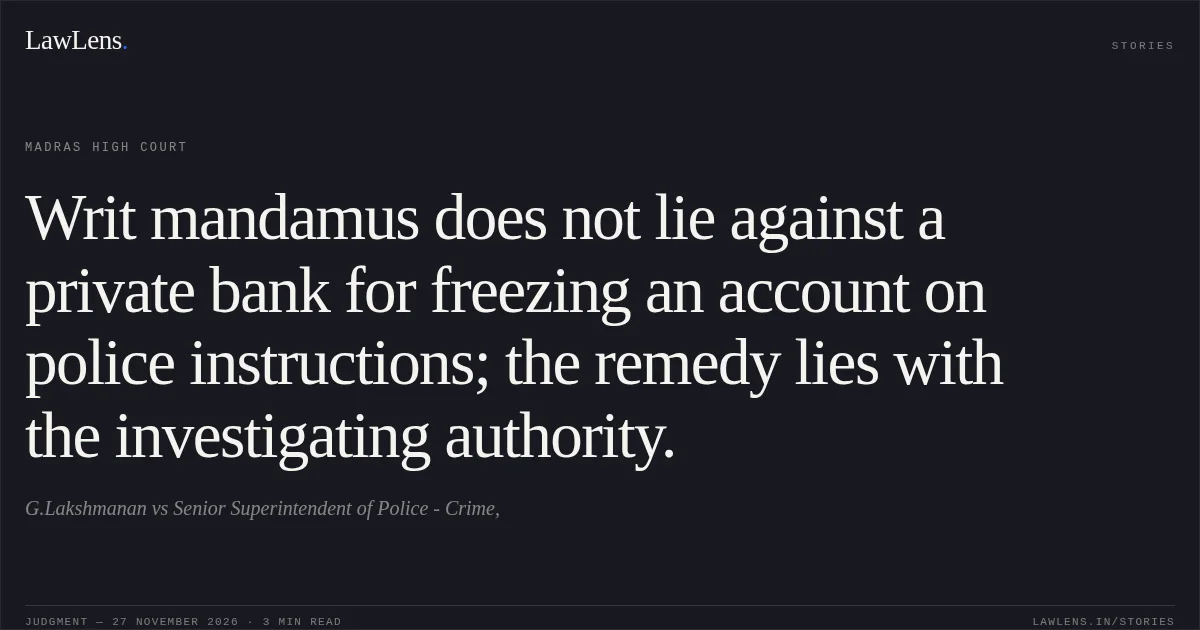
i.1. Whether a writ of mandamus under Article 226 lies against a private bank to defreeze a customer's account where the freezing was effected on police instructions.
¶ 7 · p. 4ii.2. Whether the petitioner should be relegated to placing his materials before the investigating authority for reconsideration of the freezing instruction.
¶ 8 · pp. 4–5 · ¶ 9 · p. 503Law Applied
A private banking company cannot ordinarily be compelled by mandamus to exercise its contractual functions unless the impugned action relates to a public duty or statutory obligation.
¶ 7 · p. 4Police authorities, who issued the freezing instruction, are amenable to the writ jurisdiction of the High Court.
¶ 7 · p. 4An investigating agency must consider a request for reconsideration objectively, weighing the needs of the investigation against the customer's legitimate interest in carrying on business.
¶ 8 · pp. 4–5Any continued freezing must be supported by reasons and "the applicable statutory provisions".
¶ 10 · p. 5The order cites no statute or precedent by name.
04Reasoning
The court held that the bank's private status would ordinarily bar mandamus against it.
¶ 7 · p. 4The court declined to decide the matter on that basis alone, because the freezing originated from police instructions, which are directly subject to writ review.
¶ 7 · p. 4Having regard to the nature of the allegations and the Srinagar Cyber Police origin of the instruction, the court did not adjudicate the legality of the freeze or the merits of the petitioner's claim to the funds.
¶ 8 · pp. 4–5The court instead chose a middle course: the petitioner was permitted to submit a fresh representation with the Solomon invoice, proof of the ₹6,00,000 payment, details of the SEACO remittance, and supporting documents.
¶ 9 · p. 5The investigating authority must consider these materials and decide whether continued freezing is warranted.
¶ 8 · pp. 4–5 · ¶ 10 · p. 5The order records a factual discrepancy not resolved by the court: the petitioner dates the freeze to 03.03.2025, while the bank relies on Srinagar instructions dated 05.04.2025.
¶ 3 · pp. 2–3 · ¶ 5 · pp. 3–405Holding
The writ petition was disposed of without a final determination of the freeze's legality. The police, not the private bank, is the appropriate target for relief, and the matter must first go to the investigating authority.
¶ 7–8 · pp. 4–5The first respondent (SSP, Jammu & Kashmir) is directed to consider a fresh representation from the petitioner. If the freeze is no longer warranted, the first respondent must immediately instruct the bank to defreeze the account. If it continues, the reasons and applicable statutory provisions must be stated. The bank must act "without any undue delay". No costs were awarded.
¶ 9 · p. 5 · ¶ 10 · p. 5Original Court PDF
G.LakshmananvsSenior Superintendent of Police - Crime,
Click to open original judgment
Original judgment, available to read, download and summarize on LawLens.in