01Facts
The respondent, a supplier, alleges that during 2020, pursuant to supply orders issued by the then District Welfare Officer, Saran, it supplied articles to Government schools, hostels and institutions, and that about Rs. 1,11,16,291 remains unpaid
¶ 2–3The appellants (State and departmental officials) contend that the work orders contravened the Department's guidelines (Letter No. 1352 dated 26.12.2020), that the tender procedure under Paragraph 131/D of the Bihar Financial Rules, 2005 was not followed, and that the District Level Purchase Committee (DLPC) found financial irregularities and rejected the claim on 06.08.2021, communicated on 08.11.2021
¶ 4The respondent was later directed to take back the supplied articles (Memo No. 1410, 06.06.2022)
¶ 4The appellants further allege that only one bill (for Rajkiya Ambedkar Awasiya Vidyalaya, Ramchak) was genuinely submitted and that the respondent annexed bills exceeding Rs. 78,60,149 for articles not supplied; none of the bills was admitted or passed by the competent authority
¶ 6The learned Single Judge allowed the writ petition, holding that the supplier could not be denied payment for goods utilised by institutions merely because of the officer's procedural lapses, and that the State could not question the work orders after more than a year
¶ 5The State appealed
¶ 1, 6–702Issues
i.1. Whether a writ of mandamus under Article 226 could validly direct payment of the claimed sum where the claim involves disputed questions of fact, the quantum and acceptance of supplies, and non-compliance with statutory procurement rules
¶ 10–11ii.2. Whether the learned Single Judge erred in disregarding the DLPC's adverse findings and the alleged non-compliance with the Bihar Financial Rules, 2005 and departmental guidelines
¶ 6, 9, 11iii.3. Whether the respondent should be relegated to a civil suit, with limitation left open for determination
¶ 1303Law Applied
The writ court's limited jurisdiction under Article 226 of the Constitution of India is a summary jurisdiction ill-suited to the determination of contested facts and mixed questions of law and fact, including the validity and authority of work orders, quantum and acceptance of supplies, and the effect of a directive to take back goods
¶ 10Paragraph 131/D of the Bihar Financial Rules, 2005 prescribes a mandatory tender procedure for purchases within prescribed limits, and this statutory procurement framework was invoked by the appellants
¶ 4, 9The departmental guidelines dated 26.12.2020 governed the issuance of the work orders
¶ 4, 9Limitation, if raised, must be determined in any subsequent civil proceeding
¶ 1304Reasoning
The dispute could not be conclusively resolved in writ jurisdiction because the record presented a live conflict: the respondent's claim of supply under departmental work orders versus the State's case that the orders were issued in breach of the Financial Rules and the guidelines, and that the DLPC had found irregularities
¶ 9–10The DLPC's adverse determination was a material factor that the Single Judge had not adequately weighed in directing payment of the entire claimed sum
¶ 11Because the record also disputed whether the full quantum of articles was supplied, accepted or utilised, a mandamus compelling payment of the whole amount, without adjudication of those facts, was legally unsustainable
¶ 10–11The Court did not decide the merits of the respondent's claim or the appellants' allegations and left those questions open, preserving the respondent's right to a civil remedy and directing that the civil court decide independently and without being influenced by the observations in the order
¶ 1305Holding
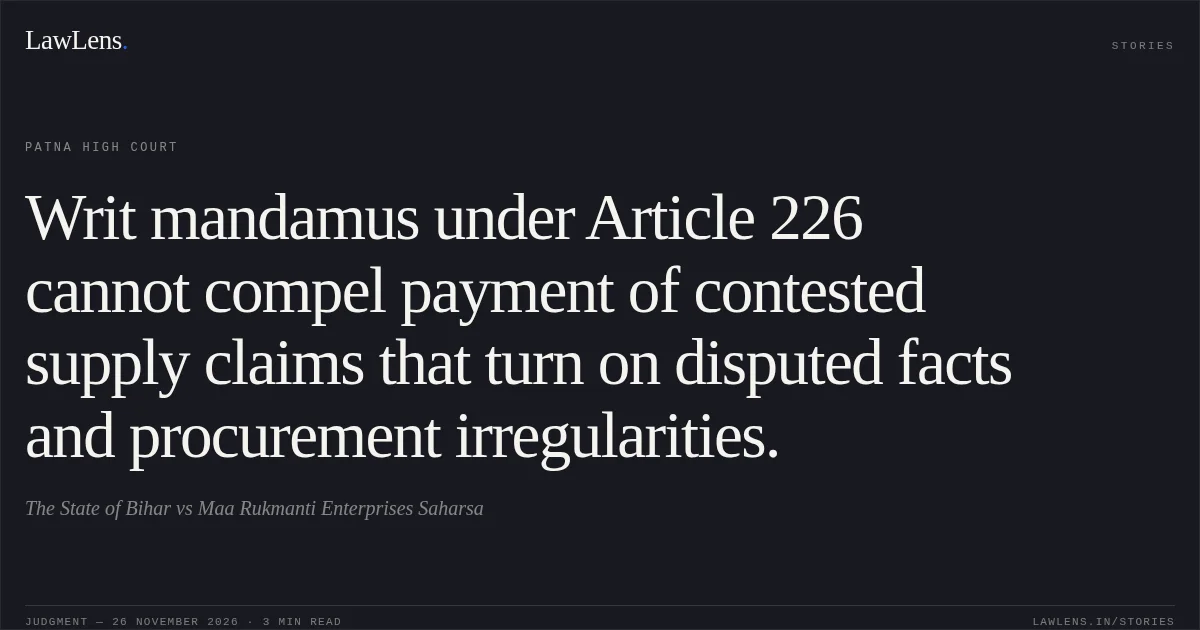
The Single Judge erred in issuing a writ of mandamus directing payment of approximately Rs. 1,11,16,291 in the face of disputed facts, the DLPC's adverse findings, and allegations of non-compliance with statutory procurement rules
¶ 11The LPA is allowed and the order dated 05.09.2024 in C.W.J.C. No. 7015 of 2023 is set aside
¶ 12The respondent is granted liberty to institute a civil suit before the competent court, which shall decide the matter on its own merits, and any question of limitation shall be considered in that suit, with the period spent pursuing the writ before the High Court taken into account
¶ 13Original Court PDF
The State of BiharvsMaa Rukmanti Enterprises Saharsa
Click to open original judgment
Original judgment, available to read, download and summarize on LawLens.in