Facts
The Respondent (NHAI) invited bids on April 2, 2026, for a user fee collection agency for the Delhi-Amritsar-Katra Expressway for a three-month period
Source reference: p. 2A corrigendum was issued on April 6, 2026, specifying that remittances would be revised as and when three specific new fee plazas became operational
Source reference: p. 3The Petitioner submitted a bid and was declared the highest bidder (H-1) on April 10, 2026
Source reference: p. 3On April 13, 2026, the Petitioner represented to the NHAI that it had made a bona fide mistake because the tender documents allegedly created a false impression that eleven plazas were already operational, whereas only eight were functional
Source reference: p. 3-4Despite this, NHAI issued a Letter of Award (LoA) on April 17, 2026
Source reference: p. 3The Petitioner approached the High Court seeking to quash the LoA or to be allowed to withdraw its bid without penalty
Source reference: p. 1-2Issues
1. Whether the writ petition is maintainable when the dispute involves contested questions of fact regarding a bona fide mistake in a commercial contract?
Source reference: p. 4, para. 11-132. Whether the court can grant relief based on the apprehension of future penal actions such as blacklisting or forfeiture?
Source reference: p. 5, para. 15Law Applied
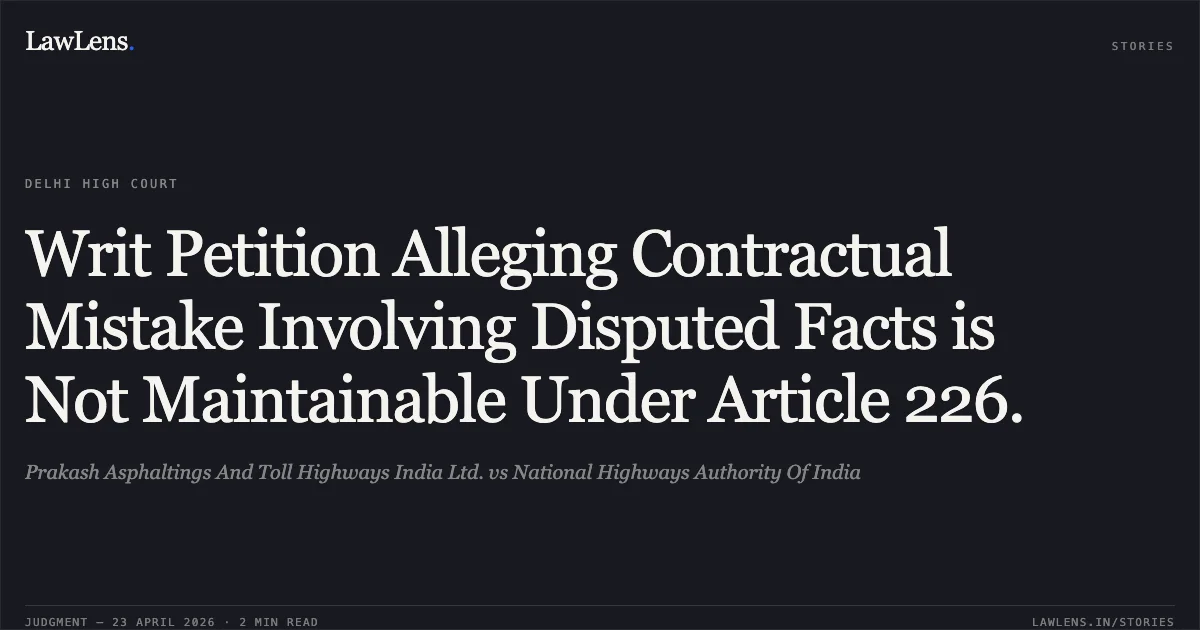
The court applied the principle that judicial review under Article 226 of the Constitution of India is limited and does not extend to resolving disputed questions of fact requiring evidence, which are better suited for a civil suit
Source reference: p. 4, para. 11, 13It further noted that extraordinary jurisdiction under Article 142 (vested in the Supreme Court) or writ jurisdiction in cases of mechanical typographical errors—as seen in M/s. Omsairam Steels & Alloys Pvt. Ltd. v. Director of Mines and Geology BBSR and Ceigall India Ltd. v. NHAI—cannot be invoked where the facts are distinct and suggest a substantive commercial dispute.
Source reference: p. 5, para. 16, 17Reasoning
The Court observed that the Petitioner’s claim—that it was misled by the tender documents—is a factual dispute that requires the appreciation of evidence, making it unsuitable for summary writ proceedings
Source reference: p. 4, para. 13The Court distinguished the precedents cited by the Petitioner: Omsairam Steels involved a clear human error where the Supreme Court exercised Article 142 powers, and Ceigall India involved a minor typographical omission of the word "crore"
Source reference: p. 5-6, para. 16-18In the present case, the court found the Petitioner's grievance was based on an interpretation of the NIT terms which did not qualify as an undisputed clerical error
Source reference: p. 6, para. 18Furthermore, the Court held that a writ cannot be entertained based on the mere "apprehension" of blacklisting or forfeiture, as such actions had not yet occurred
Source reference: p. 5, para. 15Holding
The High Court dismissed the writ petition as premature
The Court held that the Petitioner must avail alternative remedies, such as a civil suit, to resolve the factual controversy
Source reference: p. 6, para. 19The Court reserved liberty for the Petitioner to approach the writ court again should the NHAI pass an actual order of blacklisting or other severe civil consequences in the future
Source reference: p. 6, para. 19All pending applications were disposed of accordingly
Source reference: p. 6, para. 20Original Court PDF
Prakash Asphaltings And Toll Highways India Ltd.vsNational Highways Authority Of India
Click to open original judgment
Original judgment, available to read, download and summarize on LawLens.in