Facts
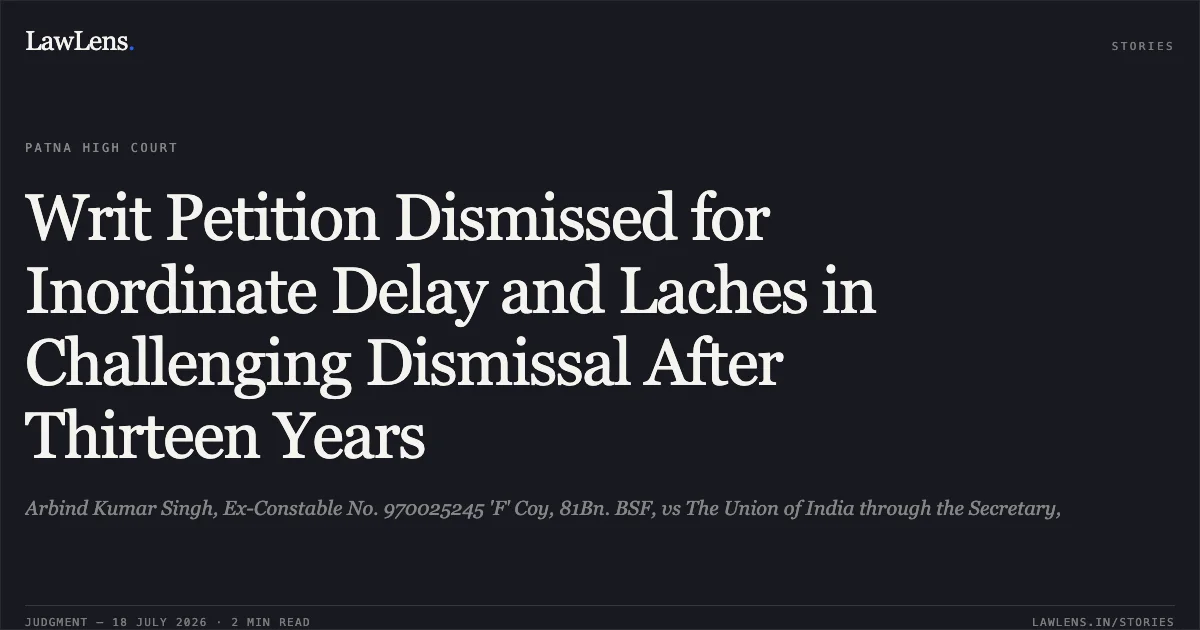
The petitioner, an Ex-Constable in the Border Security Force (BSF), was dismissed from service on 07.01.2004 following a disciplinary proceeding.
Source reference: para. 2The charges involved assaulting a senior Head Constable while under the influence of liquor and disobeying superior orders.
Source reference: para. 2-3His departmental appeal was rejected, and his subsequent Mercy Appeal was dismissed on 19.06.2007.
Source reference: para. 2The petitioner approached the High Court in November 2020—approximately 13 years after the final administrative rejection—claiming he recently learned that a co-delinquent, Suresh Kumar, had been reinstated.
Source reference: para. 3-4He further alleged that his delay was due to the BSF refusing to provide information under the RTI Act.
Source reference: para. 3-4Issues
1. Whether a writ petition challenging a dismissal order can be entertained after an inordinate delay of 13-16 years on the grounds of parity with a co-delinquent.
Source reference: para. 4-52. Whether the court should exercise its discretionary jurisdiction under Article 226 of the Constitution in cases involving stale and belated claims.
Source reference: para. 5Law Applied
The Writ Court, exercising prerogative discretionary jurisdiction under Article 226, must not entertain stale claims if a person "sleeps over his right".
Source reference: para. 5A petition should be dismissed on the sole ground of delay and laches to prevent indolent litigants from taking advantage of their own wrong as established in Mrinmoy Maity v. Chhanda Koley & Ors. (2024).
Source reference: para. 5While there is no fixed limitation for writs, the power is discretionary and should not be used to "exhume matters" already settled or where rights have accrued to third parties as per Tridip Kumar Dingal v. State of W.B. (2009).
Source reference: para. 5Reasoning
The court found that the petitioner’s cause of action had effectively "died" due to the passage of time. The dismissal order dated back to 2004 and the final administrative rejection to 2007, yet the petitioner waited until 2020 to move the Court.
Source reference: para. 4, 6The court rejected the petitioner's justification for the delay—namely, seeking information about a co-delinquent—noting that the BSF is an organization exempted from the RTI Act under Section 24 (except for corruption/human rights violations), and seeking such information via memorials or RTI does not revive a dead cause of action.
Source reference: para. 4-5Applying the principles from Mrinmoy Maity, the court determined that the petitioner was guilty of laches and that the High Court cannot permit such delay to override the finality of disciplinary proceedings.
Source reference: para. 5-6Holding
The Court answered that it was not in a position to exercise its discretionary jurisdiction due to the "inordinate delay".
The writ petition was dismissed solely on account of delay and laches.
Source reference: para. 7Acts & Sections Cited
1 provisions across 1 statute referred to in this judgment. Each provision opens on LawLens.
Right to Information Act, 20051
Original Court PDF
Arbind Kumar Singh, Ex-Constable No. 970025245 'F' Coy, 81Bn. BSF,vsThe Union of India through the Secretary,
Click to open original judgment
Original judgment, available to read, download and summarize on LawLens.in