Facts
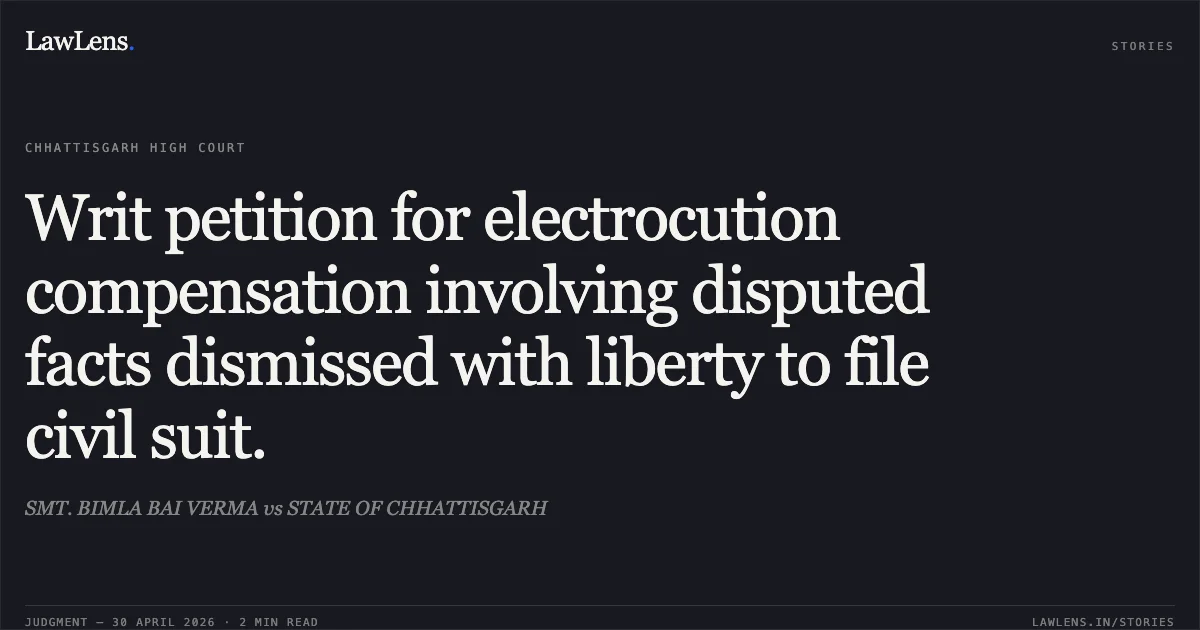
The petitioner, Smt. Bimla Bai Verma, filed a writ petition under Article 226/227 of the Constitution of India seeking compensation of ₹86 lakhs for the death of her husband, Dhiraji Ram Verma, who died due to electrocution
Source reference: p. 1-2The petitioner had already received an ex-gratia payment of ₹4 lakhs from the respondent electricity department
Source reference: p. 2-3The respondents (Chhattisgarh State Power Distribution Company Ltd.) contested the maintainability of the writ petition, arguing that the claim involved disputed questions of fact regarding negligence that required trial and evidence
Source reference: p. 3Issues
1. Whether a writ petition under Article 226 is the appropriate remedy for seeking enhanced compensation involving disputed questions of fact regarding negligence in electrocution cases?
Source reference: p. 2-32. Whether the petitioner should be granted liberty to approach a Civil Court despite potential hurdles of limitation and court fees?
Source reference: p. 3-4Law Applied
The court primarily relied on the principle that writ jurisdiction is generally not exercised when disputed questions of fact regarding negligence are involved, as established by the Supreme Court in Chairman, Grid Corpn. of Orissa Ltd. (GRIDCO) v. Sukamani Das (1999) 7 SCC 298 and SDO, Grid Corp. of Orissa Ltd. v. Timudu Oram (2005) 6 SCC 156
Source reference: p. 3It further applied the procedural precedents set by the Division Bench of the Chhattisgarh High Court in Rameshwari v. Junior/Assistant Engineer (FA No. 151/2023) and CSPDCL v. Smt. Hemlata Netam (FA No. 63/2021), which hold that in such transfers from writ to civil proceedings, the issues of limitation and court fees should not preclude the filing of a civil suit
Source reference: p. 3Reasoning
The court observed that the petitioner was claiming a substantial sum (₹86 lakhs) based on allegations of negligence which the respondents disputed
Source reference: p. 2-3Applying the precedent from Sukamani Das, the court noted that such negligence must be proved through evidence in a full trial, making the writ petition unsuitable for final adjudication
Source reference: p. 3Upon the petitioner's request to withdraw the writ and pursue a civil remedy, the court analyzed the potential bar of limitation. Relying on its own Division Bench rulings, the court reasoned that the time spent bona fide litigating before the High Court should be protected to ensure the petitioner is not left without a remedy due to procedural delays
Source reference: p. 3-4Holding
The High Court permitted the petitioner to withdraw the writ petition with liberty to file a duly constituted civil suit before the competent Civil Court
The court held that if such a suit is filed, the Civil Court shall not insist upon the issue of limitation given the pendency of the writ petition before the High Court
Source reference: para 7The petition was disposed of accordingly with no order as to costs
Source reference: para 8-9Original Court PDF
SMT. BIMLA BAI VERMAvsSTATE OF CHHATTISGARH
Click to open original judgment
Original judgment, available to read, download and summarize on LawLens.in