Facts
The petitioner, the legally married wife of Respondent No. 4, alleged that Respondent No. 4 had subjected her to cruelty and had entered into a relationship and marriage with another woman during the subsistence of their marriage, allegedly in violation of the applicable service-conduct rules.
Source reference: p. 2–3, para. 3She had earlier complained to the authorities and filed WP(C) No. 227 of 2023, which was disposed of on 04.05.2023 with a direction to the State authorities to consider and respond to her complaints in accordance with law.
Source reference: p. 2–3, para. 3As the petitioner alleged that no effective response was received, she sought information from the State Public Information Officer regarding the action taken on her complaint under the Right to Information Act, 2005.
Source reference: p. 2–3, para. 3During hearing, the State produced a communication dated 22.09.2023 stating that the information sought in the petitioner’s RTI application had been furnished.
Source reference: p. 3–4, para. 4 and para. 6The communication also disclosed that Respondent No. 4 had been issued notice on 08.09.2023 to state his views regarding disclosure of his personal data, which he opposed.
Source reference: p. 3–4, para. 4 and para. 6Issues
1. Whether the State Public Information Officer failed to discharge the statutory obligation under the Right to Information Act, 2005 by not furnishing the information sought by the petitioner regarding action taken on her complaint?
Source reference: p. 2–3, para. 32. Whether, in view of the communication dated 22.09.2023 furnishing the requested information, any further mandamus or relief survived in the writ petition?
Source reference: p. 3–4, para. 6Law Applied
The Court applied the statutory disclosure and response framework under the Right to Information Act, 2005, under which the designated Public Information Officer is required to process an RTI application and furnish the information available with the public authority, subject to statutory exemptions, including protection of personal information where applicable.
Source reference: p. 2, para. 2; p. 4, para. 6The Court also applied the general principle governing a writ of mandamus: such relief is warranted only where a subsisting public duty has not been performed and a live grievance remains.
Source reference: p. 4, paras. 6–7Once the requested information was furnished, the cause of action stood substantially addressed and no effective relief remained to be granted.
Source reference: p. 4, paras. 6–7Reasoning
The petitioner sought a direction requiring the State respondents to provide information concerning the action taken on her complaint.
Source reference: p. 3–4, para. 6Although the petitioner disputed the State’s reliance on the communication dated 22.09.2023, the Court examined the document produced by the learned Government Advocate and found that the SPIO had furnished the information sought in the RTI application.
Source reference: p. 3–4, para. 6The Court further noted that Respondent No. 4 had been given an opportunity to express his views on disclosure of his personal data and had objected to sharing it, indicating that the request had been processed with regard to the privacy-related aspect of the information.
Source reference: p. 4, para. 6Since the information had already been supplied, the petitioner’s grievance stood redressed and a writ of mandamus could not issue in the absence of any surviving default or live controversy.
Source reference: p. 4, paras. 6–7Holding
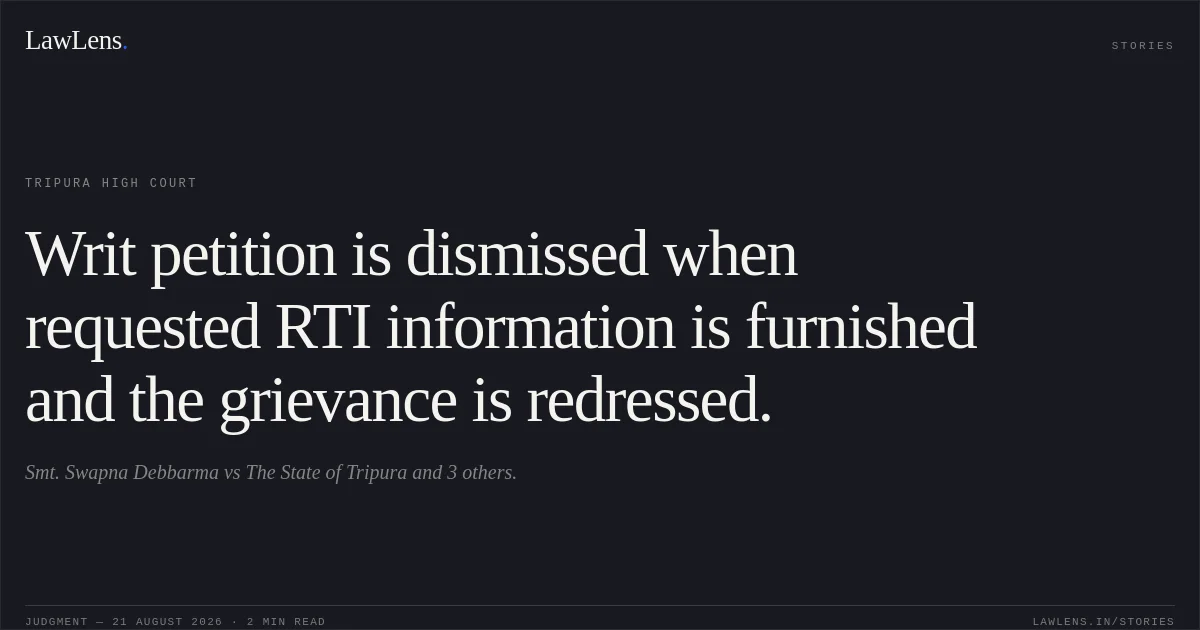
The Court held that the information sought by the petitioner had already been furnished by the SPIO and that her grievance was therefore redressed.
Consequently, no further relief survived, and the writ petition was dismissed.
Source reference: p. 4, para. 7Any pending application was also disposed of.
Source reference: p. 4, para. 7Original Court PDF
Smt. Swapna DebbarmavsThe State of Tripura and 3 others.
Click to open original judgment
Original judgment, available to read, download and summarize on LawLens.in