Facts
The petitioner, Canara Bank (erstwhile Syndicate Bank), filed a writ petition under Article 226 of the Constitution of India seeking to quash a Sale Notice dated 24/08/2023 issued by Respondent No. 3 (Bank of Baroda).
Source reference: p. 1-2The petitioner contended that the subject property (situated at Mauza-Sahbazpur, Muzaffarpur) was already mortgaged to them in 2012 to secure loan accounts of Respondent No. 5.
Source reference: p. 2These accounts were classified as Non-Performing Assets (N.P.A.) in 2015, and the petitioner had already initiated recovery proceedings under the SARFAESI Act, 2002.
Source reference: p. 2The petitioner sought to restrain Bank of Baroda from proceeding with the sale of the same property, alleging the sale notice was illegal.
Source reference: p. 2Issues
1. Whether a writ petition under Article 226 is maintainable against recovery actions taken under the SARFAESI Act when an alternative statutory remedy is available.
Source reference: p. 3-4Law Applied
High Courts should not ordinarily entertain Article 226 petitions if an effective statutory remedy exists, especially regarding bank dues [United Bank of India v. Satyawati Tondon (2010) 8 SCC 110].
Source reference: p. 3High Courts must refrain from exercising writ jurisdiction when the SARFAESI Act provides a specific redressal mechanism [Celir LLP v. Bafna Motors (Mumbai) (P) Ltd. (2024) 2 SCC 1 and PHR Invent Educational Society v. UCO Bank & Ors. (2024) INSC 297].
Source reference: p. 4Reasoning
The Court reasoned that the legislations enacted for the recovery of public money and bank dues are "a code unto themselves," containing comprehensive procedures for recovery and quasi-judicial bodies for dispute resolution.
Source reference: p. 3Referring to the precedents set by the Hon’ble Supreme Court, the Court noted that the rule of exhausting alternative remedies applies with "greater rigour" in financial recovery matters.
Source reference: p. 3Since the dispute involved a challenge to sale proceedings initiated under the SARFAESI Act, the Court found that the petitioner had an effective and alternative statutory forum to challenge the Bank of Baroda's actions.
Source reference: p. 4The Court declined to exercise its extraordinary jurisdiction under Article 226, determining that the petition was not maintainable in light of the available statutory remedies.
Source reference: p. 4Holding
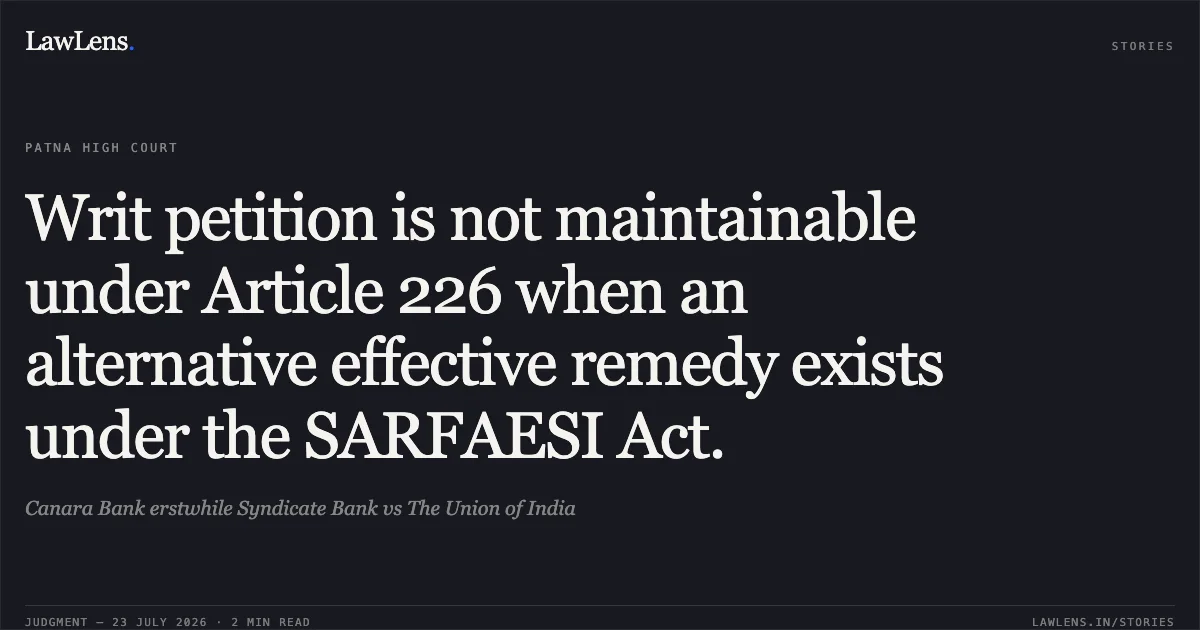
The Court held that the writ petition is not maintainable due to the availability of an alternative and effective remedy.
The petition was disposed of with the observation that the petitioners are at liberty to approach the appropriate forum/authority to seek relief.
Source reference: p. 4The Court further directed the concerned authority to consider the aspect of limitation while entertaining such a plea and disposed of all pending interlocutory applications.
Source reference: p. 4, 5Original Court PDF
Canara Bank erstwhile Syndicate BankvsThe Union of India
Click to open original judgment
Original judgment, available to read, download and summarize on LawLens.in