Facts
The petitioner, Sohan Rai, filed a writ petition under Article 226 of the Constitution challenging a demand notice dated 29.01.2022 issued by the Indian Bank for a loan of Rs. 16,00,000/-
Source reference: p. 1-2He further sought to quash an order dated 25.08.2023 issued by the Sub Divisional Officer, Patna Sadar, which authorized the bank to take possession of his dwelling house located in Mouza Gosain Tola
Source reference: p. 2The petitioner sought reliefs including the prevention of penal interest charges, an extension for repayment in smaller installments, and a stay on the possession of his property
Source reference: p. 2-3Issues
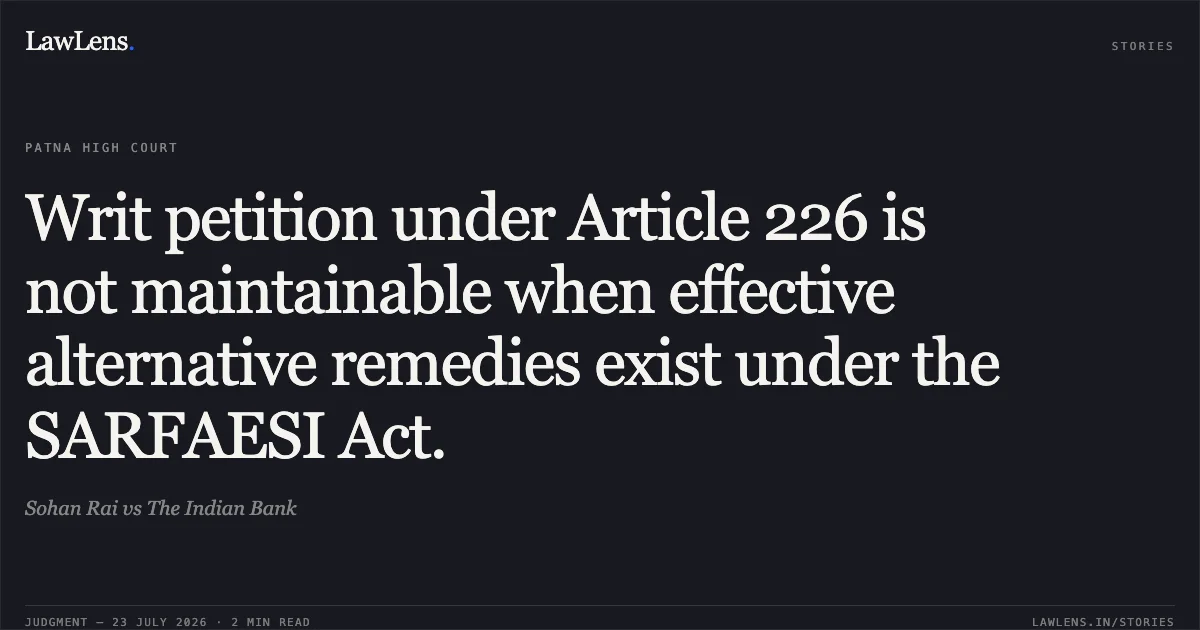
1. Whether a writ petition under Article 226 is maintainable when the petitioner has an alternative and effective remedy available under the SARFAESI Act
Source reference: p. 5, para. 6Law Applied
High Courts should not ordinarily entertain writ petitions under Article 226 if an effective statutory remedy is available, particularly in matters of debt recovery by financial institutions.
Source reference: no citationUnited Bank of India v. Satyawati Tondon (2010), which held that recovery legislations are complete codes providing for quasi-judicial redressal
Source reference: p. 3-4, para. 3Celir LLP v. Bafna Motors (Mumbai) (P) Ltd. (2024) and PHR Invent Educational Society Vs UCO Bank Ors (2024), both of which reiterated that High Courts must refrain from exercising writ jurisdiction in SARFAESI matters where statutory remedies exist
Source reference: p. 4, para. 4, p. 5, para. 5Reasoning
The Court observed that the petitioner was challenging actions taken by the bank under the SARFAESI Act, specifically the demand notice and the subsequent takeover of possession
Source reference: p. 1-2Applying the precedents of the Supreme Court, the Court reasoned that because the SARFAESI Act provides a comprehensive mechanism for challenging such measures (such as approaching the Debt Recovery Tribunal), the extraordinary jurisdiction of the High Court under Article 226 should not be invoked
Source reference: p. 5, para. 6The Court emphasized that in matters involving public money and bank dues, the rule of exhausting statutory remedies applies with "greater rigour"
Source reference: p. 3, para. 3Holding
The Court held that the writ petition is not maintainable due to the availability of an alternative and effective remedy
Accordingly, the petition was disposed of, with the petitioner granted liberty to approach the appropriate forum to seek redressal. The Court further directed the concerned authority to consider the aspect of limitation given the time spent in the present litigation
Source reference: p. 5, para. 6-7Acts & Sections Cited
1 provisions across 1 statute referred to in this judgment. Each provision opens on LawLens.
Securitisation and Reconstruction of Financial Assets and Enforcement of Security Interest Act, 20021
Original Court PDF
Sohan RaivsThe Indian Bank
Click to open original judgment
Original judgment, available to read, download and summarize on LawLens.in