Facts
The petitioner, appointed as a Publication Expert, challenged a communication dated 13.08.2026 issued by Chhattisgarh Samvaad calling upon him to submit a point-wise explanation regarding allegations concerning his appointment, educational qualifications, experience, and the validity of documents submitted at the time of appointment.
Source reference: para. 1The petitioner contended that the allegations had already been considered in earlier proceedings, that he had served for more than two decades, and that the communication disclosed a mala fide and pre-determined intention to question his continuance in service.
Source reference: para. 2(a)–(b)The respondents maintained that the communication was only a show-cause notice, granted seven days to respond, and did not constitute any final or adverse decision. They further argued that the writ petition was premature because the petitioner had not submitted his reply.
Source reference: para. 3(i)–(ii)Issues
Whether the communication dated 13.08.2026, calling for the petitioner’s explanation regarding allegations concerning his appointment, warranted interference under Article 226 of the Constitution.
Source reference: para. 5Whether a writ petition challenging a mere show-cause notice is maintainable in the absence of demonstrated lack of jurisdiction or abuse of process.
Source reference: paras. 8–10Law Applied
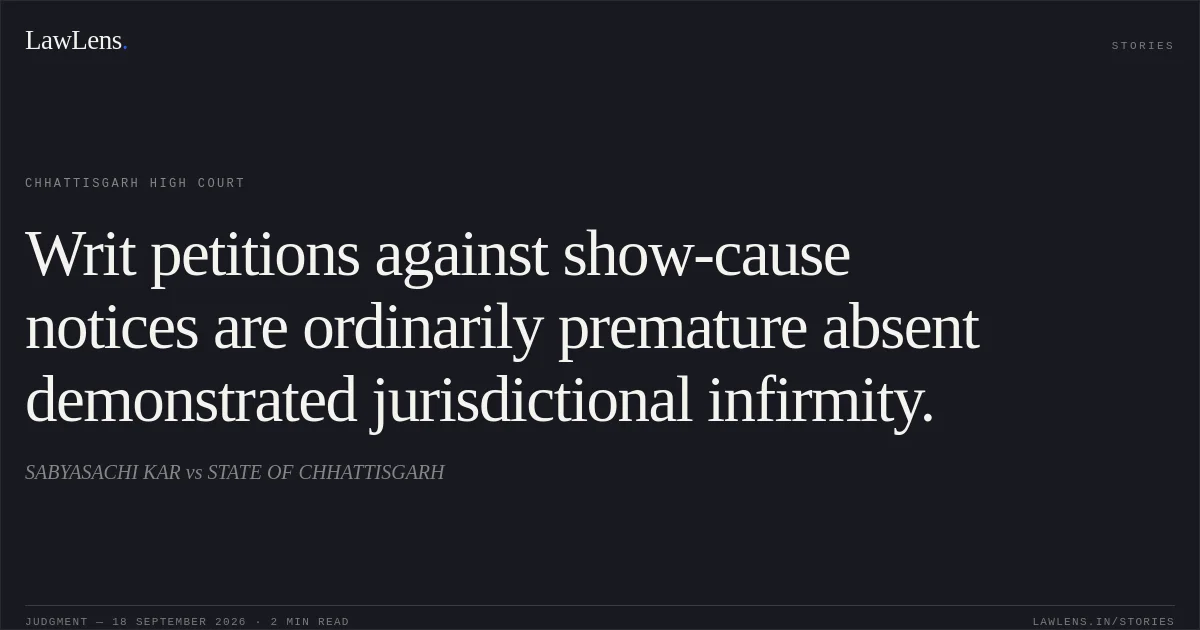
The Court applied the principle that a writ petition ordinarily does not lie against a mere show-cause notice because the concerned person must first receive an opportunity to present his case before the competent authority.
Source reference: para. 8The exception is where the notice is issued without jurisdiction, lacks any legal foundation, or constitutes an abuse of the process of law; such exceptional circumstances must be prima facie established, and disputed factual matters should not ordinarily be adjudicated at the notice stage.
Source reference: para. 9The Court relied on Union of India & Anr. v. Vicco Laboratories, (2007) 13 SCC 270, and noted that this principle had recently been reiterated in J. Sri Nisha v. Special Director, Adjudicating Authority, Directorate of Enforcement, 2026 SCC OnLine SC 517.
Source reference: paras. 9–10Reasoning
The Court found that the impugned communication merely reproduced the allegations received from the complainant and called upon the petitioner to provide a point-wise explanation within seven days.
Source reference: para. 6It neither terminated the petitioner’s service nor imposed any punishment or finally determined his civil or service rights.
Source reference: para. 6The inclusion of specific allegations in the notice did not establish that the authority had reached a pre-determined conclusion, since the allegations were yet to be considered in light of the petitioner’s response and supporting material.
Source reference: para. 7As the petitioner had not shown any jurisdictional defect, absence of legal foundation, or abuse of process, and because factual adjudication would be necessary, the Court held that interference under Article 226 at the show-cause stage was unwarranted.
Source reference: paras. 8, 11–12Holding
The Court held that the communication dated 13.08.2026 was only a show-cause notice seeking explanation and was not a final or adverse order.
The writ petition was therefore premature and was dismissed at the motion stage.
Source reference: para. 12–13The petitioner was granted liberty to submit a detailed reply before the competent authority, which was directed to consider it independently and decide the matter in accordance with law and on its own merits, uninfluenced by the observations in the judgment.
Source reference: para. 13Original Court PDF
SABYASACHI KARvsSTATE OF CHHATTISGARH
Click to open original judgment
Original judgment, available to read, download and summarize on LawLens.in