Facts
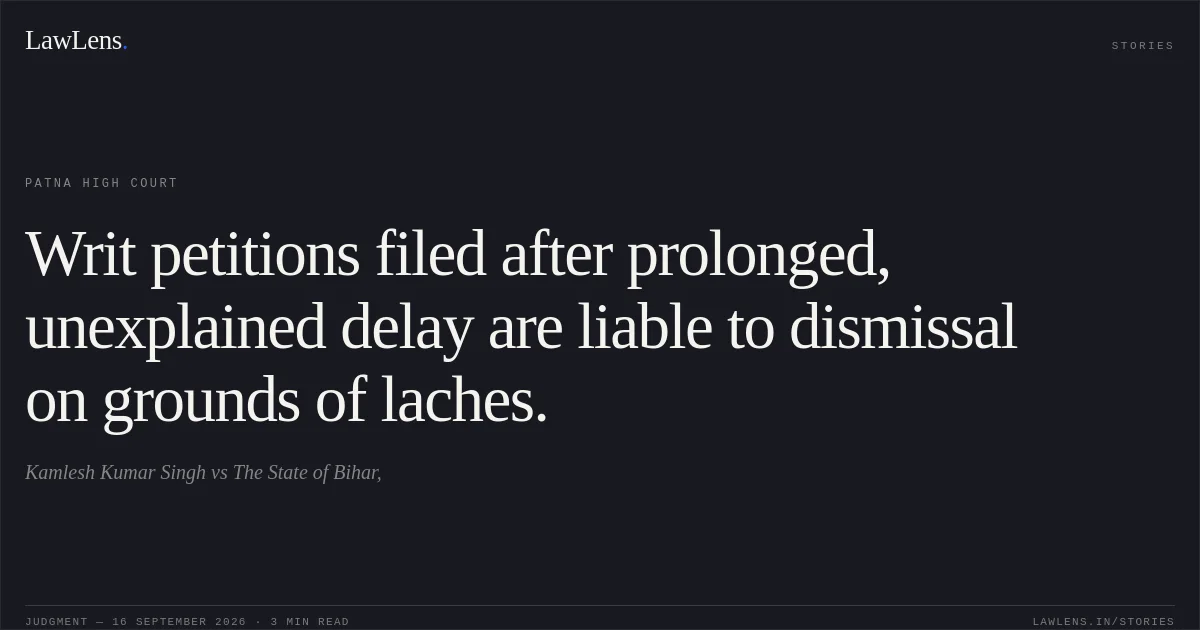
The petitioner claimed that he had participated in the recruitment process pursuant to Advertisement No. 1 of 2016 for appointment as a driver sepoy and that, despite his result, he was not permitted to join service.
Source reference: p.2–3, paras. 2–3He alleged that he was orally debarred on the ground of colour-vision deficiency without issuance of notice.
Source reference: p.2–3, paras. 2–3The recruitment process and publication of the result were completed in 2017. The petitioner nevertheless approached the Patna High Court for the first time in 2026, approximately eight years after the alleged cause of action arose.
Source reference: p.2–3, paras. 2–3The record contained no documentary proof that the petitioner had made any effort to obtain joining between 2017 and 2026; his assertion that he had made oral efforts was not accepted by the Court.
Source reference: p.3, para. 4Issues
Whether the writ petition was liable to be dismissed on the ground of delay and laches, since the petitioner approached the Court approximately eight years after completion of the recruitment process without producing evidence of any intervening effort or explanation for the delay?
Source reference: p.2–3, paras. 3–4Whether the petitioner was entitled to a direction for being taken back or appointed as a driver sepoy on the allegation that he had been orally debarred on the ground of colour vision without notice?
Source reference: p.2, para. 2; p.3, para. 4Law Applied
The Court applied the doctrine of delay and laches, under which a writ court exercising extraordinary and equitable jurisdiction may refuse relief where an aggrieved person approaches the Court after an inordinate and unexplained delay; delay reflects inaction, may prejudice accrued rights, and equity aids the vigilant rather than those who sleep over their rights.
Source reference: p.3–5, para. 4The Court relied principally on Chennai Metropolitan Water Supply and Sewerage Board v. T.T. Murali Babu, (2014) 4 SCC 108, particularly paragraphs 16 and 17, which hold that courts must scrutinise the explanation for delay and may reject belated claims where the delay causes prejudice or reflects indolence.
Source reference: p.3–5, para. 4It also relied on the coordinate Bench decision in Gyasuddin @ Gyasuddin Khan v. The State of Bihar & Ors., C.W.J.C. No. 13306 of 2023, decided on 11 March 2024, recognising that an unexplained and inordinate delay is sufficient to deny writ relief.
Source reference: p.5–6, para. 5Reasoning
The Court found that the petitioner’s alleged grievance arose no later than 2017, when the recruitment process and result were completed, but that he took no documented step to secure joining until filing the writ petition in 2026.
Source reference: p.2–3, paras. 3–4The Court rejected the petitioner’s assertion of oral efforts because no supporting document or contemporaneous representation was produced.
Source reference: p.3, para. 4Applying the principles in T.T. Murali Babu and Gyasuddin, the Court held that an unexplained delay of approximately eight years disentitled the petitioner to discretionary writ relief.
Source reference: p.3–7, paras. 4–6In view of this threshold defect, the Court did not grant relief on the merits of the alleged oral debarment or colour-vision objection.
Source reference: p.3–7, paras. 4–6Holding
The Court held that the writ petition was barred by delay and laches.
Since the petitioner approached the Court approximately eight years after the alleged cause of action and failed to provide a satisfactory explanation or documentary evidence of having pursued joining, the petition was found devoid of merit and was dismissed.
Source reference: p.6–7, para. 6No direction was issued for the petitioner’s appointment or joining as a driver sepoy.
Source reference: p.6–7, para. 6Original Court PDF
Kamlesh Kumar SinghvsThe State of Bihar,
Click to open original judgment
Original judgment, available to read, download and summarize on LawLens.in