Facts
The Appellant (Financial Creditor), an NBFC, extended loans totaling ₹22.75 Crores to the Respondent (Corporate Debtor) between 2011 and 2016 based on an oral understanding
Source reference: para 2The debt was evidenced by bank statements, demand promissory notes, confirmation letters, and TDS deductions on interest
Source reference: para 2, 3Following a default, the Appellant filed a Section 7 petition (CP 215/2022), which was later withdrawn after the parties executed a Settlement Agreement on 18.11.2022
Source reference: para 2When the Respondent breached the settlement terms, the Appellant filed a fresh Section 7 petition (CP 146/2023)
Source reference: para 2The Adjudicating Authority (NCLT, Kolkata) dismissed this second petition on 23.09.2024, holding that: (i) the withdrawal of the first petition without specific liberty to file afresh barred the second petition; (ii) the matter was hit by res judicata; and (iii) an NBFC must have a written loan agreement per RBI guidelines to establish a "financial debt"
Source reference: para 3, 7, 8Issues
1. Whether the breach of settlement terms constitutes a "financial debt" and provides a fresh cause of action for a Section 7 petition
Source reference: para 62. Whether a petition withdrawn without the explicit leave of the Court precludes a petitioner from filing afresh on the same cause of action under the IBC
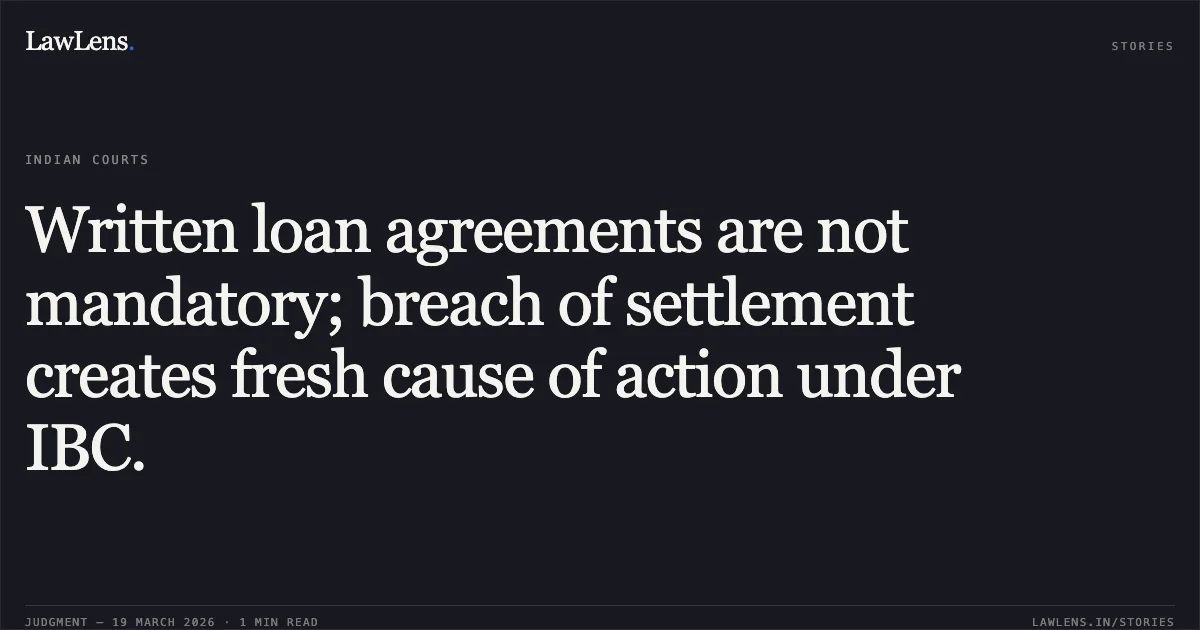
Source reference: para 63. Whether an explicit written agreement is a mandatory instrument for an NBFC to substantiate a financial debt under the IBC
Source reference: para 6Law Applied
The court primarily applied Section 5(8) of the IBC, which defines "financial debt" as a debt disbursed against the consideration for the time value of money
Source reference: para 3It relied on Section 238 of the IBC, which mandates that the Code overrides any inconsistent provisions in other laws or instruments, including RBI Circulars
Source reference: para 11, 12The court followed the precedent in Desana Impex Limited v. Brick and Mortar Realty Private Limited, establishing that a written contract is not a sine qua non for proving a financial debt if the transaction's nature is otherwise evident
Source reference: para 12It further applied the principles from Shraddha Enterprises v. Simplex Infrastructures Ltd., holding that a breach of settlement creates a new cause of action and technicalities regarding "liberty to revive" should not shield unscrupulous debtors
Source reference: para 18Finally, it cited Innoventive Industries Ltd. v. ICICI Bank regarding the Adjudicating Authority's limited scope under Section 7 to merely verify debt and default
Source reference: para 22Reasoning
The Tribunal found that the NCLT erred by relying on an RBI Master Circular to mandate a written loan agreement, noting that Section 238 of the IBC ensures the Code’s supremacy over such circulars
Source reference: para 11-13Ample evidence, including bank statements and TDS deductions, sufficiently proved the debt and default
Source reference: para 14Regarding the withdrawal of the first petition, the Tribunal clarified that res judicata does not apply because the first petition was never adjudicated on merits
Source reference: para 21The Tribunal reasoned that the breach of a Settlement Agreement provides a distinct and fresh cause of action
Source reference: para 21It rejected the "hyper-technical" requirement of obtaining explicit liberty to revive, observing that such a rule would allow Corporate Debtors to use sham settlements to permanently evade insolvency proceedings
Source reference: para 18-20The Tribunal concluded that since the debt and default (above the threshold limit) were clearly established, the Adjudicating Authority was statutorily bound to admit the petition
Source reference: para 24Holding
The NCLAT allowed the appeal and set aside the Impugned Order dated 23.09.2024
It held that a written agreement is not mandatory to prove financial debt and that a fresh Section 7 petition is maintainable upon the breach of a settlement agreement, notwithstanding the unconditional withdrawal of a prior petition
Source reference: para 13, 21The Adjudicating Authority was directed to pass an order of admission for the Section 7 application within one month and proceed with the CIRP in accordance with the law
Source reference: para 25No order as to costs was made
Source reference: para 25Acts & Sections Cited
8 provisions across 2 statutes referred to in this judgment. Each provision opens on LawLens.
Code of Civil Procedure, 19081
Insolvency and Bankruptcy Code, 2016.7
Original Court PDF
Subham Capital Private LimitedvsVedic Realty Private Limited
Click to open original judgment
Original judgment, available to read, download and summarize on LawLens.in