Facts
The petitioners, original plaintiffs in Regular Civil Suit No. 8 of 2022 pending before the Principal Civil Judge, Nizar, filed an application below Exhibit 31 seeking to join additional parties as co-plaintiffs and to make consequential amendments.
Source reference: pp. 2–3, paras. 3–5The application was inadvertently filed under Order I Rule 13 CPC instead of Order I Rule 10(2) CPC.
Source reference: pp. 2–3, paras. 3–5The Trial Court rejected the application solely because the provision invoked did not apply to the reliefs sought, without examining the application on merits.
Source reference: p. 3, paras. 4–5The petitioners challenged that order under Article 227 of the Constitution, contending that an application should not be rejected merely because an incorrect statutory provision was cited.
Source reference: pp. 1–2, paras. 2–3.2Issues
Whether an application seeking addition of parties as co-plaintiffs could be rejected solely because it was incorrectly filed under Order I Rule 13 instead of Order I Rule 10(2) CPC?
Source reference: pp. 2–3, paras. 3.1–5Whether the Trial Court was required to consider and decide the application on its merits by exercising the jurisdiction available under Order I Rule 10(2) CPC?
Source reference: pp. 3–6, paras. 6–8, 10.1Law Applied
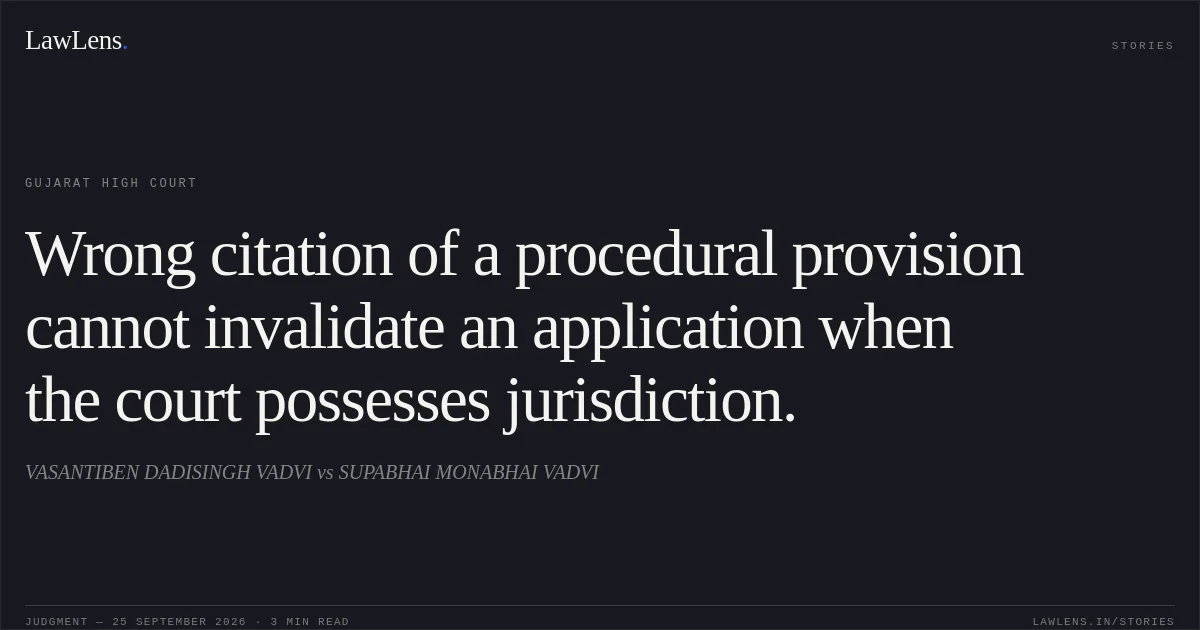
The Court applied the principle that mere citation of a wrong or incorrect statutory provision does not invalidate an application or order where the court otherwise possesses jurisdiction and the power to grant the relief.
Source reference: no citationRelying on Pruthvirajsinh Nodhubha Jadeja (Dead) by LRs v. Jayeshkumar Chhakaddas Shah, (2019) 9 SCC 533, the Court reiterated that an application filed under an incorrect provision may nevertheless be considered under the correct provision.
Source reference: p. 3, para. 7.1It also relied on P.K. Palanisamy v. N. Arumugham, (2009) 9 SCC 173, and N. Mani v. Sangeetha Theatre, (2004) 12 SCC 278, for the rule that wrong citation or non-citation of the source of power does not vitiate an exercise of jurisdiction when that power exists in law.
Source reference: pp. 3–5, paras. 7.2–7.3The relevant procedural provision was Order I Rule 10(2) CPC, which empowers the court to add necessary or proper parties.
Source reference: no citationReasoning
The High Court found that the petitioners’ substantive request was for impleadment or addition of parties as co-plaintiffs, a relief falling for consideration under Order I Rule 10(2) CPC.
Source reference: p. 2, para. 4Although Order I Rule 13 had been mistakenly cited, the Trial Court possessed jurisdiction to examine the application under the correct provision.
Source reference: no citationBy rejecting the application solely on the technical ground of incorrect statutory citation, without adjudicating its merits, the Trial Court failed to exercise jurisdiction vested in it.
Source reference: pp. 3–6, paras. 5–8The High Court therefore held that the impugned order was legally unsustainable and that the application had to be restored for determination after hearing all concerned parties.
Source reference: no citationHolding
The petition was allowed.
The High Court quashed and set aside the Trial Court’s order dated 15 July 2026 rejecting the Exhibit 31 application and restored that application to its original file.
Source reference: p. 6, paras. 10–11The Trial Court was directed to hear all concerned parties and decide the application in accordance with law, treating it as an application under Order I Rule 10(2) CPC, with liberty to permit formal correction of the provision if necessary.
Source reference: p. 6, para. 10.1Since the order was passed without hearing the respondents, they were granted liberty to seek recall or modification within one month of receiving the order.
Source reference: p. 6, para. 9Acts & Sections Cited
2 provisions across 1 statute referred to in this judgment. Each provision opens on LawLens.
Army Act, 19502
Original Court PDF
VASANTIBEN DADISINGH VADVIvsSUPABHAI MONABHAI VADVI
Click to open original judgment
Original judgment, available to read, download and summarize on LawLens.in