Facts
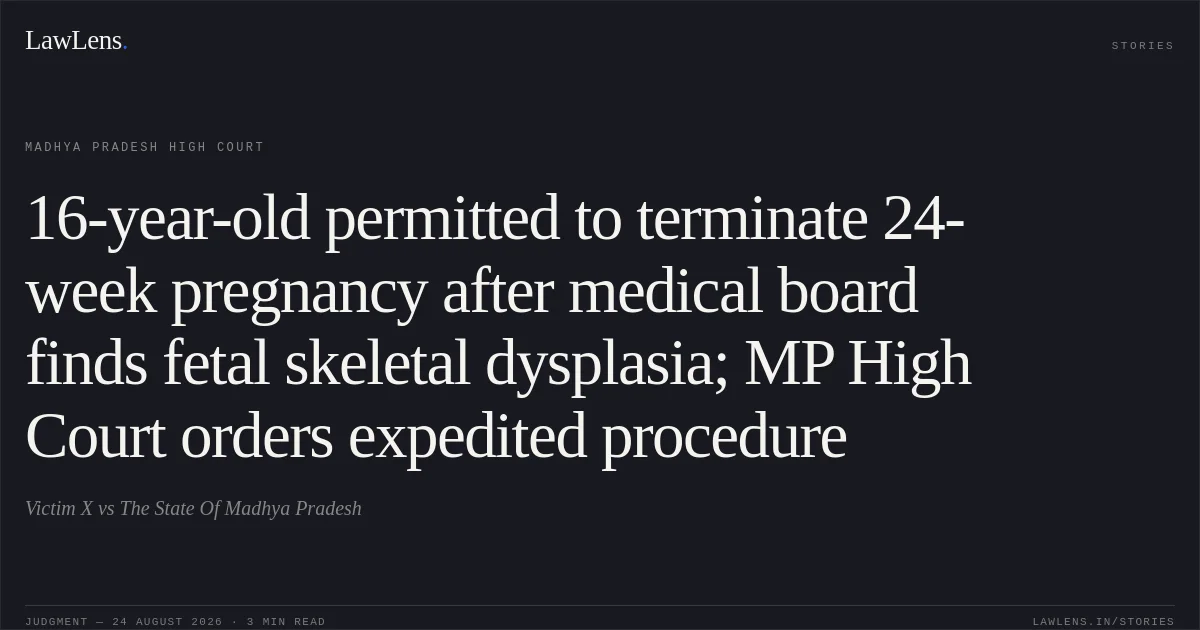
The minor petitioner, identified as Victim X, sought permission for termination of her pregnancy.
Source reference: no citationPursuant to the Court’s earlier directions, the Head of the Department of Obstetrics and Gynaecology, MTH Hospital, MGMMC, Indore, submitted a Medical Board report dated 22 August 2026.
Source reference: p.1The Board found the petitioner physically and mentally/emotionally fit for the procedure.
Source reference: p.1Ultrasound revealed a live intrauterine pregnancy of approximately 24 weeks and 2 days, with the fetus suffering from skeletal dysplasia and left-foot CTEV; the fetus weighed approximately 719 grams and was in breech presentation.
Source reference: p.1The Medical Board opined that termination could be performed.
Source reference: p.1The Court also considered the Standard Operating Procedures prescribed in In Re: (Suo Motu) v. State of Madhya Pradesh and Others, W.P. No. 5184 of 2025, concerning termination of pregnancies exceeding 24 weeks in cases involving survivors of sexual assault, rape, or incest.
Source reference: pp.2–4Issues
Whether the petitioner, a minor survivor seeking termination of a pregnancy exceeding 24 weeks, could be permitted to undergo termination on the basis of the Medical Board’s opinion and the applicable provisions of the Medical Termination of Pregnancy Act, 1971.
Source reference: pp.1, 4–5Whether the termination procedure should be conducted subject to safeguards concerning medical fitness, expert supervision, preservation of fetal/DNA material, post-operative care, and protection of the petitioner’s privacy.
Source reference: pp.2–5Law Applied
The Court applied Section 3(2) of the Medical Termination of Pregnancy Act, 1971, governing termination by registered medical practitioners, along with Sections 3(2B) and 5(1), which preserve the power to terminate pregnancies in medically permissible circumstances beyond the ordinary statutory limit.
Source reference: pp.3–4Rule 3B of the Medical Termination of Pregnancy Rules, 2003 identifies minors, survivors of sexual assault or rape, and pregnancies involving foetal malformation carrying a substantial risk of incompatibility with life or serious handicap as eligible categories for termination up to 24 weeks.
Source reference: p.4The Court relied on X v. Principal Secretary, Health and Family Welfare Department, (2023) 9 SCC 433, which recognised reproductive autonomy, access to safe and legal abortion, and the woman’s ultimate decision-making authority over her body under Article 21 of the Constitution.
Source reference: p.4It further applied the safeguards and procedure prescribed in In Re: (Suo Motu) v. State of Madhya Pradesh and Others, W.P. No. 5184 of 2025, including expert medical supervision, preservation of fetal material for DNA examination, post-operative care, and strict confidentiality of the victim’s identity.
Source reference: pp.2–4Reasoning
The Medical Board’s report established that the petitioner was medically and mentally fit and that termination was technically possible.
Source reference: p.1The ultrasound additionally disclosed significant foetal abnormalities, including skeletal dysplasia, supporting the statutory consideration of foetal malformation and the need to protect the petitioner’s physical and mental health.
Source reference: p.1Although the pregnancy was approximately 24 weeks and 2 days, the Court considered the petitioner’s minority, her status as a victim, the medical opinion, the constitutional guarantee of reproductive autonomy, and the statutory provisions permitting medically justified termination beyond the ordinary limit.
Source reference: pp.3–5The Court directed that the procedure be preceded by fresh verification of the petitioner’s physical and mental fitness and be conducted expeditiously by the concerned doctors in accordance with the safeguards in the earlier Division Bench directions.
Source reference: p.5Since a criminal offence was registered, the Court specifically required preservation of DNA samples from the fetus and compliance with the applicable forensic and privacy safeguards.
Source reference: p.5Holding
The Court answered the issues in favour of the petitioner and granted permission for termination of the pregnancy.
The concerned doctors were directed to conduct the procedure, preferably within one or two days, after fresh verification of the petitioner’s physical and mental fitness.
Source reference: p.5The procedure was to be performed with appropriate expert medical care, preservation of fetal/DNA material for the criminal investigation, necessary post-operative treatment, and strict protection of the petitioner’s privacy.
Source reference: no citationThe writ petition was accordingly disposed of, and a copy of the order was directed to be supplied to the State counsel for compliance.
Source reference: p.6Acts & Sections Cited
2 provisions across 1 statute referred to in this judgment. Each provision opens on LawLens.
Original Court PDF
Victim XvsThe State Of Madhya Pradesh
Click to open original judgment
Original judgment, available to read, download and summarize on LawLens.in