01Facts
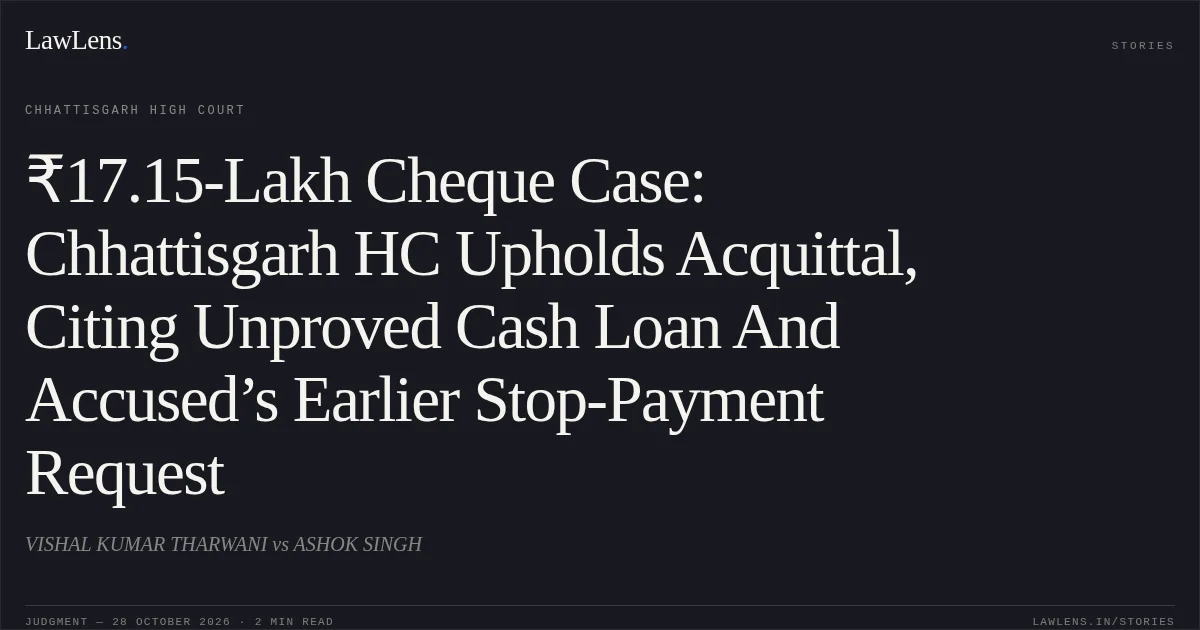
The complainant alleged that he advanced the respondent ₹17,15,000 in cash between December 2012 and January 2013 and that the respondent issued a cheque for that amount, which was dishonoured. The trial court convicted the respondent under Section 138 of the Negotiable Instruments Act, 1881; the appellate court reversed the conviction and acquitted him, finding that the complainant had not established his financial capacity to make the loan. The complainant appealed against the acquittal.
¶ 1–3, 7The respondent maintained that the cheque had been stolen, relying on a police complaint and a stop-payment request made before the cheque was presented.
¶ 7, 13, 1502Issues
i.Whether the respondent rebutted the presumptions under Sections 118(a) and 139 of the NI Act by raising a probable defence concerning the alleged loan and the cheque’s possession.
¶ 8, 16, 20–21ii.Whether the appellate court’s acquittal was a reasonably possible view on the evidence, such that it should not be disturbed in the appeal against acquittal.
¶ 23–24, 2703Law Applied
Sections 118(a) and 139 of the NI Act raise rebuttable presumptions that a cheque was issued for consideration and in discharge of a debt or liability; the accused may rebut them on a balance of probabilities, including by relying on the complainant’s evidence.
¶ 8–10Where the accused specifically challenges the complainant’s financial capacity, the complainant may be required to explain that capacity with cogent material once a probable defence is raised; the burden is not on the complainant to establish capacity at the outset.
¶ 17–18An appellate court may reappraise an acquittal, but should not interfere where the acquittal reflects a reasonable view of the evidence and two reasonable conclusions are possible; the acquittal reinforces the presumption of innocence.
¶ 23–24Provisions in the judgment · 6 · Linked ones open on LawLens
Code of Criminal Procedure, 1973 Section 313Section 378
Negotiable Instruments Act, 1881 Section 118Section 138Section 139Section 145
04Reasoning
The Court accepted that the cheque presumptions initially favoured the complainant, but held that the respondent raised a probable defence.
¶ 11–16, 21The complainant did not specify the dates on which the loan was advanced, and the supporting material did not establish that the funds shown in his mother’s account or the ₹7 lakh borrowed from Rahaslal were actually advanced to the respondent. The complainant did not examine his mother or Rahaslal, produce relevant business or income records, or provide consistent evidence of the transaction.
¶ 11–16, 21The respondent’s police complaint and stop-payment request, made before the cheque’s first dishonour for “payment stopped by drawer,” lent support to the alleged theft defence.
¶ 13, 20, 22In those circumstances, the appellate court reasonably found the statutory presumption rebutted and the complainant’s evidence insufficient to establish the debt; its conclusion was not perverse or based on a misreading of the evidence.
¶ 21, 25, 2705Holding
The Court held that the respondent raised a probable defence rebutting the presumptions under Sections 118 and 139 of the NI Act, and that the appellate court’s acquittal was a plausible view of the evidence.
¶ 27–28Finding no illegality, perversity, or other ground warranting interference, the High Court dismissed the acquittal appeal.
¶ 27–28Original Court PDF
VISHAL KUMAR THARWANIvsASHOK SINGH
Click to open original judgment
Original judgment, available to read, download and summarize on LawLens.in