01Facts
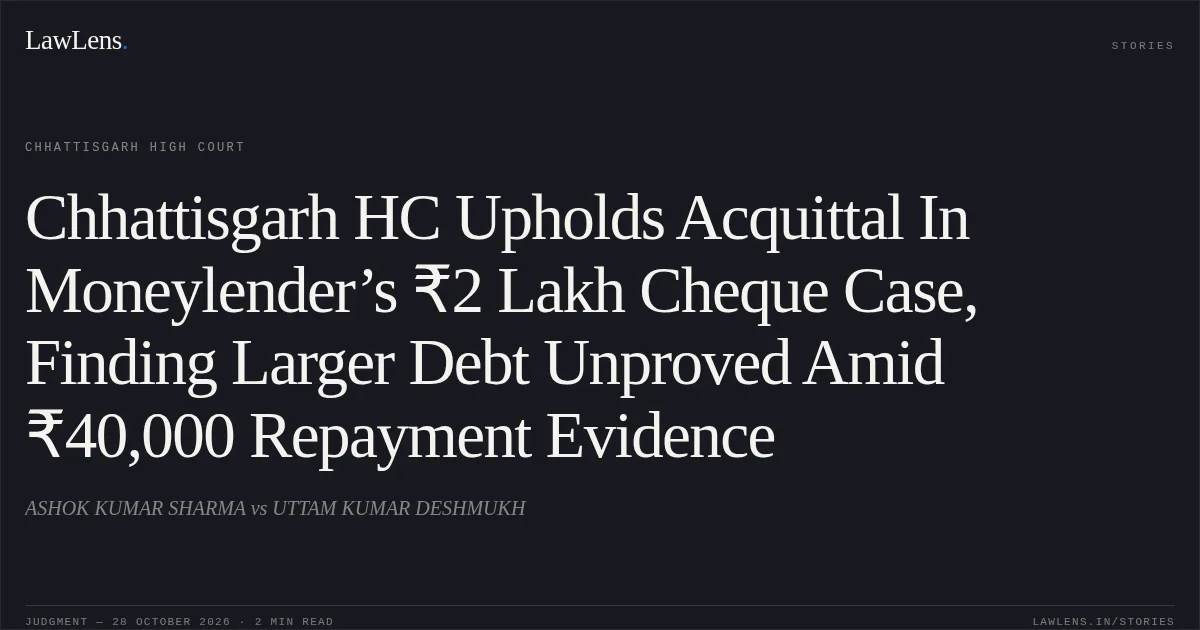
The appellant’s complaint under Section 138 of the Negotiable Instruments Act, 1881 (NI Act) alleged that the respondent issued a cheque for ₹2 lakh towards repayment of loans advanced on different occasions.
¶ 1–2, 6–7The cheque was dishonoured for insufficient funds, and the respondent did not pay after notice.
¶ 1–2, 6–7The respondent admitted his signature on the cheque but maintained that he had borrowed only ₹40,000, repaid it, and had given the cheque and other signed documents as security.
¶ 1–2, 6–7The trial court acquitted him, finding that the complainant had not established a legally recoverable debt.
¶ 1–2, 6–7The complainant appealed under Section 378(4) of the Code of Criminal Procedure, 1973.
¶ 1–2, 6–702Issues
i.Whether the respondent raised a probable defence sufficient to rebut the presumptions under Sections 118(a) and 139 of the NI Act
¶ 7, 16–18ii.Whether the trial court’s acquittal was a possible view of the evidence or warranted appellate interference
¶ 20–2303Law Applied
Under Sections 118(a) and 139 of the NI Act, admission of the cheque’s execution attracts rebuttable presumptions of consideration and that the cheque was received in discharge of a debt or liability.
¶ 7–9, 17–22Under Rangappa v. Sri Mohan, (2010) 11 SCC 441, the presumption includes a legally enforceable debt; under Basalingappa v. Mudibasappa, (2019) 5 SCC 418, the accused may rebut it on a preponderance of probabilities, including by relying on the complainant’s evidence.
¶ 7–9, 17–22Once a probable defence rebuts the presumption, the complainant must prove the debt as a matter of fact; Rajesh Jain v. Ajay Singh, (2023) 10 SCC 148, explains that the presumption no longer assists the complainant after rebuttal.
¶ 7–9, 17–22The Court also applied the appellate principles governing acquittals, including that an acquittal should not be disturbed where the trial court adopted a reasonably possible view and that the acquittal reinforces the presumption of innocence.
¶ 7–9, 17–22Provisions in the judgment · 5 · Linked ones open on LawLens
Code of Criminal Procedure, 1973 Section 378Section 313
Negotiable Instruments Act, 1881 Section 138Section 139Section 118
04Reasoning
Although the respondent’s admitted signature initially attracted the statutory presumptions, the Court found that the defence rebutted them on a balance of probabilities.
¶ 10–20The complainant did not identify when the alleged ₹2 lakh loan was advanced; the loan and the agreement relied upon were omitted from the demand notice and complaint; and the complainant produced no independent evidence of the advance or money-lending records.
¶ 10–20His evidence also acknowledged the earlier ₹40,000 loan and its repayment, while the respondent’s account was supported by repayment documents, the testimony of DW-2, a police complaint alleging misuse of the cheque, and the complainant’s evidence in the dismissed civil suit.
¶ 10–20Taken cumulatively, these circumstances made the alleged ₹2 lakh debt doubtful.
¶ 10–20The complainant then failed to establish that debt after the burden shifted back to him.
¶ 10–20The acquittal was therefore a reasonable view supported by the evidence and was not perverse or based on a misreading of material evidence.
¶ 10–20, 2305Holding
The Court held that the respondent had rebutted the presumptions under Sections 118 and 139 of the NI Act and that the complainant had not proved a legally recoverable debt of ₹2 lakh.
¶ 18, 23–24Finding no basis to interfere with the trial court’s acquittal, the High Court dismissed the appeal.
¶ 18, 23–24Original Court PDF
ASHOK KUMAR SHARMAvsUTTAM KUMAR DESHMUKH
Click to open original judgment
Original judgment, available to read, download and summarize on LawLens.in