Facts
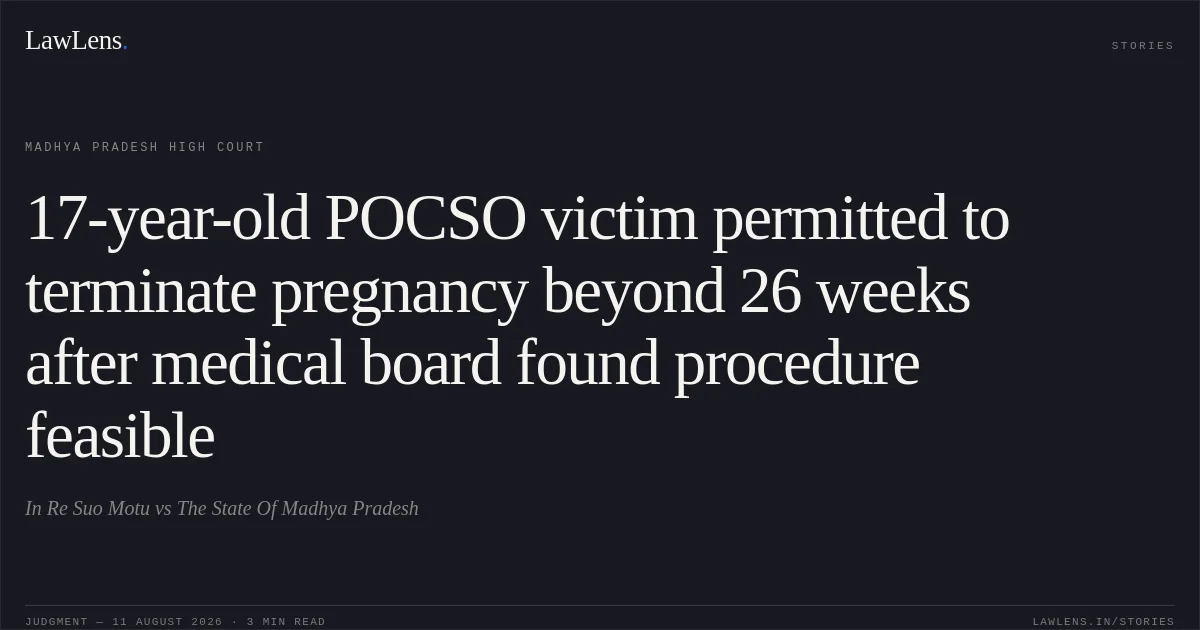
A report from the Special Judge, POCSO Court, Sardarpur, District Dhar, indicated that the victim was a minor, aged approximately 16 years and 3 months.
Source reference: p.1Following a missing-person report, Crime/complaint No. 0009/2026 was registered at Police Station Sardarpur on 27 January 2026.
Source reference: p.1The victim was medically examined at MGM Medical College and MY Hospital, Indore, by a Medical Board, which assessed her age at approximately 17 years and found that the fetus was more than 26 weeks old.
Source reference: p.1The victim’s haemoglobin level was 9.7%, and the Medical Board opined that termination of pregnancy could be undertaken after correction of anaemia and completion of the necessary medical procedure.
Source reference: p.1The matter was registered as a suo motu writ petition pursuant to the procedure prescribed by the High Court for cases involving pregnancies exceeding 24 weeks in survivors of sexual assault or rape.
Source reference: pp.1–3Issues
Whether the High Court should permit termination of the minor victim’s pregnancy, which had progressed beyond 26 weeks, on the basis of the Medical Board’s opinion and the victim’s status as a survivor of sexual assault.
Source reference: pp.1, 5Whether the termination should be subject to safeguards concerning the victim’s physical and mental fitness, preservation of fetal DNA and forensic evidence, and post-operative medical care.
Source reference: pp.2–3, 5–6Law Applied
The Court applied Section 3(2) of the Medical Termination of Pregnancy Act, 1971, governing termination of pregnancies by registered medical practitioners, and Rule 3B of the Medical Termination of Pregnancy Rules, 2003, which recognises survivors of sexual assault or rape and minors as eligible categories for termination up to 24 weeks.
Source reference: p.4It relied on the Division Bench’s directions in In Re (Suo Motu) v. State of Madhya Pradesh, W.P. No. 5184 of 2025, dated 20 February 2025, prescribing a procedure for pregnancies exceeding 24 weeks: referral to the Special Judge, examination by a Medical Board, reference to the High Court, termination by an expert medical team if directed, appropriate medical and post-operative care, and preservation of fetal material for DNA analysis.
Source reference: pp.2–3The Court also relied on X v. Principal Secretary, Health and Family Welfare Department, (2023) 9 SCC 433, which recognised reproductive autonomy, the right to access safe and legal abortion, and the woman’s ultimate decision-making authority over termination where her physical or mental health is at stake.
Source reference: pp.4–5Privacy was required to be maintained under Section 5A of the Medical Termination of Pregnancy Act, 1971.
Source reference: p.3Reasoning
The Court treated the Medical Board’s opinion as establishing that termination was medically possible despite the pregnancy exceeding 26 weeks.
Source reference: pp.1, 4–5The victim’s minority and her status as a survivor of sexual assault were material circumstances supporting the exercise of the Court’s constitutional and statutory jurisdiction.
Source reference: pp.1, 4–5Although her haemoglobin was low, the Board had specifically stated that termination could be performed after correction of anaemia; accordingly, the Court directed fresh verification of her physical and mental fitness before the procedure.
Source reference: p.1, p.5Applying the prescribed SOPs, the Court required the procedure to be performed by the concerned expert doctors with appropriate safeguards, including preservation of fetal DNA and other forensic material for use in the pending criminal investigation, while ensuring the victim’s privacy and post-operative care.
Source reference: pp.2–3, 5–6Holding
The Court granted permission for termination of the victim’s pregnancy and directed the concerned doctors to undertake the procedure after fresh verification of her physical and mental fitness.
The procedure was to be carried out expeditiously, preferably within one or two days, in accordance with the SOPs laid down in W.P. No. 5184 of 2025.
Source reference: pp.5–6The medical team was directed to preserve DNA samples from the fetus and comply with all requirements necessary for the criminal investigation, including the protection of forensic evidence and the victim’s privacy.
Source reference: pp.5–6The suo motu writ petition was accordingly disposed of.
Source reference: p.6Acts & Sections Cited
2 provisions across 1 statute referred to in this judgment. Each provision opens on LawLens.
Original Court PDF
In Re Suo MotuvsThe State Of Madhya Pradesh
Click to open original judgment
Original judgment, available to read, download and summarize on LawLens.in