Facts
The batch comprised six applications seeking regular bail on the ground that the applicants had been detained before their formal arrests and produced before the Magistrate beyond twenty-four hours from the commencement of their actual detention, allegedly violating Article 22(2) of the Constitution and Section 58 of the Bharatiya Nagarik Suraksha Sanhita, 2023 (“BNSS”).
Source reference: para. 1–2Five applicants faced prosecution under the NDPS Act, involving alleged possession, transportation, procurement or conspiracy relating to commercial quantities of narcotic or psychotropic substances; the sixth applicant, in B.A. No. 1161/2026, faced serious IPC charges including rape and murder.
Source reference: para. 2; para. 10On the facts, the Court found that the pre-arrest custody in B.A. Nos. 693/2026, 1422/2026, 2852/2026, 1161/2026 and 14864/2025 was authorised by statutory procedures, whereas the detention in B.A. No. 2601/2026 was unauthorised and preceded the formal arrest by more than twenty-four hours.
Source reference: paras. 27(i)–(vii)Issues
Whether the twenty-four-hour period for production before a Magistrate under Article 22(2) of the Constitution and Section 58 of the BNSS begins from the time of formal arrest or from the time of prior effective detention or curtailment of liberty.
Source reference: paras. 7–9, 15–16, 26Whether pre-arrest detention for search, seizure, enquiry, examination or investigation is legally permissible where authorised by specific statutory provisions, and whether such detention attracts the Article 22(2) time limit.
Source reference: paras. 17–25Whether the detention and production of each applicant complied with Article 22(2), Sections 58 and 187 of the BNSS, and the applicable provisions of the NDPS Act.
Source reference: paras. 27(i)–(vii)Whether the applicants accused of offences involving commercial quantities of narcotic substances satisfied the requirements for bail under Section 37 of the NDPS Act.
Source reference: para. 27(vi)Law Applied
Article 21 protects personal liberty against arbitrary deprivation, while Article 22(2) requires an arrested person to be produced before the nearest Magistrate within twenty-four hours, excluding only the time necessary for journey; Section 58 of the BNSS gives statutory effect to this safeguard and Section 187 governs continued detention when investigation cannot be completed within that period.
Source reference: paras. 7, 11–14The Court relied on Khatri v. State of Bihar, (1981) 1 SCC 627, D.K. Basu v. State of West Bengal, (1997) 1 SCC 416, CBI v. Anupam J. Kulkarni, (1992) 3 SCC 141, Arnesh Kumar v. State of Bihar, (2014) 8 SCC 273, and Directorate of Enforcement v. Subhash Sharma, 2025 KLT OnLine 1436 (SC), for the strict and constitutional character of the twenty-four-hour production requirement.
Source reference: para. 8The Court distinguished arrest from custody, holding that custody does not invariably amount to arrest.
Source reference: paras. 15–16Pre-arrest restraint may be lawful where expressly authorised by provisions such as Sections 179(1) and 35(3) of the BNSS, Sections 42, 43, 50 and 67 of the NDPS Act, Rule 3 of the NDPS Disposal Rules, Section 50 of the PMLA, and Sections 107 and 108 of the Customs Act; in such cases, the twenty-four-hour period begins upon formal arrest.
Source reference: paras. 18–26The Court also relied on Najmunisha v. State of Gujarat, 2024 SCC OnLine SC 520, to hold that temporary restraint incidental to a statutorily regulated search and seizure does not, by itself, violate fundamental rights.
Source reference: para. 20(a)For the NDPS matters involving commercial quantities, Section 37 of the NDPS Act required reasonable grounds to believe that the accused was not guilty and was unlikely to commit an offence while on bail.
Source reference: para. 27(vi)Reasoning
The Court adopted a qualified approach to the Biswajit Mandal principle. It held that where detention before formal arrest is unauthorised and effectively curtails liberty, the twenty-four-hour period must be calculated from the actual detention; however, custody incidental to a search, seizure, statutory enquiry or examination under an express statutory provision does not attract Article 22(2) until formal arrest.
Source reference: para. 26Applying this distinction, the Court treated the detention in B.A. Nos. 693/2026, 1422/2026 and 2852/2026 as authorised under Sections 42, 43 and 50 of the NDPS Act, and the detention in B.A. No. 14864/2025 as authorised under Sections 42 and 67 of that Act; production in each case was therefore within twenty-four hours of formal arrest.
Source reference: paras. 27(i)–(iii), (v)The custody in B.A. No. 1161/2026 was pursuant to a notice under Section 160(1) Cr.P.C. while the applicant was only a suspect, and the subsequent arrest and production were also held procedurally compliant.
Source reference: para. 27(iv)In contrast, the remand report in B.A. No. 2601/2026 failed to specify the time of detention, while supporting material established that the applicant had been detained at approximately 10:30 p.m. on 23 March 2026 and formally arrested only at 4:00 p.m. on 24 March 2026.
Source reference: para. 27(vii)Since that detention was not supported by any statutory procedure and production occurred twenty-four hours after actual detention, the Court found a violation of Article 22(2) and Sections 58 and 187(1) of the BNSS.
Source reference: para. 27(vii)The remaining NDPS applicants also failed to satisfy the stringent twin conditions under Section 37 because the materials disclosed serious, prima facie allegations and no reasonable grounds to conclude that they were not guilty.
Source reference: para. 27(vi)Holding
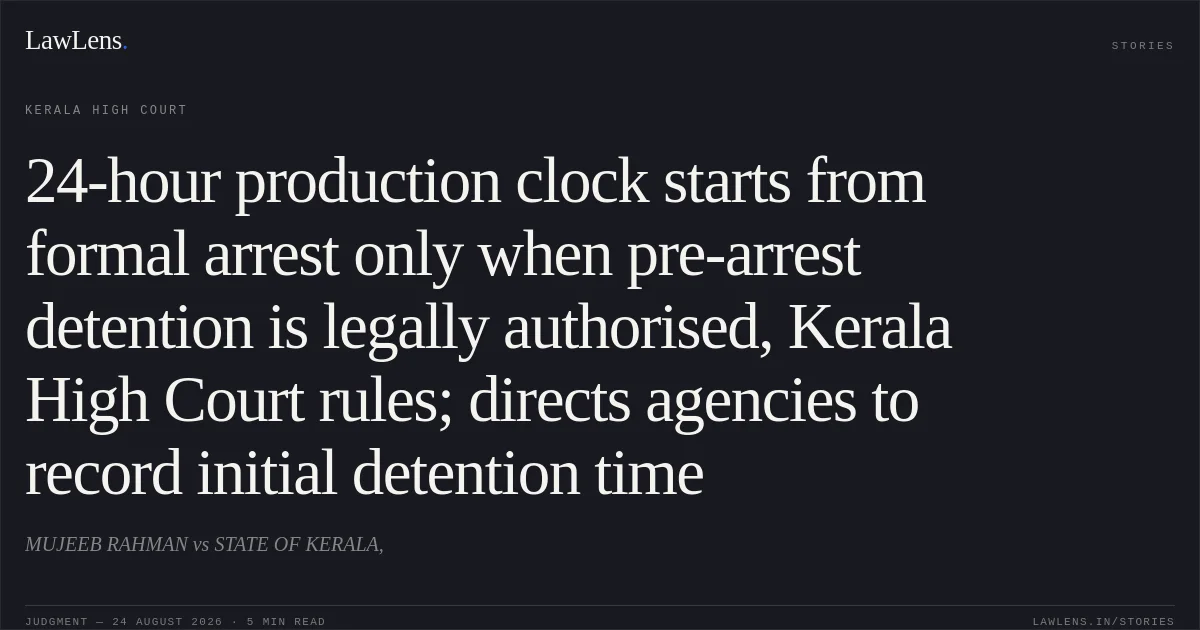
The Court held that the twenty-four-hour production requirement ordinarily runs from formal arrest, but where a person is effectively detained before arrest without statutory authority, the period runs from the time of such unauthorised detention.
B.A. No. 2601/2026 was allowed because the applicant’s unauthorised pre-arrest detention violated Article 22(2) and Sections 58 and 187 of the BNSS; he was directed to be released on bail on executing a bond of ₹1,00,000 with two solvent sureties for the like amount, subject to cooperation with investigation, weekly reporting, non-interference with witnesses, restrictions on leaving Kerala and other specified conditions.
Source reference: paras. 27(vii), 29B.A. Nos. 14864/2025, 693/2026, 1161/2026, 1422/2026 and 2852/2026 were dismissed, both for want of an Article 22(2) violation and, in the NDPS cases involving commercial quantities, for failure to satisfy Section 37 of the NDPS Act.
Source reference: para. 29The Court also issued guidelines requiring documentation of initial detention and formal arrest, communication of arrest grounds, timely production and transmission of records, judicial scrutiny of remand, and compliance with constitutional and statutory safeguards.
Source reference: para. 28Acts & Sections Cited
38 provisions across 6 statutes referred to in this judgment. Each provision opens on LawLens.
Bharatiya Nagarik Suraksha Sanhita, 20237
Code of Criminal Procedure, 19736
Indian Penal Code, 18608
Narcotic Drugs and Psychotropic Substances Act, 1985
Customs Act,19623
Prevention of Money-Laundering Act, 20022
Original Court PDF
MUJEEB RAHMANvsSTATE OF KERALA,
Click to open original judgment
Original judgment, available to read, download and summarize on LawLens.in