Facts
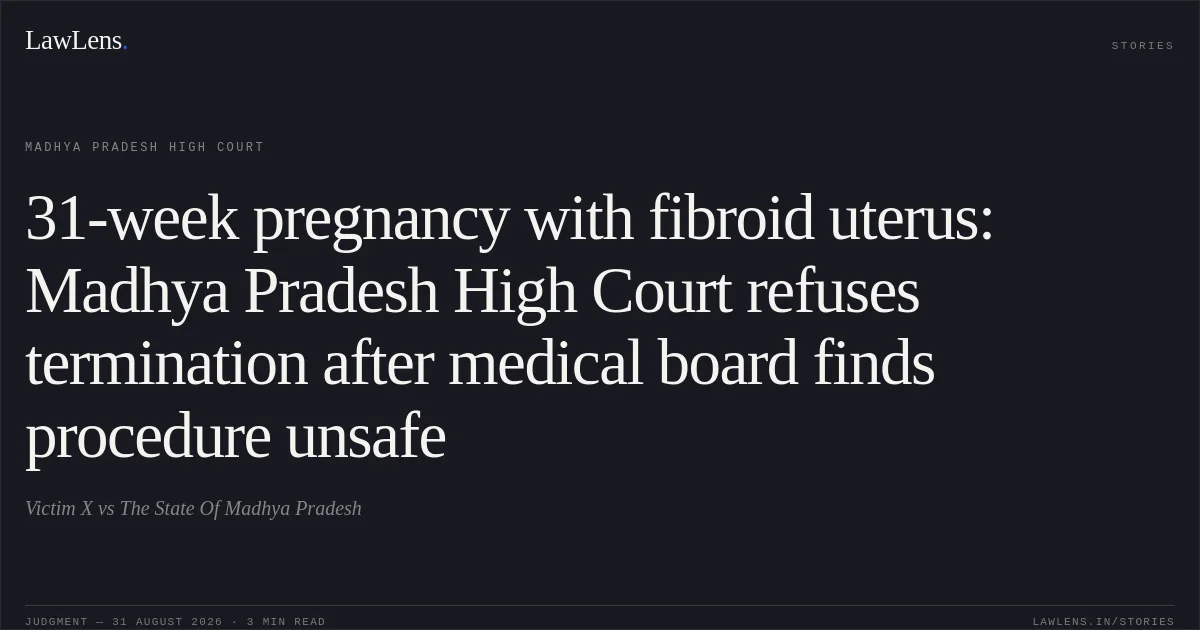
The petitioner, a rape survivor, approached the Madhya Pradesh High Court under Article 226 seeking constitution of a Medical Board to assess the safety and feasibility of terminating her pregnancy, consequential termination if medically permissible, preservation of legally permissible medical/biological material, and medical and psychological assistance.
Source reference: p.1Pursuant to the Court’s order dated 24 August 2026, a Medical Board at Maharaja Tukojirao Hospital, M.Y. Hospital and MGM Medical College, Indore, examined her on 25 August 2026. The Board reported that the pregnancy was 31 weeks and 1 day advanced, the fetus weighed approximately 1.7 kg and was healthy, and the petitioner was anaemic and not medically fit at that stage; termination was not recommended.
Source reference: p.1The Court further noted that the fetus was situated against an anterior-wall fibroid in a fibroid uterus and that termination at such an advanced stage could cause serious complications, including fatality.
Source reference: p.2Issues
Whether the Court could direct termination of the petitioner’s pregnancy at approximately 31 weeks when the Medical Board opined that termination was medically unsafe and not feasible.
Source reference: pp.1–2Whether the petitioner’s reproductive autonomy, the anguish arising from a rape-induced pregnancy, and her welfare justified termination notwithstanding the statutory restrictions and the medical risks to her life.
Source reference: pp.2–4Law Applied
The Court applied the Medical Termination of Pregnancy Act, 1971, particularly Sections 3(2-B) and 5(1), under which termination beyond the ordinary statutory limit may be considered where substantial foetal abnormalities exist or termination is immediately necessary to save the pregnant woman’s life.
Source reference: p.3Explanation 2 to Section 3 recognises the anguish caused by a rape-induced pregnancy as presumed grave injury to the mental health of the pregnant woman, but the Court held that the statutory relaxation does not generally permit termination beyond 24 weeks unless the statutory exceptional conditions are satisfied.
Source reference: p.3Relying on A (Mother of X) v. State of Maharashtra , (2024) 6 SCC 327, the Court recognised reproductive autonomy under Article 21 and stated that a Medical Board must assess the woman’s physical and emotional well-being; however, safety and welfare remain paramount.
Source reference: p.3The Court also relied on ABC Through Maheshbhai Kanjibhai Parmar v. State of Gujarat , R/Special Criminal Application (Direction) No. 11324 of 2026, decided on 7 August 2026, and A. v. State of M.P. & Ors. , reported in I.L.R. 2025 M.P. 1717, for the principle that termination should not be directed where it endangers the survivor’s life.
Source reference: pp.2–4It further referred to the protection of the unborn child under Article 21 and Article 39(f) of the Constitution.
Source reference: p.4Reasoning
The Medical Board found no foetal abnormality warranting termination and specifically concluded that the pregnancy could not safely be terminated because it was at an advanced stage, involved a viable and healthy fetus, and was complicated by the petitioner’s anaemia and fibroid uterus.
Source reference: p.1Applying Sections 3(2-B) and 5(1) of the 1971 Act, the Court held that neither substantial foetal abnormality nor an immediate necessity to save the petitioner’s life was established.
Source reference: p.2Although the Court acknowledged the petitioner’s reproductive autonomy and the presumed mental-health injury arising from rape, those considerations had to be balanced against the medical evidence and the risk that termination could result in severe complications or death.
Source reference: pp.2–4Since the expert opinion did not support termination and instead indicated that the procedure was medically dangerous, the Court concluded that welfare and constitutional autonomy could not justify an order contrary to medical safety.
Source reference: p.5Holding
The Court answered the issues against the petitioner and dismissed the writ petition.
It refused to direct termination of the pregnancy because the pregnancy was approximately 31 weeks advanced and the Medical Board considered termination medically unsafe and potentially fatal.
Source reference: p.5No order permitting or directing termination was granted.
Source reference: p.5Acts & Sections Cited
4 provisions across 3 statutes referred to in this judgment. Each provision opens on LawLens.
Indian Penal Code, 18601
Bharatiya Nagarik Suraksha Sanhita, 20231
Original Court PDF
Victim XvsThe State Of Madhya Pradesh
Click to open original judgment
Original judgment, available to read, download and summarize on LawLens.in