Facts
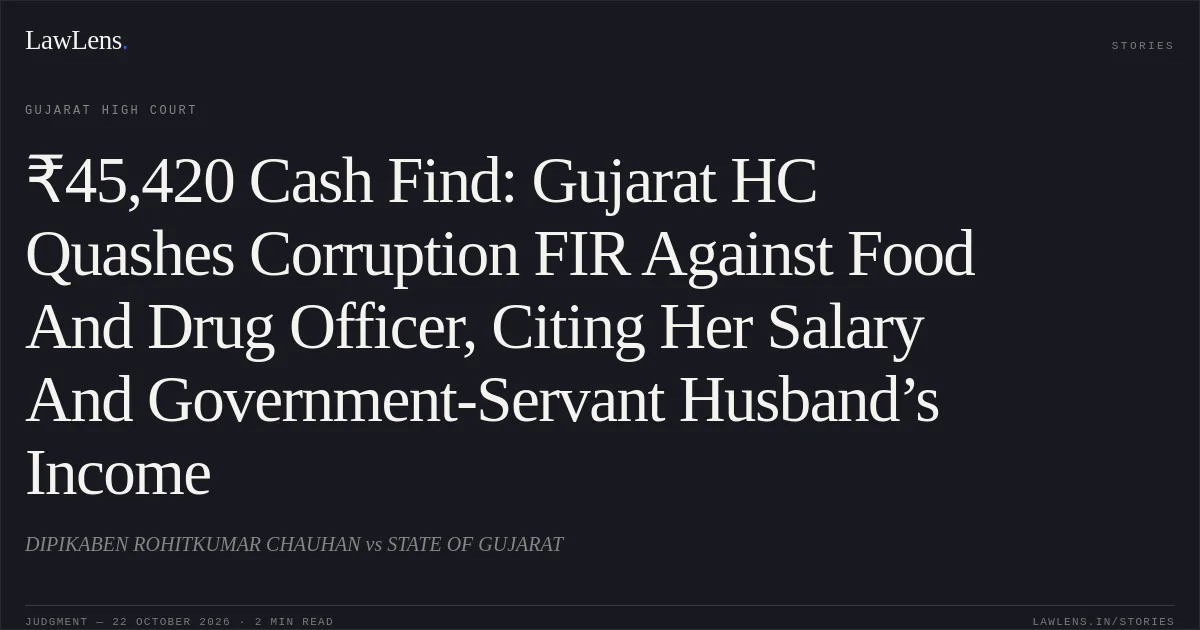
The applicant, a public servant, was searched by an ACB raiding party on 14 October 2014 while in a car with her husband. The search recovered ₹45,420 from her handbag and ₹30,128 from her husband.
Source reference: p. 1–3The applicant was unable to explain the cash to the complainant’s satisfaction, and an FIR was registered under Sections 12, 13(1)(e) and 13(2) of the Prevention of Corruption Act, 1988; Section 13(1)(d) was later added and Section 12 deleted.
Source reference: p. 1–3The applicant sought to quash the FIR and consequential proceedings under Section 482 of the Code of Criminal Procedure, 1973. She contended that the cash was not tainted and was not disproportionate to her known income; the State opposed the application on the ground that she had not satisfactorily explained its source.
Source reference: p. 3–6The charge-sheet and two later ACB communications closing disproportionate-assets applications were before the Court.
Source reference: p. 4, 6, 8Issues
1. Whether the FIR and charge-sheet disclosed the ingredients of criminal misconduct under Section 13(1)(d) of the Prevention of Corruption Act, 1988.
Source reference: p. 6–72. Whether possession of ₹45,420, coupled with the applicant’s initial inability to explain it, disclosed an offence under Section 13(1)(e) of the Act.
Source reference: p. 7–93. Whether the FIR and consequential proceedings should be quashed qua the applicant under Section 482 CrPC.
Source reference: p. 1, 9–10Law Applied
Section 482 CrPC empowers the High Court to quash criminal proceedings in an appropriate case.
Source reference: no citationFor Section 13(1)(d) of the Prevention of Corruption Act, the prosecution must disclose how the public servant obtained a valuable thing or pecuniary advantage through corrupt or illegal means, by abuse of position, or without public interest.
Source reference: p. 7For Section 13(1)(e), as set out by the Court, the prosecution must establish that the accused is a public servant, identify the pecuniary resources or property in the accused’s possession, establish the accused’s known sources of income, and show that the resources or property are disproportionate to those sources; the accused’s ability to account for the resources is also relevant.
Source reference: p. 7–8No precedent was cited.
Source reference: no citationReasoning
The Court found no evidence in the FIR or charge-sheet explaining how the applicant had obtained the cash through corrupt or illegal means, by abusing her position, or otherwise within Section 13(1)(d); the recovery was not the result of a trap and the money was not alleged to be tainted.
Source reference: p. 7As to Section 13(1)(e), the prosecution had not shown that ₹45,420 was disproportionate to the applicant’s known income. The Court noted her salary, her husband’s salary and statements recorded during the investigation that supported her explanation for possessing the cash.
Source reference: p. 7–9It held that the applicant’s inability to explain the money immediately upon questioning, without evidence establishing disproportionality, was insufficient to make out the offence.
Source reference: p. 8–9Holding
The Court held that the materials did not disclose offences under Sections 13(1)(d) or 13(1)(e) of the Prevention of Corruption Act against the applicant.
It allowed the application and quashed the FIR, C.R. No. 8 of 2014, registered with the Gandhinagar ACB Police Station, together with the consequential proceedings, qua the applicant; the Rule was made absolute to that extent.
Source reference: p. 9–10Acts & Sections Cited
3 provisions across 2 statutes referred to in this judgment. Each provision opens on LawLens.
Code of Criminal Procedure, 19731
Prevention of Corruption Act, 19882
Original Court PDF
DIPIKABEN ROHITKUMAR CHAUHANvsSTATE OF GUJARAT
Click to open original judgment
Original judgment, available to read, download and summarize on LawLens.in