Facts
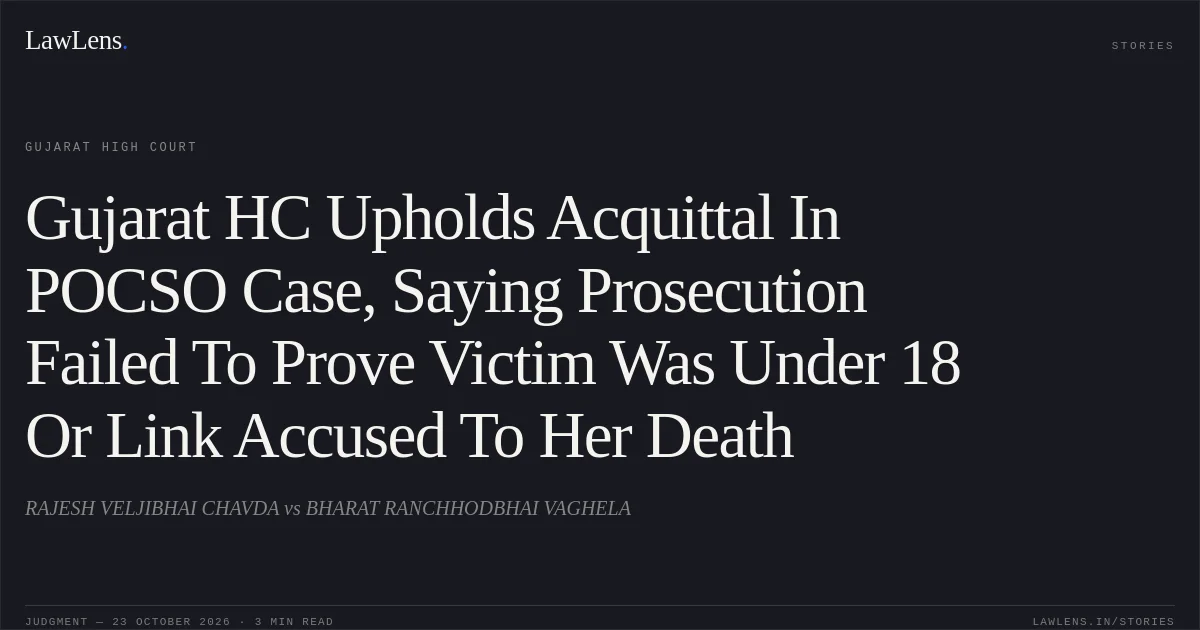
The prosecution alleged that the accused abducted the victim, then aged about 16 years and five months, from her parents’ custody on 8 May 2024, raped and harassed her, and thereby contributed to her suicide.
Source reference: pp. 1–3, paras. 1–3.4The victim’s body was found in a field; the post-mortem attributed her death to poisoning.
Source reference: pp. 1–3, paras. 1–3.4The Special Judge acquitted the accused of offences under IPC Sections 363, 366, 376(2)(n) and 306, and POCSO Act Sections 4, 6 and 12. The appellant challenged the acquittal under Section 419 of the BNSS.
Source reference: pp. 1–3, paras. 1–3.4The High Court considered the appeal at the admission stage.
Source reference: p. 5, para. 5Issues
1. Whether the prosecution proved beyond reasonable doubt that the victim was a minor on the date of the incident, so as to attract the POCSO Act and its statutory presumptions.
Source reference: pp. 5–8, paras. 6, 8, 102. Whether the evidence established the alleged kidnapping, rape and abetment of suicide, and whether the acquittal warranted appellate interference.
Source reference: pp. 6–9, paras. 7, 11–12Law Applied
Under POCSO Act Sections 29 and 30, the statutory presumptions apply only where the necessary foundational facts are established; the Court held that the victim’s minority had not been proved and therefore the presumptions could not be invoked.
Source reference: p. 7, para. 8The Court also held that Evidence Act Section 114A could not support a presumption of rape in the absence of evidence establishing the foundation for the charge.
Source reference: p. 7, para. 8Relying on Birka Shiva v. State of Telangana, 2025 INSC 863, and the authorities discussed there, the Court stated that a birth or school-record entry’s admissibility does not itself prove its contents: its authenticity and the source of the underlying information must be established through evidence.
Source reference: pp. 7–8, paras. 9–10On an appeal against acquittal, interference is justified in exceptional cases involving compelling circumstances or a perverse judgment; where another reasonable view is possible, the appellate court should respect the acquittal and the strengthened presumption of innocence, as stated with reference to Tulasareddi @ Mudakappa & Anr. v. State of Karnataka & Ors., 2026 INSC 67.
Source reference: p. 9, para. 11Reasoning
The victim’s brother could not recall her date of birth, the birth certificate was neither exhibited nor brought on record, and the investigating officer’s evidence only showed that he had sought verification; no witness was examined to prove her age. The Court therefore upheld the finding that minority was not established, precluding the POCSO presumptions.
Source reference: pp. 5–8, paras. 6, 8, 10On the remaining charges, the brother was in Surat at the relevant time, had not seen the victim with the accused, and could not say how or with whom she had left. The persons said to have informed him about the accused’s custody of the victim and the discovery of her body, as well as the grandmother, were not examined. Although the post-mortem recorded death by poisoning, the evidence did not establish rape, persistent harassment, or that the accused caused the victim to commit suicide.
Source reference: p. 6, para. 7Given these evidentiary deficiencies and the standard governing appeals against acquittal, the Court found no perversity or basis to interfere.
Source reference: p. 9, paras. 11–12Holding
The Court answered the issues against the appellant, holding that the prosecution had failed to prove the victim’s minority or the charges beyond reasonable doubt, and that the acquittal was not perverse.
It dismissed the appeal and confirmed the acquittal entered on 25 March 2026 in Special POCSO Case No. 44 of 2024.
Source reference: pp. 9–10, paras. 12–15Acts & Sections Cited
11 provisions across 4 statutes referred to in this judgment. Each provision opens on LawLens.
Indian Penal Code, 18604
Protection of Children from Sexual Offences Act, 20125
Bharatiya Nagarik Suraksha Sanhita, 20231
Code of Criminal Procedure, 19731
Original Court PDF
RAJESH VELJIBHAI CHAVDAvsBHARAT RANCHHODBHAI VAGHELA
Click to open original judgment
Original judgment, available to read, download and summarize on LawLens.in