Facts
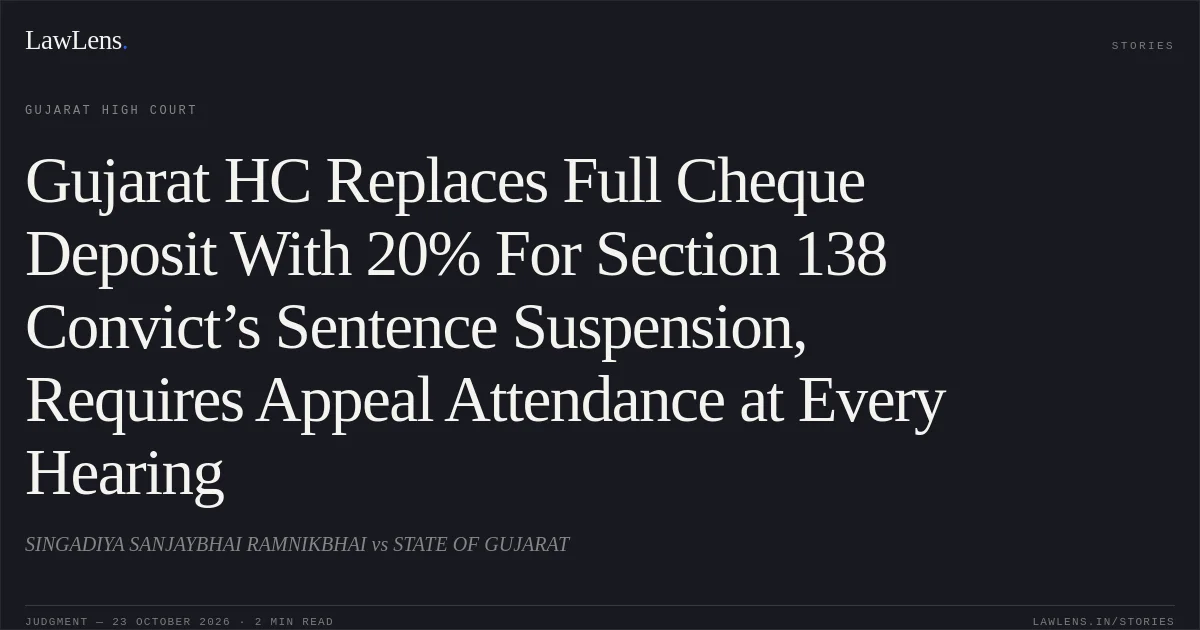
The petitioner was convicted under Section 138 of the Negotiable Instruments Act, sentenced to one year’s simple imprisonment, and directed to pay compensation equivalent to the cheque amount.
Source reference: pp. 3–6After filing an appeal, he challenged the Sessions Court’s condition that he deposit the entire cheque amount within 60 days to obtain suspension of sentence.
Source reference: pp. 3–6The three connected matters concerned separate cheques and similar orders.
Source reference: pp. 3–6The respondent relied on the petitioner’s absences before the Magistrate and Appellate Court, and on his advocate’s retirement pursis, to support the condition.
Source reference: pp. 3–6Issues
Whether the Appellate Court’s requirement that the petitioner deposit 100% of the cheque amount as a condition for suspension of sentence was justified, absent special or cogent reasons.
Source reference: pp. 3–6Whether the petitioner’s non-attendance could be addressed by conditions securing his presence rather than by requiring deposit of the entire cheque amount.
Source reference: pp. 4–7Law Applied
Section 138 of the Negotiable Instruments Act concerns the offence of dishonour of a cheque; Section 148 provides for a deposit in an appeal by a convicted person, and the Court referred to its contemplated requirement when considering an appropriate percentage of the cheque amount.
Source reference: pp. 4–6Conditions imposed for suspension of sentence should not be onerous or incapable of compliance if imposed mechanically; the court must consider the circumstances of the case, including the petitioner’s financial condition and the fact that the conviction is under appeal.
Source reference: p. 5The Appellate Court may address concerns about an appellant’s attendance by imposing conditions securing the appellant’s presence.
Source reference: p. 6Reasoning
The Court found that the Appellate Court had not given special or cogent reasons for requiring deposit of the full cheque amount.
Source reference: p. 5It held that such a condition should not be imposed mechanically and that the Appellate Court should consider the relevant circumstances, including the petitioner’s financial condition and pending appeal.
Source reference: p. 5Although the respondent raised concerns about the petitioner’s attendance, the Court considered those concerns capable of being addressed by attendance undertakings.
Source reference: pp. 6–7It therefore replaced the full-deposit condition with a 20% deposit and conditions requiring the petitioner’s attendance.
Source reference: pp. 6–7Holding
The Court allowed the applications and quashed the impugned orders dated 9 January 2026 in Criminal Appeal Nos. 10, 12 and 11 of 2026.
The petitioner was directed to deposit 20% of the cheque amount within four weeks, file an undertaking within one week to comply with the conditions, and undertake to attend every hearing before the Appellate Court, whether or not his advocate is present.
Source reference: pp. 6–7Acts & Sections Cited
2 provisions across 1 statute referred to in this judgment. Each provision opens on LawLens.
Negotiable Instruments Act, 18812
Original Court PDF
SINGADIYA SANJAYBHAI RAMNIKBHAIvsSTATE OF GUJARAT
Click to open original judgment
Original judgment, available to read, download and summarize on LawLens.in