Facts
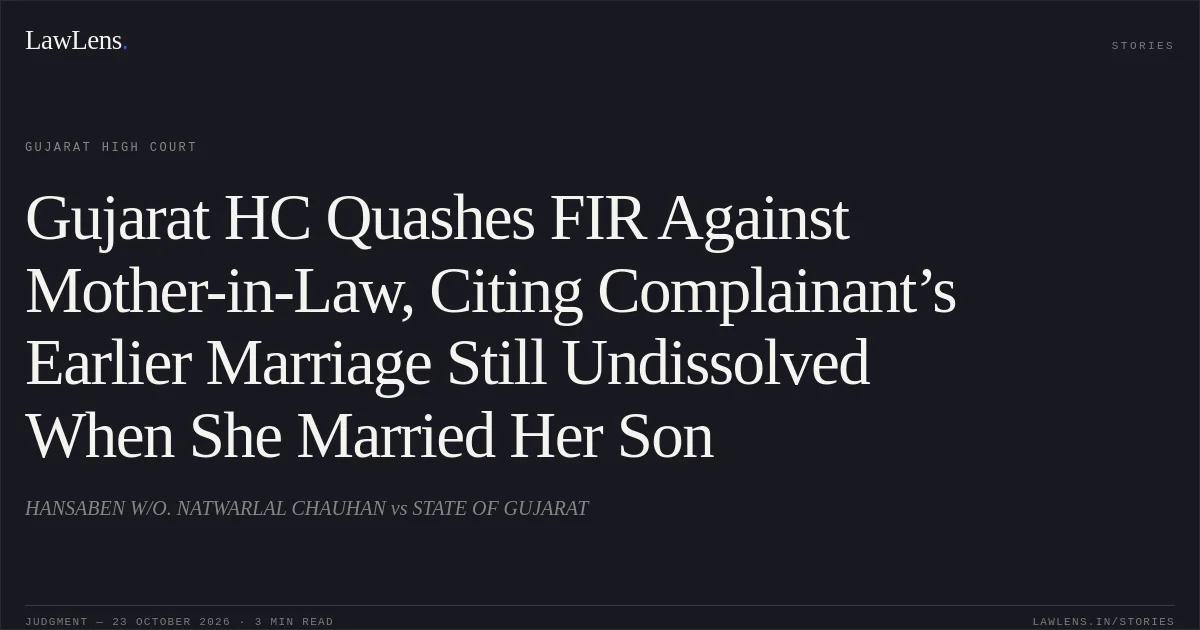
The applicant, the complainant’s mother-in-law, sought quashing under Section 482 of the Code of Criminal Procedure, 1973, of an FIR registered against her and others under Sections 498A, 323, 494, 406 and 114 IPC
Source reference: para. 1, 5.2The complainant married the applicant’s son in February 2007 and later lived with him in London.
Source reference: para. 2–2.2The complainant had previously married another person; she obtained a divorce decree on 20 November 2007, after her marriage to the applicant’s son.
Source reference: para. 2–2.2The FIR alleged, among other things, that the applicant had abetted her son’s mistreatment of the complainant and had not disclosed his subsequent marriage.
Source reference: para. 2–2.2, 5.5Issues
1. Whether the FIR’s allegations, taken at face value, disclosed a prima facie case against the applicant for the offences alleged, including abetment under Section 114 IPC.
Source reference: para. 5.2, 6.1–6.42. Whether the High Court should exercise its inherent jurisdiction under Section 482 CrPC to quash the FIR and consequential proceedings against the applicant.
Source reference: para. 5.1–5.2, 7Law Applied
Section 482 CrPC preserves the High Court’s inherent power to prevent abuse of process and secure the ends of justice.
Source reference: para. 5.1Under State of Haryana v. Bhajan Lal, quashing may be appropriate where allegations do not disclose an offence, are inherently improbable, or proceedings are manifestly mala fide.
Source reference: para. 5.1The Court also relied on Preeti Gupta v. State of Jharkhand and Kahkashan Kausar v. State of Bihar for the need to scrutinise matrimonial-cruelty allegations carefully, particularly general allegations against relatives; K. Subba Rao v. State of Telangana cautions against proceeding against relatives without specific instances of involvement.
Source reference: para. 5.3–5.4The Court applied Section 498A IPC to conduct constituting cruelty as defined in that section, Section 494 IPC to a subsequent marriage during the subsistence of a valid marriage, and Sections 405–406 IPC to criminal breach of trust, requiring entrustment and dishonest misappropriation or conversion.
Source reference: para. 5.3, 6–6.3It relied on P. Sivakumar v. State and Shivcharan Lal Verma v. State of M.P. in concluding that the marriage at issue, entered into while the complainant’s earlier marriage subsisted, was void and that Section 498A was consequently not attracted on the facts as assessed by the Court.
Source reference: para. 5.6–5.7, 6Reasoning
The Court found that the complainant’s earlier marriage had been dissolved only after her marriage to the applicant’s son, and held that the latter marriage was therefore null and void; on that basis, it concluded that Section 498A was not attracted.
Source reference: para. 5.5, 6The alleged physical abuse in London in November 2014 was described as vague and general, without specific details of date, time or place, and no distinct role by the applicant was identified.
Source reference: para. 6.1The Court considered the Section 494 allegation immaterial to the applicant in light of its finding about the subsisting prior marriage, found no allegation of entrustment or misappropriation to support Section 406, and held that Section 114 could not apply where the substantive offences were not made out against her.
Source reference: para. 6.2–6.4It therefore considered the case to fall within categories (1), (3), (5) and (7) of Bhajan Lal.
Source reference: para. 7Holding
The Court allowed the application under Section 482 CrPC and quashed the FIR and all consequential proceedings for the offences under Sections 498A, 323, 494, 406 and 114 IPC qua the applicant.
The Rule was made absolute, and direct service was permitted.
Source reference: para. 8–8.1Acts & Sections Cited
11 provisions across 3 statutes referred to in this judgment. Each provision opens on LawLens.
Code of Criminal Procedure, 19733
Indian Penal Code, 18606
Original Court PDF
HANSABEN W/O. NATWARLAL CHAUHANvsSTATE OF GUJARAT
Click to open original judgment
Original judgment, available to read, download and summarize on LawLens.in