Facts
The complainant appealed against the acquittal of the accused of offences under Sections 363, 366 and 376 of the Indian Penal Code and Section 4 of the POCSO Act.
Source reference: paras. 2, 4; pp. 1–2The prosecution alleged that the accused took the victim from her home at night and sexually assaulted her. The trial court acquitted the accused, finding that the prosecution had not proved the victim’s age and that the evidence did not establish forcible taking or sexual intercourse. The complainant challenged that acquittal.
Source reference: paras. 8–11; pp. 3–4Issues
Whether the trial court was justified in acquitting the accused, including on the ground that the prosecution had not proved the victim was below 18 years of age.
Source reference: para. 12; pp. 4–5Whether the trial court’s assessment of the victim’s evidence concerning kidnapping and rape was perverse or otherwise warranted appellate interference.
Source reference: paras. 12, 19–20; pp. 4, 7–8Law Applied
Under Section 413 of the Bharatiya Nagarik Suraksha Sanhita, an appeal may be brought against an acquittal. An appellate court should exercise restraint in such an appeal: the acquittal reinforces the presumption of innocence, and interference is warranted where the judgment is perverse or compelling circumstances justify it; a reasonably possible view should not be displaced (Tulasareddi @ Mudakappa & Anr. v. State of Karnataka & Ors., 2026 INSC 67).
Source reference: para. 14; p. 5A public or official record may be admissible under Section 35 of the Indian Evidence Act, but admissibility does not by itself prove the truth of its contents; its probative value depends on proof of authenticity and the source of the information (Birka Shiva v. State of Telangana, 2025 INSC 863).
Source reference: paras. 16–17; pp. 6–7Reasoning
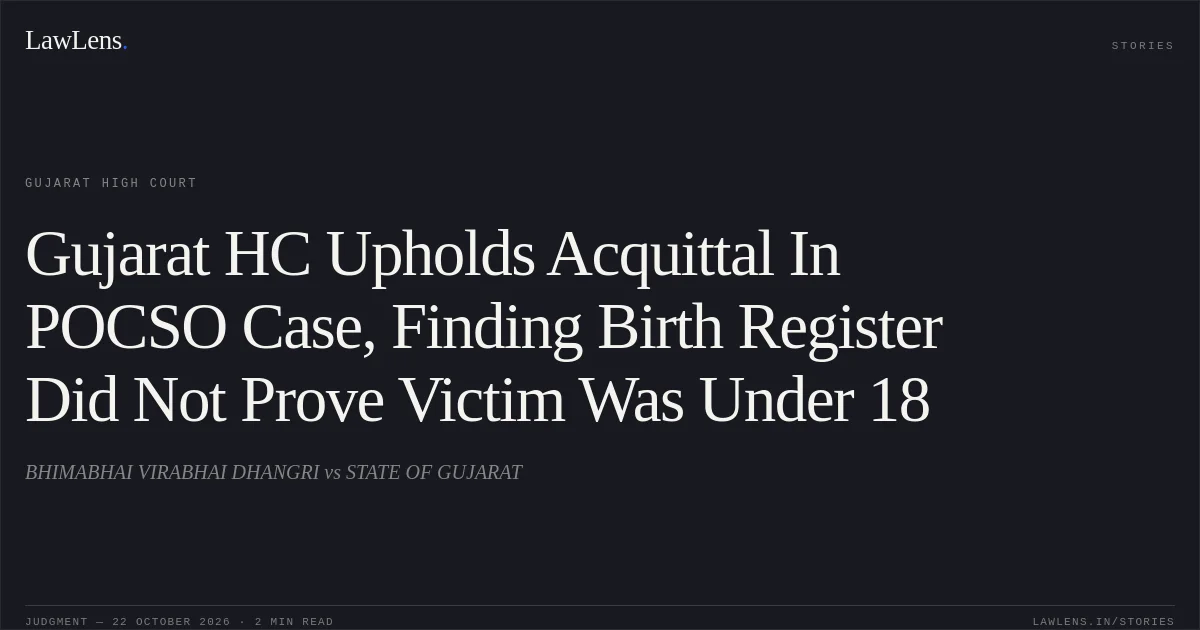
The Court held that the birth register and certificate did not establish the victim’s age because the Talati-cum-Mantri had no personal knowledge of the registration, and the prosecution had not proved who supplied the date of birth or its source. Applying the evidentiary principles in Birka Shiva, the Court found the age entry insufficient to prove minority.
Source reference: paras. 15, 18; pp. 5, 7It further considered the victim’s conduct as recounted in the judgment—including that she did not raise an alarm, seek assistance, or tell the rickshaw driver or other persons that she was being taken forcibly—and concluded that her account of forcible taking and rape did not inspire confidence. In the absence of proof of minority, the Court treated her as an adult and found the trial court’s conclusion of consensual conduct to be a possible view. It found no perversity in the acquittal warranting appellate intervention.
Source reference: para. 19; p. 7; para. 20; p. 8Holding
The High Court held that the prosecution had failed to prove the charges beyond reasonable doubt and that the trial court’s acquittal was based on a proper appreciation of the evidence and was not perverse.
The appeal was dismissed at the admission stage.
Source reference: paras. 20–21; p. 8Acts & Sections Cited
6 provisions across 4 statutes referred to in this judgment. Each provision opens on LawLens.
Bharatiya Nagarik Suraksha Sanhita, 20231
Indian Penal Code, 18603
Protection of Children from Sexual Offences Act, 20121
Code of Criminal Procedure, 19731
Original Court PDF
BHIMABHAI VIRABHAI DHANGRIvsSTATE OF GUJARAT
Click to open original judgment
Original judgment, available to read, download and summarize on LawLens.in