Facts
The writ petition, Writ-C No. 17384 of 2026, was disposed of on 5 May 2026 with directions to conduct fresh elections of the Committee of Management of Nehru Vidyapeeth Intermediate College, Reotipur, Ghazipur, substantially on the basis of the electoral college allegedly undisputed in the 2009 election.
Source reference: para. 1Shiv Shankar Singh, arrayed as respondent no. 6 in the writ petition, thereafter filed the present review application alleging that he had not authorised any advocate to appear for him and that the writ proceedings had been advanced on the basis of a forged or unauthorised vakalatnama.
Source reference: para. 2The Court noted that the applicant had earlier challenged the order dated 5 May 2026 by Special Appeal No. 691 of 2026, which was dismissed with liberty to adopt an appropriate remedy.
Source reference: para. 3On the Court’s direction, the disputed and admitted signatures were examined by the Forensic Science Laboratory. The parties did not object to the expert report.
Source reference: paras. 28–30Issues
Whether the review application disclosed sufficient grounds to review or recall the order dated 5 May 2026, particularly in view of the disputed vakalatnama and the fact that the 2009 election was not undisputed?
Source reference: paras. 16, 71–84Whether the filing of the vakalatnama and caveat application involved fraud upon the Court, unauthorised representation, or professional misconduct?
Source reference: paras. 16–17, 49–57Whether the conduct of the advocates and litigants, including the alleged concealment of material facts regarding the 2009 election, amounted to interference with the administration of justice?
Source reference: paras. 31–39, 66–77Whether procedural safeguards should be introduced for verification of vakalatnamas filed with caveat applications under Chapter XXII Rule 5 of the Allahabad High Court Rules, 1952?
Source reference: paras. 78–83Law Applied
Order III Rules 1, 2 and 4 of the Code of Civil Procedure, 1908 require an advocate to act on behalf of a party only pursuant to a genuine and valid appointment or vakalatnama.
Source reference: paras. 51–53The Court applied the review and inherent jurisdiction of the High Court to correct an order affected by material concealment or circumstances undermining the administration of justice.
Source reference: paras. 55, 84The Court referred to the Bharatiya Nyaya Sanhita, 2023 concerning false documents, forgery, cheating, false personation and false affidavits.
Source reference: paras. 48, 67–68The Court relied on Bhagwan Singh v. State of U.P., Kunj Bihari v. Jhinguri, Narain Pandey v. Pannalal Pandey, J.S. Jadhav v. Mustafa Haji Mohamed Yusuf, Saumya Chauras v. Enforcement Directorate, and other authorities for the propositions that filing a vakalatnama without authority, misleading the Court, or concealing material facts may constitute abuse of process and serious professional misconduct.
Source reference: paras. 58–65Reasoning
The Court found that the allegation that the entire writ order had been procured through a forged vakalatnama was not established in the manner asserted by the applicant.
Source reference: paras. 28–30, 49, 57, 84Although the FSL report indicated that the disputed signature did not match the comparison material, the admitted signatures of Shiv Shankar Singh also failed to match the sample signatures, making the report inconclusive as to forgery and weakening the applicant’s sworn assertion that he had never signed the vakalatnama.
Source reference: paras. 28–30, 49, 57, 84Independently, the Court held that the order dated 5 May 2026 had proceeded on the mistaken premise that the 2009 election was undisputed.
Source reference: paras. 11–15, 32–37, 71–74The record showed that the Joint Director of Education had found that election doubtful, that the then District Inspector of Schools had denied conducting it, and that directions for fresh elections had attained finality after dismissal of the earlier writ proceedings.
Source reference: paras. 11–15, 32–37, 71–74Consequently, S.C. Dwivedi and his client were held responsible for concealing material facts and misleading the Court, while R.C. Dwivedi’s conduct was treated as a failure to contest an incorrect factual premise rather than active concealment.
Source reference: paras. 33–35, 50, 72–74Holding
The review application was allowed to the extent that the order dated 5 May 2026 was reviewed and recalled, though for reasons distinct from the applicant’s unsubstantiated claim of deliberate forgery.
The matter was directed to be placed before the Court having jurisdiction for further adjudication.
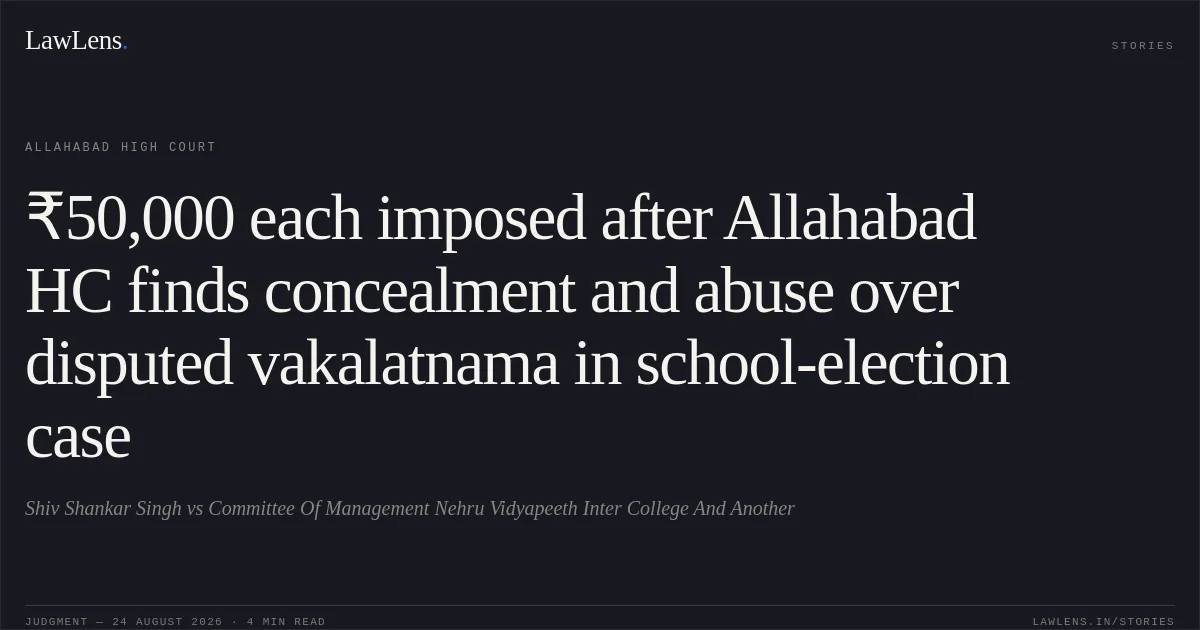
Source reference: para. 84The Court imposed costs of ₹50,000 each upon the petitioner, Awadhesh Rai, and respondent no. 6/applicant, Shiv Shankar Singh, for abusing the process of Court and misleading it; the amounts were to be deposited with the High Court Legal Services Committee within one month, failing which contempt proceedings were directed to be initiated.
Source reference: para. 77Finally, the Court directed that a copy of the order be placed before the Chief Justice for considering amendment of Chapter XXII Rule 5 of the Allahabad High Court Rules, 1952 to require an affidavit supporting a caveat application.
Source reference: paras. 78–83Acts & Sections Cited
14 provisions across 4 statutes referred to in this judgment. Each provision opens on LawLens.
Code of Civil Procedure, 19081
Advocates Act, 19613
Bharatiya Nyaya Sanhita, 20237
Bharatiya Sakshya Adhiniyam, 20233
Original Court PDF
Shiv Shankar SinghvsCommittee Of Management Nehru Vidyapeeth Inter College And Another
Click to open original judgment
Original judgment, available to read, download and summarize on LawLens.in