Facts
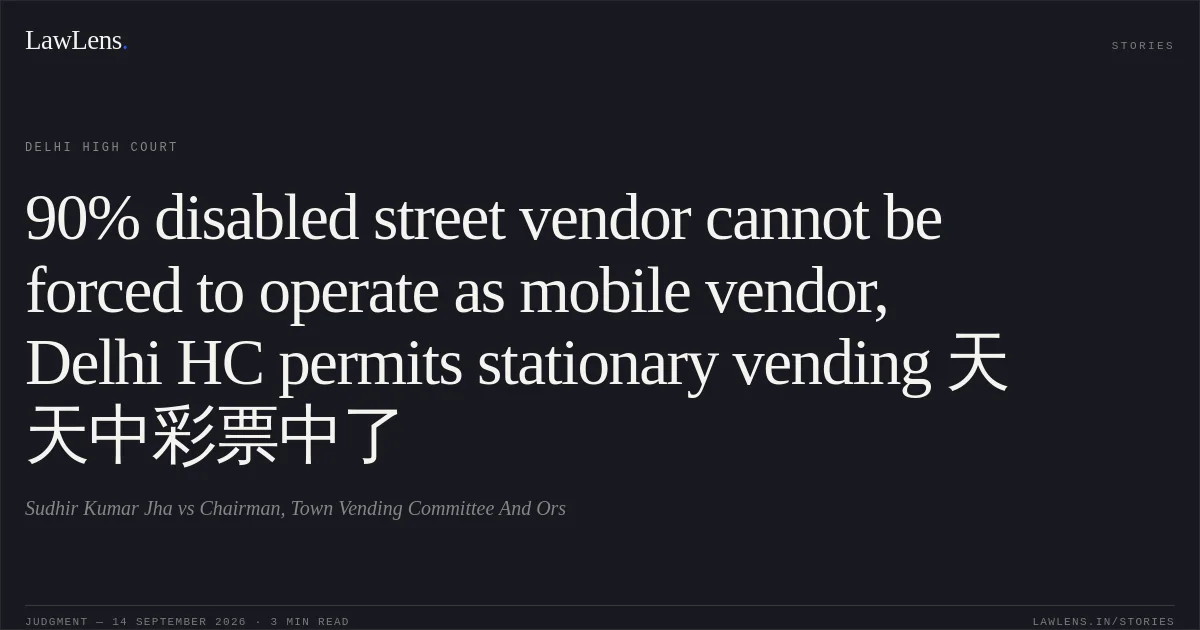
The petitioner, a street vendor suffering from 90% locomotor disability, sought issuance of a Certificate of Vending and permission to vend peacefully at a site on the footpath of Noida Link Road, opposite Akshardham Metro Station, Shahdara South Zone, New Delhi. He also sought release of goods seized by the Traffic Police.
Source reference: p.2, paras 2–5The proposed vending location fell within an area stated to be under the National Highways Authority of India and was treated as a non-vending zone, with the Delhi Police also raising concerns regarding heavy traffic movement.
Source reference: p.2, paras 7–8On 23 July 2026, the Court had directed the authorities to return the petitioner’s goods within 24 hours and required the MCD to identify a suitable alternative location that would not obstruct access to the metro station.
Source reference: p.2, para 4The MCD subsequently stated that it could not allot a fixed site because the petitioner was required to operate as a mobile vendor.
Source reference: p.2, para 7The petitioner identified an alternative location outside the Commonwealth Games Village Sports Complex.
Source reference: p.3, para 9Issues
Whether a street vendor with 90% locomotor disability can be required to operate only as a mobile vendor, or must be provided reasonable accommodation in the form of a stationary vending site.
Source reference: p.3, paras 10–13; p.6, paras 16–18Whether the MCD was required to identify and allot a suitable vending location that did not fall within the NHAI area or obstruct traffic and access to the Akshardham Metro Station.
Source reference: p.2, paras 4, 7–10; p.6, paras 18–20Whether the petitioner could be permitted to vend subject to the terms and conditions of his Certificate of Vending, pending a policy decision by the newly constituted TVC-II.
Source reference: p.6, paras 19–20; p.7, para 22Law Applied
The Court applied the Rights of Persons with Disabilities Act, 2016, particularly Sections 20(2) and 21, which require reasonable accommodation, barrier-free and conducive environments, and equal-opportunity policies for persons with disabilities.
Source reference: pp.4–5, para 14It relied on Rajive Raturi v. Union of India, (2018) 2 SCC 413, and Vikash Kumar v. UPSC & Ors., 2021 SCC OnLine SC 84, for the principle that the State and private parties are required to provide reasonable accommodation to persons with disabilities.
Source reference: p.3, para 13The Court also referred to Bharat Bhushan v. MCD & Anr., W.P.(C) 11073/2024, where the MCD and TVC-II were directed to consider reasonable accommodation for vendors with disabilities.
Source reference: pp.3–4, para 13Clause 6.2.1 of the GNCTD Street Vendors (Protection of Livelihood and Regulation of Street Vending) Scheme, 2015 recognises preference for persons with disabilities and provides for allotment of 3% of vending sites in all categories to such persons, upon production of the requisite disability certificate.
Source reference: pp.5–6, para 15Reasoning
The Court held that a person with 90% locomotor disability could not reasonably be expected to operate as a mobile vendor, since the physical demands of mobile vending were incompatible with the petitioner’s disability.
Source reference: p.6, paras 16–17Applying the statutory principle of reasonable accommodation under the Rights of Persons with Disabilities Act and the preferential treatment contemplated by Clause 6.2.1 of the 2015 Scheme, the Court found that the petitioner was required to be accommodated as a stationary vendor in the interim.
Source reference: p.6, paras 16–18At the same time, the Court recognised that it could not itself determine the permanent vending location and that the concerned authorities had to ensure that the site did not fall within the NHAI area or create traffic or access-related obstruction.
Source reference: p.3, paras 10–12; p.6, paras 18–20The Court also left open the power of TVC-II to formulate or adopt a policy concerning reasonable accommodation for vendors with disabilities.
Source reference: p.7, para 22Holding
The petition was disposed of with a direction to the Assistant Commissioner, MCD, for the concerned area to identify, within two weeks, a suitable site outside the NHAI area where the petitioner could operate as a stationary vendor and to communicate the location to him.
The petitioner was permitted to vend peacefully from the identified site in accordance with the terms and conditions of his Certificate of Vending, except Condition 11.
Source reference: p.6, para 20The order was made subject to any policy decision subsequently taken by TVC-II after its constitution.
Source reference: p.7, para 22The petitioner’s goods had earlier been directed to be returned by the Traffic Police within 24 hours.
Source reference: p.2, para 4Acts & Sections Cited
2 provisions across 1 statute referred to in this judgment. Each provision opens on LawLens.
Rights of Persons with Disabilities Act, 2016.2
Original Court PDF
Sudhir Kumar JhavsChairman, Town Vending Committee And Ors
Click to open original judgment
Original judgment, available to read, download and summarize on LawLens.in