Facts
The petitioners, who were defendants in Civil Suit No. 6-A/1975, participated in the proceedings until 24 September 1975, when they were absent; an ex parte judgment and decree followed on 25 September 1975.
Source reference: para. 4They applied under Order IX Rule 13 read with Section 151 of the Code of Civil Procedure (CPC) to set aside the decree. An application filed in 2007 was withdrawn on 10 October 2017, and the present application was filed on 3 November 2017.
Source reference: para. 2The trial court rejected the application on 1 October 2024, and the appellate court dismissed the petitioners’ appeal on 28 March 2026. The petitioners challenged those orders under Article 227 of the Constitution, attributing the delay to livelihood-related absence, deaths among the parties, and lack of awareness among their legal representatives.
Source reference: paras. 1–2Issues
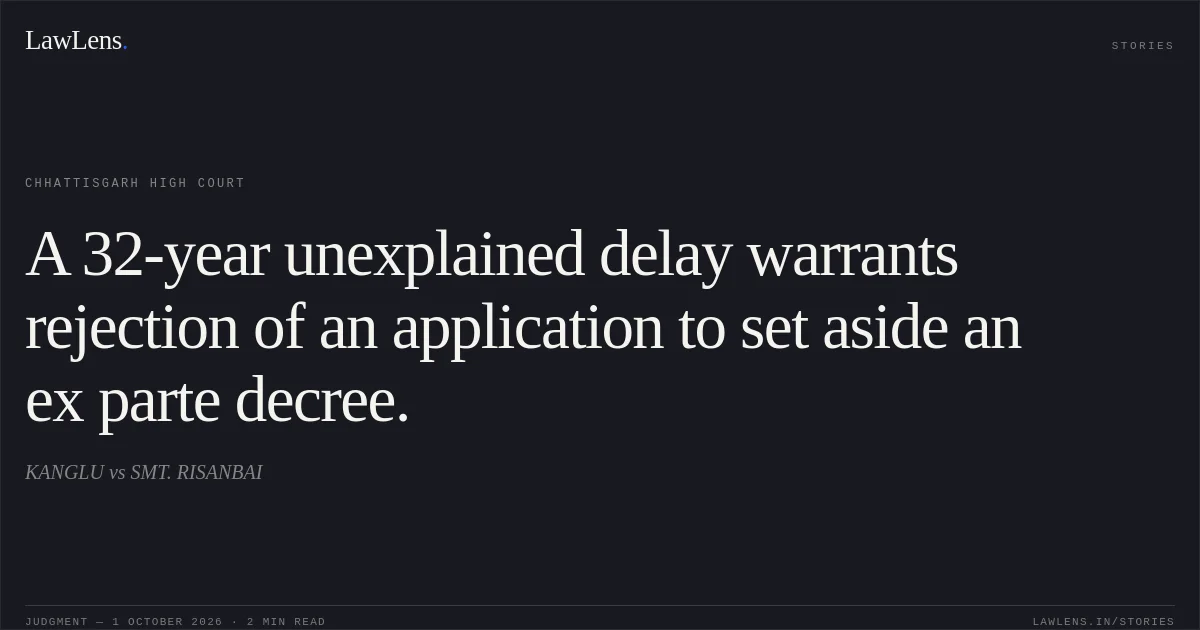
Whether the petitioners established sufficient grounds to set aside the 1975 ex parte decree under Order IX Rule 13 CPC, despite filing their application after approximately 32 years.
Source reference: paras. 2, 4Whether the courts below committed a jurisdictional error warranting interference under Article 227 of the Constitution.
Source reference: para. 5Law Applied
Order IX Rule 13 CPC provides the procedural basis for seeking to set aside an ex parte decree; the petitioners invoked it with Section 151 CPC.
Source reference: para. 2The Court’s reasoning proceeded on the principle that an exceptionally long delay in seeking that relief requires a plausible and bona fide explanation.
Source reference: para. 4In exercising supervisory jurisdiction under Article 227, the Court considered whether the subordinate courts’ decisions disclosed a jurisdictional error.
Source reference: para. 5Reasoning
The petitioners had participated in the suit and knew of its pendency, yet took no steps to ascertain its status or seek appropriate relief after their absence on 24 September 1975.
Source reference: para. 4The Court found their explanations—livelihood-related absence and subsequent lack of awareness among legal representatives—insufficient to account for the roughly 32-year delay, and held that the explanation was not bona fide.
Source reference: paras. 2, 4As the trial and appellate courts had properly rejected the application and appeal, the Court found no jurisdictional error justifying Article 227 intervention.
Source reference: para. 5Holding
The Court held that the petitioners had not provided a plausible explanation for the delay and that no jurisdictional error had been shown in the orders below.
It dismissed the writ petition, leaving in place the rejection of the Order IX Rule 13 CPC application and the ex parte decree.
Source reference: para. 6Acts & Sections Cited
1 provisions across 1 statute referred to in this judgment. Each provision opens on LawLens.
Code of Civil Procedure, 19081
Original Court PDF
KANGLUvsSMT. RISANBAI
Click to open original judgment
Original judgment, available to read, download and summarize on LawLens.in