Facts
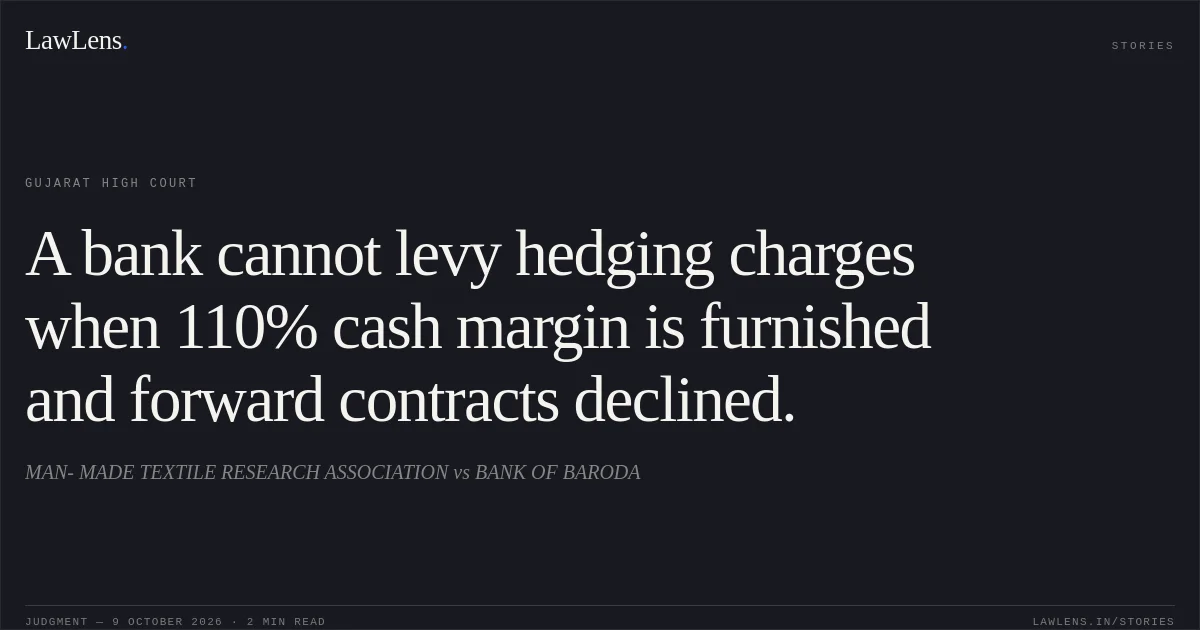
The petitioner, a research institution, obtained three letters of credit (LoCs) to import machinery.
Source reference: pp. 2–6Under the bank’s sanction terms, the petitioner provided 100% cash margin and an additional 10% margin if it did not book a forward contract.
Source reference: pp. 2–6The petitioner provided 110% margin and instructed the bank not to book forward contracts.
Source reference: pp. 2–6When the petitioner later sought rollovers, the bank hedged the transactions and, upon closure of the LoCs in 2014, debited a total of ₹49,24,068 as hedging charges.
Source reference: pp. 7–10The petitioner sought reversal and, after the bank declined, filed this writ petition seeking reimbursement.
Source reference: pp. 11–17Issues
1. Whether the bank could recover hedging charges despite the petitioner having furnished 110% cash margin and instructed the bank not to book forward contracts.
Source reference: pp. 18–192. Whether the contractual nature of the dispute or the RBI circulars relied on by the bank precluded relief under Article 226 or justified the charges.
Source reference: pp. 17–19Law Applied
Under Article 226, a contractual dispute is not excluded from judicial review merely because it arises from a contract; however, the Court should avoid resolving disputed questions of fact requiring an evidentiary trial.
Source reference: p. 17The Court relied on Unitech Limited v. Telangana State Industrial Infrastructure Corporation (TSHC), (2021) 16 SCC 35, para 39.6.
Source reference: p. 17The parties’ contractual terms required 100% cash margin and prescribed an additional 10% margin if no forward contract was booked.
Source reference: pp. 2–3The RBI circulars relied on by the bank concerned monitoring unhedged foreign-currency exposure.
Source reference: pp. 18–19Reasoning
The material facts—including the 110% margin, the petitioner’s instruction against forward contracts, and the debits—were admitted, leaving no factual dispute requiring a civil trial.
Source reference: p. 18The bank produced no written consent authorising hedging; its assertion that the petitioner’s consultant had agreed to it did not establish such consent.
Source reference: pp. 15–16Because the bank had obtained the additional margin, the Court considered the exposure not to be unhedged and held the RBI circulars inapplicable to justify the charges.
Source reference: pp. 18–19The contractual character of the dispute therefore did not bar the Court from granting relief under Article 226.
Source reference: pp. 17–18Holding
The Court held that the bank was not entitled to recover the ₹49,24,068 in hedging charges and allowed the writ petition.
It directed the bank to refund that amount with interest at 8% per annum from the respective dates of debit until repayment.
Source reference: p. 20Original Court PDF
MAN- MADE TEXTILE RESEARCH ASSOCIATIONvsBANK OF BARODA
Click to open original judgment
Original judgment, available to read, download and summarize on LawLens.in