Facts
The appellant/plaintiff filed a suit for permanent injunction in O.S. No. 25511/2023, alleging that he had paid ₹1,00,000 to defendant Nos. 1 and 2 in 2012 and had thereafter been put in possession of the suit property.
Source reference: para. 4He alleged that defendant Nos. 1 and 2 subsequently sold the property to defendant Nos. 3 and 4 and that all the defendants were interfering with his possession.
Source reference: para. 4Defendant Nos. 3 and 4 filed an application under Order VII Rule 11(a) and (d) CPC, contending that the plaint disclosed no cause of action and that the suit was barred by law.
Source reference: para. 5The trial court allowed the application and rejected the plaint by order dated 17 July 2025.
Source reference: paras. 2, 6The plaintiff challenged that order in the present Regular First Appeal.
Source reference: para. 7Issues
Whether the plaint disclosed a cause of action for instituting a suit for permanent injunction?
Source reference: para. 9, Point No. 1Whether defendant Nos. 3 and 4 established that the plaint disclosed no cause of action?
Source reference: para. 9, Point No. 2Whether the suit for permanent injunction was not maintainable because the plaintiff had other efficacious remedies under Section 41(h) of the Specific Relief Act, 1963?
Source reference: para. 9, Point No. 3Whether the trial court’s order rejecting the plaint required interference in appeal?
Source reference: para. 9, Point No. 4Law Applied
The Court applied Order VII Rule 11(a) and (d) of the Code of Civil Procedure, 1908, under which a plaint may be rejected where it does not disclose a cause of action or where the suit appears from the plaint to be barred by law.
Source reference: paras. 2, 5–6It also applied Section 41(h) of the Specific Relief Act, 1963, which provides that an injunction cannot be granted where an equally efficacious relief can certainly be obtained through another usual mode of proceeding, except in cases of breach of trust.
Source reference: para. 11The Court proceeded on the principle that the plaint must contain material facts establishing the plaintiff’s asserted right, possession, and cause of action; where the pleaded facts are illusory or do not constitute a legally enforceable basis for injunction, the plaint is liable to rejection.
Source reference: para. 13Reasoning
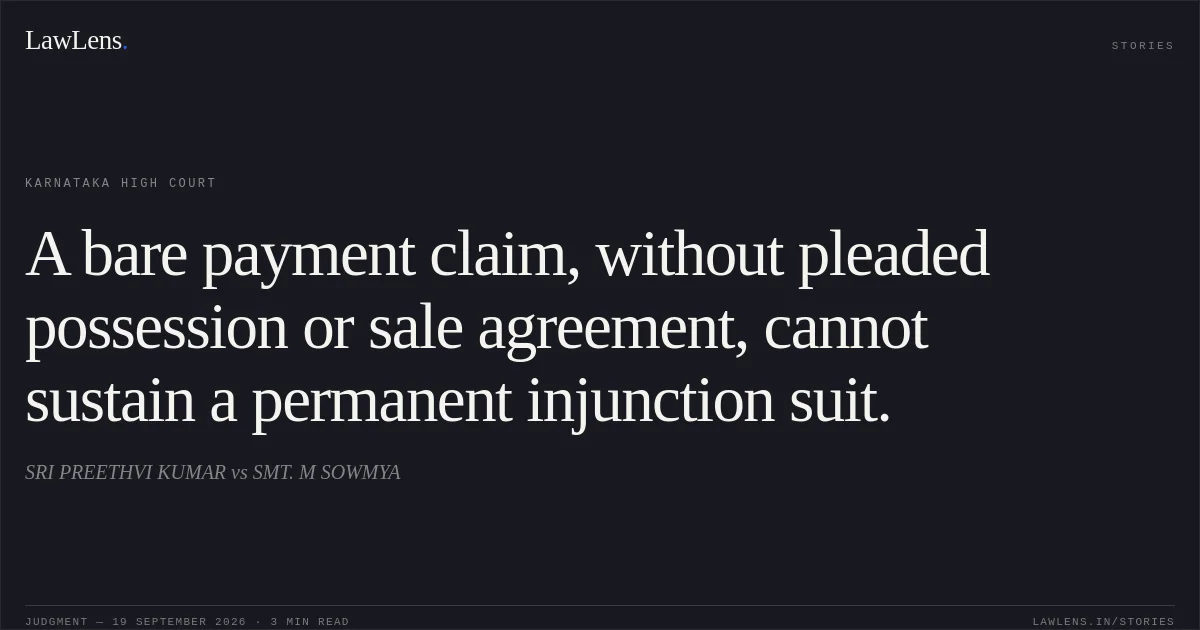
The Court found that the plaint merely stated that the plaintiff had paid ₹1,00,000 to defendant Nos. 1 and 2 in 2012; it did not plead the existence of any agreement of sale or explain how the plaintiff had acquired possession of the suit property.
Source reference: para. 12Consequently, the pleadings did not establish that the plaintiff was in lawful possession or disclose a substantive basis for seeking protection by permanent injunction.
Source reference: para. 12Even assuming that the payment represented token advance under an oral agreement of sale, the plaintiff’s appropriate remedies would have been recovery of money or specific performance, both of which were considered efficacious alternatives under Section 41(h) of the Specific Relief Act.
Source reference: para. 12On an examination of the plaint averments alone, the Court held that the alleged cause of action was illusory and imaginary and did not constitute a cause of action for permanent injunction.
Source reference: para. 13The trial court’s order under Order VII Rule 11(a) and (d) CPC was therefore found legally justified.
Source reference: para. 13Holding
The High Court answered the questions concerning absence of cause of action and availability of an efficacious alternative remedy in favour of defendant Nos. 3 and 4, and held that the trial court’s rejection of the plaint did not warrant interference.
The Regular First Appeal was accordingly dismissed, and the order dated 17 July 2025 rejecting the plaint was upheld.
Source reference: Order, p. 10Acts & Sections Cited
3 provisions across 2 statutes referred to in this judgment. Each provision opens on LawLens.
Code of Civil Procedure, 19082
Specific Relief Act, 19631
Original Court PDF
SRI PREETHVI KUMARvsSMT. M SOWMYA
Click to open original judgment
Original judgment, available to read, download and summarize on LawLens.in