Facts
The 25 petitioners, claiming to be residents of Village Rajpardi, Taluka Jhagadia, District Bharuch—a Scheduled Area—challenged the notification dated 28 June 2022 issued under Section 3 of the Gujarat Water and Gas Pipelines (Acquisition of Right of User in Land) Act, 2000 (“Gujarat Pipeline Act”).
Source reference: paras. 2–4The notification proposed acquisition of the right of user in their lands for the Aamboli–Rajpipla Gas Pipeline Project, Section Vanthevav–Bhadam.
Source reference: paras. 2–4The petitioners alleged that the acquisition proceedings violated the Panchayats (Extension to the Scheduled Areas) Act, 1996 (“PESA Act”) and the Gujarat Provisions of the Panchayats (Extension to the Scheduled Areas) Rules, 2017, particularly because the concerned Gram Sabhas or Gram Panchayats had not been consulted.
Source reference: paras. 5–8The petition was filed approximately four years after the Section 3 notification. During the hearing, Gujarat State Petronet Ltd. produced the subsequent declaration dated 29 April 2023 issued under Section 6(4) of the Gujarat Pipeline Act.
Source reference: paras. 13–16The respondents also stated that the pipeline had already been laid and that notices dated 20 December 2025 were issued to landowners for verification of ownership and disbursement of compensation.
Source reference: paras. 19–20Issues
1. Whether the petitioners could challenge the Section 3 notification dated 28 June 2022 on the ground that the mandatory consultation and participation requirements under the PESA Act and Gujarat PESA Rules had not been complied with.
Source reference: paras. 5–122. Whether the writ petition was maintainable after an unexplained delay of approximately four years, particularly when a declaration under Section 6 had subsequently been issued and the acquisition process had substantially concluded.
Source reference: paras. 13–183. Whether the petitioners were entitled to challenge the acquisition proceedings when the petition did not disclose the subsequent Section 6 declaration and the notices issued for determination and payment of compensation.
Source reference: paras. 18–22Law Applied
The Court considered Section 4 of the PESA Act, 1996, especially Section 4(i), which requires consultation with the Gram Sabha or Panchayats at the appropriate level before acquisition of land in Scheduled Areas for development projects and before rehabilitation or resettlement.
Source reference: para. 10Rules 23 and 24 of the Gujarat PESA Rules, 2017 were also applied: Rule 23 requires the Gram Sabha to exercise functions relating to land acquisition under the Right to Fair Compensation and Transparency in Land Acquisition, Rehabilitation and Resettlement Act, 2013, while Rule 24 requires rehabilitation details to be placed before the Gram Sabha and recorded in its minutes.
Source reference: para. 9Under Sections 3 and 6 of the Gujarat Pipeline Act, the State may propose and subsequently declare acquisition of the right of user in land; upon publication of the Section 6 declaration, the right of user vests absolutely in the State Government free from encumbrances.
Source reference: paras. 3, 15–16Section 9 restricts construction, excavation and planting of trees over the affected land but preserves the owner’s or occupier’s existing use, and Section 10 provides for compensation, with a remedy before the Collector for redetermination of disputed compensation.
Source reference: paras. 16–17The Court also applied the principles of delay and laches, waiver, and the requirement that a writ petitioner make full and candid disclosure of material facts.
Source reference: paras. 18, 21–22Reasoning
The Court noted that the petitioners’ reliance on PESA and the Gujarat PESA Rules raised a potential requirement of Gram Sabha consultation in acquisition matters.
Source reference: paras. 11–12However, the Court held that the challenge could not be entertained because it was brought nearly four years after the Section 3 notification and did not address the subsequent Section 6 declaration dated 29 April 2023, by which the right of user had vested in the State.
Source reference: paras. 13–18The acquisition process had substantially progressed, the pipeline had reportedly been laid, and the 2025 notices showed that the authorities were proceeding with compensation rather than initiating a fresh acquisition process.
Source reference: paras. 19–20The Court further found that the petitioners had not disclosed these material developments and had approached the Court only after receiving notices concerning compensation.
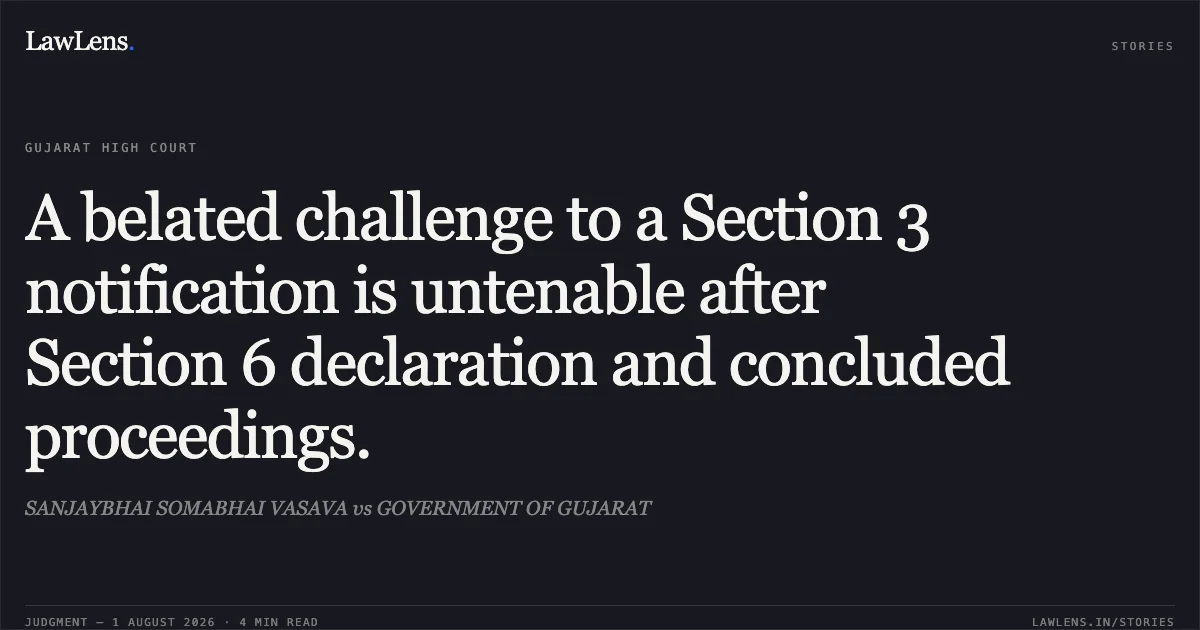
Source reference: paras. 20–22In these circumstances, the delayed and incomplete challenge to the initial proposal notification was held to be untenable.
Source reference: paras. 20–22Holding
The Court declined to entertain the challenge to the Section 3 notification dated 28 June 2022, holding that the petitioners’ delayed challenge was unsustainable in view of the subsequent Section 6 declaration, completion of the acquisition process, laying of the pipeline, and the petitioners’ failure to disclose material facts.
The Special Civil Application was accordingly disposed of without granting the requested relief and without any order as to costs.
Source reference: para. 23Acts & Sections Cited
8 provisions across 3 statutes referred to in this judgment. Each provision opens on LawLens.
Gujarat Water and Gas Pipelines (Acquisition of Right of User in Land) Act, 20004
Gujarat Panchayats Act, 19933
Right to Fair Compensation and Transparency in Land Acquisition, Rehabilitation and Resettlement Act, 20131
Original Court PDF
SANJAYBHAI SOMABHAI VASAVAvsGOVERNMENT OF GUJARAT
Click to open original judgment
Original judgment, available to read, download and summarize on LawLens.in