Facts
Suraj Bhan, aged approximately 42 years and employed as a Head Master, left home on 7 December 2011 and did not return.
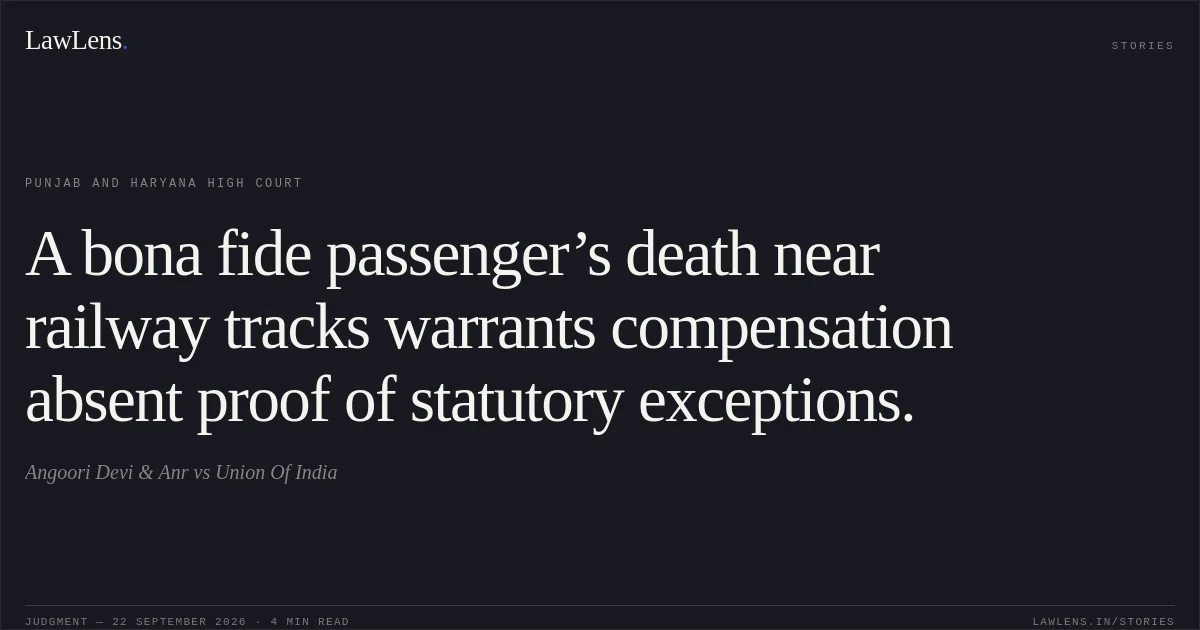
Source reference: paras. 1–5; pp. 1–3The appellants alleged that he purchased a second-class ticket from Kurukshetra to Ambala Cantt. on 12 December 2011 and another ticket from Ambala Cantt. to Patiala on 13 December 2011, boarded a passenger train, and accidentally fell from it between Rajpura and Shambhu.
Source reference: paras. 1–5; pp. 1–3His dead body was recovered near the railway track on 14 December 2011.
Source reference: paras. 1–5; pp. 1–3The appellants identified the body and claimed compensation under Section 124-A of the Railways Act, 1989.
Source reference: paras. 1–5; pp. 1–3The Railways disputed that Suraj Bhan was a bona fide passenger and alleged suicide and intoxication.
Source reference: paras. 1–5; pp. 1–3The Railway Claims Tribunal dismissed the claim, holding that he was not travelling in a train and had committed suicide while intoxicated, thereby attracting the statutory exceptions under Section 124-A.
Source reference: paras. 1–5; pp. 1–3The appellants challenged that award under Section 23 of the Railway Claims Tribunal Act, 1987.
Source reference: para. 1; p. 1Issues
Whether Suraj Bhan was a bona fide passenger within the meaning of the Explanation to Section 124-A of the Railways Act, 1989?
Source reference: paras. 4–5, 10–10.1; pp. 2, 4–5Whether his death resulted from an “untoward incident”, namely accidental falling from a passenger train under Section 123(c)(2) read with Section 124-A of the Railways Act?
Source reference: paras. 9, 11–13; pp. 4–8Whether the Railways established that the death fell within the exceptions of suicide, self-inflicted injury, or intoxication under the proviso to Section 124-A?
Source reference: para. 14; pp. 8–9What compensation and interest were payable to the appellants?
Source reference: paras. 16–17; pp. 9–10Law Applied
The Court applied Sections 123(c)(2) and 124-A of the Railways Act, 1989: accidental falling of a passenger from a train constitutes an “untoward incident,” and the Railway Administration is liable to pay statutory compensation without proof of negligence.
Source reference: para. 9.1; pp. 4–5The Explanation to Section 124-A treats a person possessing a valid ticket as a bona fide passenger.
Source reference: para. 9.1; pp. 4–5The proviso to Section 124-A excludes liability where the death results from, inter alia, suicide, attempted suicide, self-inflicted injury, or an act committed in a state of intoxication.
Source reference: para. 9.1; pp. 4–5The Court relied on Union of India v. Prabhakaran Vijaya Kumar, (2008) 9 SCC 527, for the beneficial and liberal interpretation of the railway-compensation provisions, and Union of India v. Rina Devi, (2019) 3 SCC 572, for the principle that the claimant’s initial burden is light, the matter is assessed on a preponderance of probabilities, and the burden shifts to the Railways after foundational facts are established.
Source reference: para. 9.1; pp. 4–5The Court also applied the principle in Radha Yadav v. Union of India that the compensation applicable on the date of the accident, with reasonable interest, must be compared with the statutory compensation applicable on the date of the award, and the higher amount should be granted.
Source reference: para. 16; p. 9Reasoning
The Court found that the Railways’ own DRM report recorded recovery of two tickets from the deceased, including the Ambala Cantt.–Patiala ticket dated 13 December 2011, which had been verified as genuine.
Source reference: paras. 10–10.1; pp. 4–6The Tribunal’s finding that no search or recovery of tickets had occurred was contradicted by the DRM report and the jamatalashi record.
Source reference: paras. 10–10.1; pp. 4–6The deceased’s unexplained absence from home for several days did not negate his status as a passenger, since the relevant consideration was possession of a valid ticket.
Source reference: paras. 10–10.1; pp. 4–6Regarding the occurrence, the dead body was recovered on the route covered by the ticket shortly after its purchase, and there was no independent explanation for his presence at the railway location.
Source reference: para. 11.1; pp. 6–7These circumstances, assessed cumulatively and on a preponderance of probabilities, supported accidental falling from a train.
Source reference: para. 11.1; pp. 6–7The absence of an eyewitness was not fatal to the claim.
Source reference: para. 11.1; pp. 6–7The crushed injuries and the body’s location on the down line did not conclusively rule out an accidental fall, as a passenger falling from a moving train could subsequently come under its wheels.
Source reference: paras. 12–13; pp. 7–8The Railways also failed to produce the keyman who first noticed the body or establish the exact position of the body through a duly proved site plan.
Source reference: paras. 12–13; pp. 7–8Finally, the presence of a liquor bottle did not prove consumption or intoxication, while the police opinion and use of the word “Khudkushi” were insufficient to establish suicide.
Source reference: para. 14; pp. 8–9There was no suicide note, eyewitness, or other corroborative evidence, and the final medical opinion had in fact been placed on record.
Source reference: para. 14; pp. 8–9Holding
The appeal was allowed and the Tribunal’s award dated 10 November 2016 was set aside.
The Court held that Suraj Bhan was a bona fide passenger and that his death resulted from an untoward incident under Section 123(c)(2) read with Section 124-A of the Railways Act.
Source reference: para. 15; p. 9The finding that the appellants were his dependants was affirmed.
Source reference: para. 15; p. 9The appellants were held entitled to compensation of Rs. 4,00,000 with simple interest at 9% per annum from the date of filing of the claim application until realization, or Rs. 8,00,000, whichever was higher, in accordance with Rina Devi and Radha Yadav.
Source reference: paras. 16–17; pp. 9–10The Railways were directed to deposit the determined amount with accrued interest before the Tribunal within three months of receiving the certified judgment.
Source reference: para. 17; p. 10The Tribunal was directed to disburse the amount among the eligible dependants.
Source reference: para. 17; p. 10In case of default, the Railways would be liable to pay interest at 12% per annum from expiry of the three-month period until actual realization.
Source reference: para. 17; p. 10Acts & Sections Cited
2 provisions across 2 statutes referred to in this judgment. Each provision opens on LawLens.
Railway Claims Tribunal Act, 19871
Railways Act, 19891
Original Court PDF
Angoori Devi & AnrvsUnion Of India
Click to open original judgment
Original judgment, available to read, download and summarize on LawLens.in