Facts
The testator, Rajeshwari Nagarkar, executed a Will on August 23, 2005, bequeathing certain properties in Satara to her son-in-law (the Applicant) and others to her children
Source reference: para. 9Following her death in 2008, the named Executor obtained probate from the Civil Judge Senior Division, Pune, on December 13, 2011
Source reference: para. 2, 8In 2013, the Respondents (testator’s brother and nephew) filed Miscellaneous Application No. 616/2013 seeking revocation of the probate under Section 383 of the Indian Succession Act, 1925
Source reference: para. 2They contended that the testator lacked title to the properties, alleging that a prior Will by the family matriarch (Radhabai) in favor of the testator had been superseded by a subsequent Will in favor of the Respondents
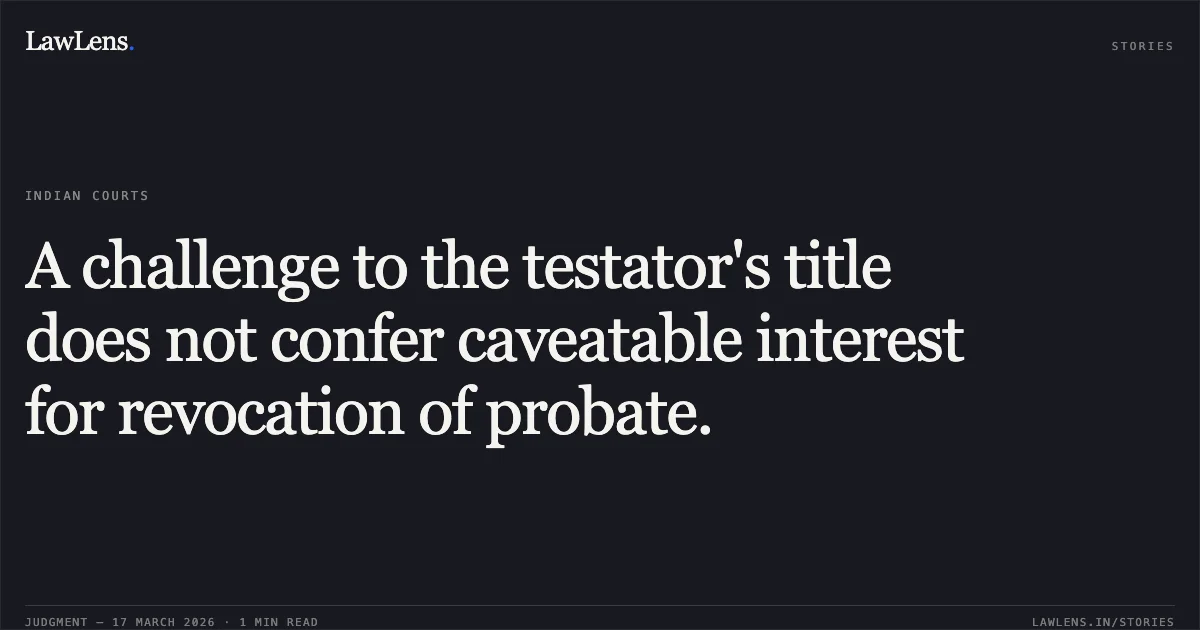
Source reference: para. 10The Applicant challenged the maintainability of this revocation application, arguing that a challenge to the testator's title does not constitute a "caveatable interest"
Source reference: para. 1The Trial Court rejected the Applicant’s objection twice, most recently on December 20, 2022, holding the revocation application maintainable
Source reference: para. 1, 3Issues
1. Whether a probate revocation application is maintainable when the primary ground is a challenge to the testator's title to the bequeathed properties (i.e., whether the Respondents possess a "caveatable interest")
Source reference: para. 1, 122. Whether a probate grant is invalid or beyond jurisdiction if the Will was executed and properties located outside the Ordinary Original Civil Jurisdiction of the High Court
Source reference: para. 5, 27Law Applied
The court primarily applied Section 383 of the Indian Succession Act, 1925, regarding the revocation of probate
Source reference: para. 2It relied extensively on the principle established in Krishna Kumar Birla v. Rajendra Singh Lodha (2008) 4 SCC 300, which mandates that a caveator must show a "caveatable interest"—meaning the probate must prejudice a right by defeating a line of succession
Source reference: para. 13The court noted that a person questioning the testator’s title is a stranger to probate proceedings
Source reference: para. 13This was supported by Saroj Agarwalla v. Yasheel Jain (2017) 14 SCC 285
Source reference: para. 18Kanwarjit Singh Dhillon v. Hardyal Singh Dhillon (2007) 11 SCC 357, which clarified that Probate Courts cannot adjudicate title disputes
Source reference: para. 19Regarding jurisdiction, the court applied Mahesh N. Bhat v. Mark Uppaluri (2018) SCC OnLine Bom 9891, holding that while probate is optional for Wills executed outside Presidency towns under Section 57, it is not prohibited
Source reference: para. 27Reasoning
The Court analyzed the apparent conflict between Krishna Kumar Birla and G. Gopal v. C. Bhaskar (2008) 10 SCC 489
Source reference: para. 15-16It reconciled the two by noting that G. Gopal involved caveators who would have inherited through the testator via a settlement deed, whereas the Respondents in the present case claimed title adverse to the testator
Source reference: para. 24Applying the K.K. Birla test, the Court held that the Respondents' claim—that the testator never owned the property—renders them "strangers" to the probate proceeding because they do not assert a right through a line of succession of the testator
Source reference: para. 24, 29The Court emphasized that a Probate Court’s jurisdiction is limited to determining the genuineness and due execution of the Will, not the testator's ownership
Source reference: para. 20, 26Furthermore, the Court rejected the Respondents' argument that the probate was "superfluous" or "invalid" due to the location of the properties (Satara) and execution (Pune), clarifying that the law makes probate optional, not prohibited, in such regions
Source reference: para. 27-28Holding
The Court allowed the Civil Revision Application and set aside the Trial Court’s order dated December 20, 2022
It held that Miscellaneous Application No. 616/2013 was not maintainable because the Respondents, by questioning the testator's title rather than their status as intestate heirs, lacked a caveatable interest
Source reference: para. 29-30The Court dismissed the revocation application, noting that the Respondents’ remedy lies in their already instituted substantive title suit
Source reference: para. 29, 31Acts & Sections Cited
4 provisions across 2 statutes referred to in this judgment. Each provision opens on LawLens.
Indian Succession Act, 19253
Code of Civil Procedure, 19081
Original Court PDF
SUNIL WAMAN BHIDEvsCHANDRAHAS LAXMAN KANHERE AND ORS.
Click to open original judgment
Original judgment, available to read, download and summarize on LawLens.in