01Facts
The prosecution alleged that the petitioner had sexual intercourse with the victim, then a minor, and later married her by tying a thali, lived with her at his parents’ house, and subsequently threatened her.
pp. 4–5The victim contacted the Child Helpline on 6 February 2025; a complaint was later lodged and an FIR registered on 4 September 2025.
pp. 4–5After investigation, a chargesheet was filed for offences under the Bharatiya Nyaya Sanhita, 2023 (BNS), the POCSO Act and the Prohibition of Child Marriage Act.
pp. 4–5The petitioner’s date of birth was recorded as 12 December 2006, making him 17 at the time of the alleged incident; the victim’s date of birth was recorded as 3 August 2010.
pp. 5–6The petitioner had been in an observation home since 8 September 2025 and, following an order under Section 19 of the Juvenile Justice (Care and Protection of Children) Act, 2015, had been shifted to a place of safety.
p. 8He sought regular bail under Section 483 of the Bharatiya Nagarik Suraksha Sanhita, 2023 (BNSS).
pp. 3–4The State opposed bail, citing the gravity of the charges, risk of absconding, possible delay to trial and risk of similar offending.
pp. 3–4The victim and her parents had given evidence before the trial court but did not support the prosecution.
pp. 7–802Issues
i.1. Whether the petitioner was entitled to regular bail under Section 483 BNSS, having regard to the gravity of the alleged offences and the circumstances of his custody.
pp. 2–4, 8–9ii.2. Whether the prosecution’s concerns about absconding, interference with witnesses or further offending could be addressed through bail conditions.
pp. 3–4, 9–1003Law Applied
The Court considered Section 483 BNSS, under which the petitioner sought regular bail, and the charges under Sections 137(2), 64(2)(m), 65(1), 352 and 351(2), read with Section 3(5) BNS, Sections 4 and 6 of the POCSO Act, and Section 9 of the Prohibition of Child Marriage Act.
p. 2It also noted the petitioner’s transfer to a place of safety following an order under Section 19 of the Juvenile Justice (Care and Protection of Children) Act, 2015.
p. 8The Court applied the principle that “bail is rule and jail is an exception,” observing that pre-trial detention should not operate as punishment and that appropriate conditions may address risks raised by the prosecution.
pp. 8–9Provisions in the judgment · 12 · Linked ones open on LawLens
Bharatiya Nagarik Suraksha Sanhita, 2023 Section 483
Code of Criminal Procedure, 1973 Section 439
Bharatiya Nyaya Sanhita, 2023 Section 137Section 64Section 65Section 352Section 351Section 3
Protection of Children from Sexual Offences Act, 2012 Section 4Section 6
Prohibition of Child Marriage Act, 2006 Section 9
Juvenile Justice (Care and Protection of Children) Act, 2015. Section 19
04Reasoning
The Court acknowledged the seriousness of the charged offences and the State’s objections, but found that the investigation was complete and the chargesheet had been filed.
p. 3, 6It gave weight to the victim and her parents not supporting the prosecution at trial, the absence of material showing prior offending, and the petitioner’s custody in a place of safety.
pp. 7–9The Court clarified that release on bail would not amount to acquittal, as the trial—including the examination of official witnesses and the doctor—would continue.
pp. 7–8It considered that the State’s concerns could be met by requiring the petitioner to attend and assist the trial, refrain from contacting the victim and her parents, avoid witness interference and not commit further offences.
pp. 9–1005Holding
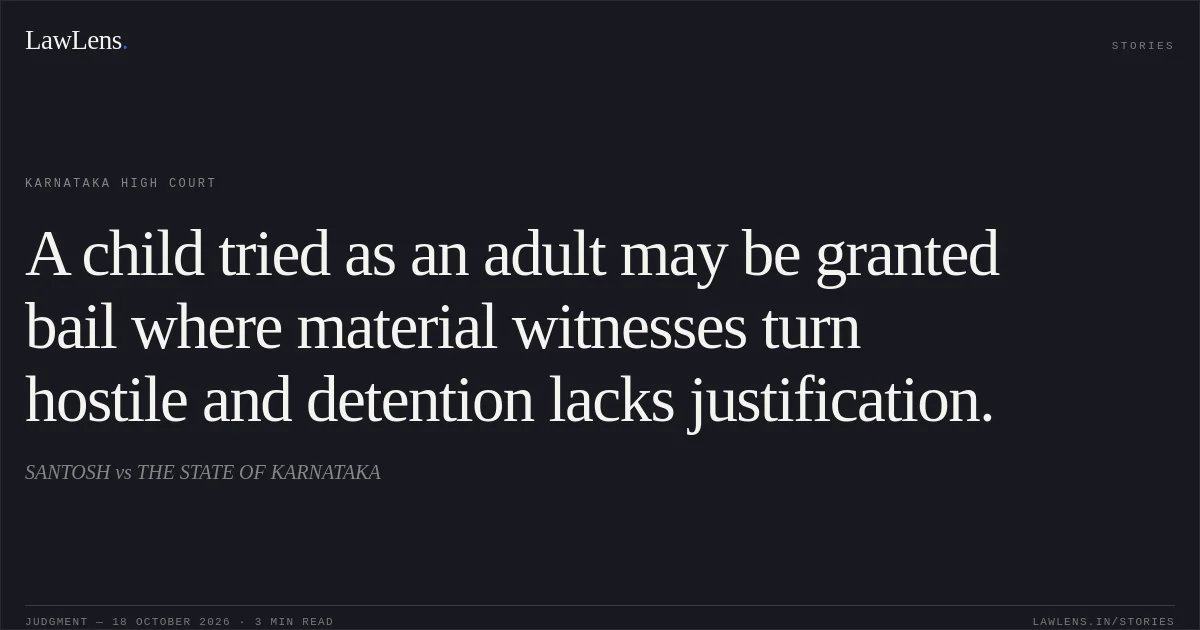
The High Court allowed the petition and ordered the petitioner’s release on bail in Spl. Case (POCSO) No. 28/2026, on execution of a personal bond of ₹2,00,000 with two sureties for the like sum, subject to conditions including attendance at trial, no contact with the victim or her parents, no tampering with witnesses and no further offending.
pp. 10–11The Court directed that breach of any bail condition would result in cancellation of bail.
p. 11Original Court PDF
SANTOSHvsTHE STATE OF KARNATAKA
Click to open original judgment
Original judgment, available to read, download and summarize on LawLens.in