Facts
On 25 September 2024, the petitioner was arrested after allegedly driving a vehicle transporting 138 kilograms of ganja, and an offence under Section 8/20 of the NDPS Act was registered against him.
Source reference: para. 2He was initially detained in the District Jail as an adult.
Source reference: para. 2During proceedings before the Special Judge, NDPS, he was found to have been below 18 years of age at the time of the incident, and the case was transferred to the Juvenile Justice Board (JJB).
Source reference: para. 2The JJB rejected his application for bail under Section 12 of the Juvenile Justice (Care and Protection of Children) Act, 2015 (JJ Act); the appellate court affirmed that decision.
Source reference: para. 1He challenged both orders in revision under Section 102 of the JJ Act.
Source reference: para. 1The petitioner argued that there was no basis to find that release would expose him to the risks specified in Section 12, and that he had no criminal antecedents and the investigation was complete.
Source reference: para. 3Issues
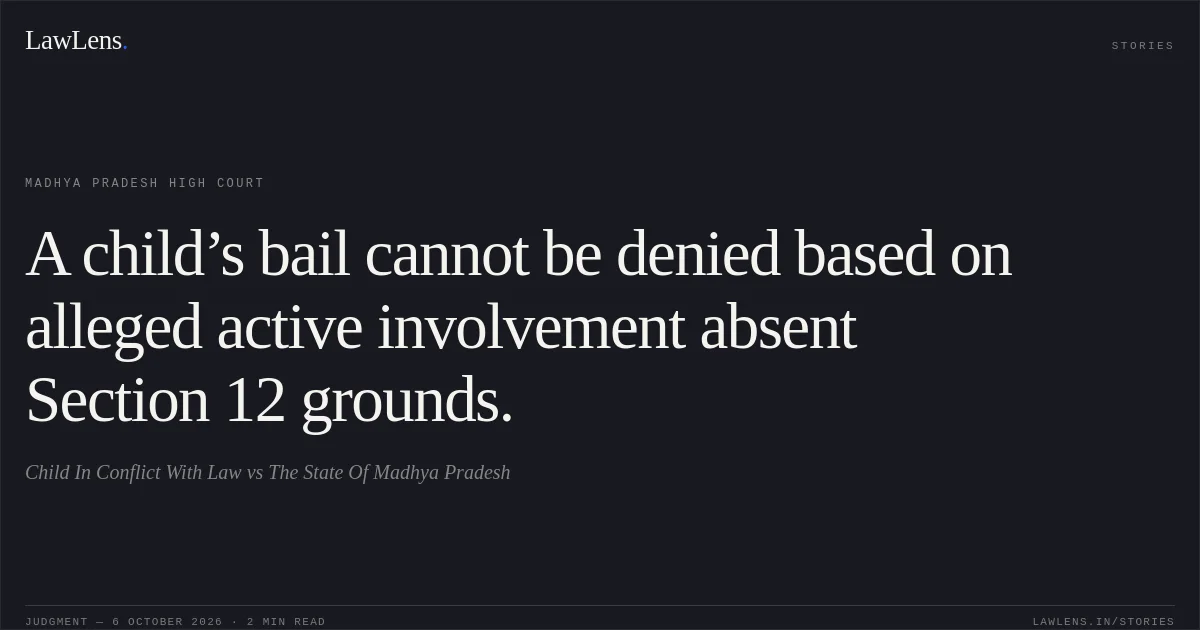
1. Whether the JJB and appellate court erred in refusing bail under Section 12 of the JJ Act to a child in conflict with law.
Source reference: paras. 1, 62. Whether the petitioner’s alleged active role in transporting ganja, without material establishing a statutory ground for refusal, justified continued detention.
Source reference: para. 6Law Applied
Section 12 of the JJ Act governs bail for a person who is apparently a child and provides for release on bail, with or without surety, unless there are reasonable grounds for believing that release is likely to bring the child into association with a known criminal, expose the child to moral, physical or psychological danger, or defeat the ends of justice.
Source reference: para. 6Section 102 of the JJ Act provides the basis for the High Court’s revision.
Source reference: para. 1The Court also identified the child’s best interests, rehabilitation and reformation as paramount considerations under the JJ Act.
Source reference: para. 7Reasoning
The Court accepted that the petitioner was below 18 at the time of the alleged offence and assessed the refusal of bail against Section 12’s specified grounds.
Source reference: para. 6It found no material indicating that release would bring him into association with a known criminal.
Source reference: para. 6The lower courts had relied primarily on his alleged active role, which the Court held did not satisfy the statutory requirements for refusing bail.
Source reference: para. 6Given the child’s age and the rehabilitative purpose of the JJ Act, the Court considered continued detention inconsistent with his best interests.
Source reference: para. 7Holding
The High Court held that the courts below erred in refusing bail, allowed the revision and set aside their orders.
It directed that the child be released into his uncle’s custody on a personal bond of ₹50,000 with a solvent surety in the like amount, subject to conditions including supervision by the uncle, attendance before the JJB, avoidance of association with criminals, compliance with the Board’s conditions and vigilance by the Probation Officer.
Source reference: para. 10The Court further directed that breach of bail conditions would result in automatic cancellation.
Source reference: para. 11Acts & Sections Cited
4 provisions across 2 statutes referred to in this judgment. Each provision opens on LawLens.
Juvenile Justice (Care and Protection of Children) Act, 2015.2
Narcotic Drugs and Psychotropic Substances Act, 19852
Original Court PDF
Child In Conflict With LawvsThe State Of Madhya Pradesh
Click to open original judgment
Original judgment, available to read, download and summarize on LawLens.in