Facts
The appellant-plaintiff instituted Title Suit No. 555 of 2016 seeking a declaration that the Schedule-I properties, though purchased in the names of his brothers and cousin brothers, had been acquired from his funds and belonged to him, with title and possession vesting in him.
Source reference: p. 2–3He pleaded that the defendants held the properties in a relationship of trust and that the original sale deeds and possession remained with him.
Source reference: p. 2–3During the suit, the parties filed a written compromise dated 5 December 2016, under which the defendants relinquished their claims over the properties and confirmed the appellant’s claim.
Source reference: p. 3The Trial Court rejected the compromise under Order XXIII Rule 3 of the Code of Civil Procedure, 1908 (“CPC”), holding that the claim was founded on a benami transaction, did not fall within the fiduciary-capacity exception, and was barred by Sections 3 and 4 of the Benami Transactions (Prohibition) Act, 1988, as amended (“Benami Act”).
Source reference: p. 3–5The suit was consequently dismissed as barred by law, leading to the present first appeal under Section 96 CPC.
Source reference: p. 2Issues
1. Whether the Trial Court was entitled to examine suo motu whether the suit was barred under the Benami Act, despite the absence of a separately framed issue and despite the parties’ consent to the compromise.
Source reference: para. 10, 12–152. Whether the appellant’s claim that he was the real owner of properties purchased in the defendants’ names was barred by Section 4 of the Benami Act, or whether it fell within the exception relating to property held in a fiduciary capacity.
Source reference: para. 10–11, 16–283. Whether the compromise dated 5 December 2016 constituted a lawful compromise capable of being recorded under Order XXIII Rule 3 CPC notwithstanding the statutory bar under the Benami Act.
Source reference: para. 10, 29–34Law Applied
The Court applied Section 96 CPC governing first appeals; Order VII Rule 11(d) CPC, under which a plaint may be rejected where the suit appears from its own statements to be barred by law; and Order XXIII Rule 3 CPC, which permits recording only of a lawful written compromise.
Source reference: p. 12–18Under Sections 2(a), 3 and 4 of the Benami Act, a transaction in which consideration is provided by one person but the property is held in another’s name may attract statutory prohibition, and Section 4 bars a suit or claim by a person asserting that he is the real owner of benami property.
Source reference: p. 12–18The fiduciary-capacity exception applies only where the ostensible holder is legally obliged to hold or deal with the property for the benefit of the alleged beneficial owner; mere blood relationship or an assertion of trust is insufficient.
Source reference: p. 12–18The Court relied on Patil Automation Pvt. Ltd. v. Rakheja Engineers Pvt. Ltd., (2022) 10 SCC 1, for the principle that the court may invoke Order VII Rule 11(d) suo motu in a clear case; Marcel Martins v. M. Printer, (2012) 5 SCC 342, and Pawan Kumar v. Babulal, (2019) 4 SCC 367, concerning the Section 4 bar and fiduciary exception; K. Venkata Seshiah v. Kanduru Ramasubbamma, (1991) 3 SCC 338, on lawful compromises; and Manjula v. D.S. Srinivas, 2026 SCC OnLine SC 831, on meaningful scrutiny of pleadings to determine whether a genuine triable issue or a statutory bar exists.
Source reference: p. 8–12, 18–20Reasoning
The Court held that the appellant’s own pleadings made the statutory issue apparent: he asserted that he had paid the consideration, that the properties stood in the defendants’ names, and that he was their real or beneficial owner.
Source reference: p. 10–11, 13–14Such a claim directly sought enforcement of beneficial ownership in benami property and therefore attracted Section 4 of the Benami Act.
Source reference: p. 10–11, 13–14The Trial Court could examine this bar suo motu under Order VII Rule 11(d) CPC, and the absence of a separately framed issue did not confer jurisdiction to adjudicate a claim prohibited by statute.
Source reference: p. 9–12The alleged fiduciary relationship was not established merely because the parties were brothers or cousins.
Source reference: p. 16–18, 20The appellant produced no deed, document, or material particulars showing that the defendants were legally bound to hold or deal with the properties for his benefit; the parties’ compromise-stage depositions also did not establish such fiduciary capacity.
Source reference: p. 16–18, 20The Court further held that the defendants’ consent and relinquishment could not transform an otherwise prohibited claim into a lawful one.
Source reference: p. 20–24Since a compromise decree is a judicial act, the court must independently be satisfied that the compromise is lawful; party consent cannot indirectly achieve an object prohibited by substantive law.
Source reference: p. 20–24Holding
The Court answered the issues against the appellant.
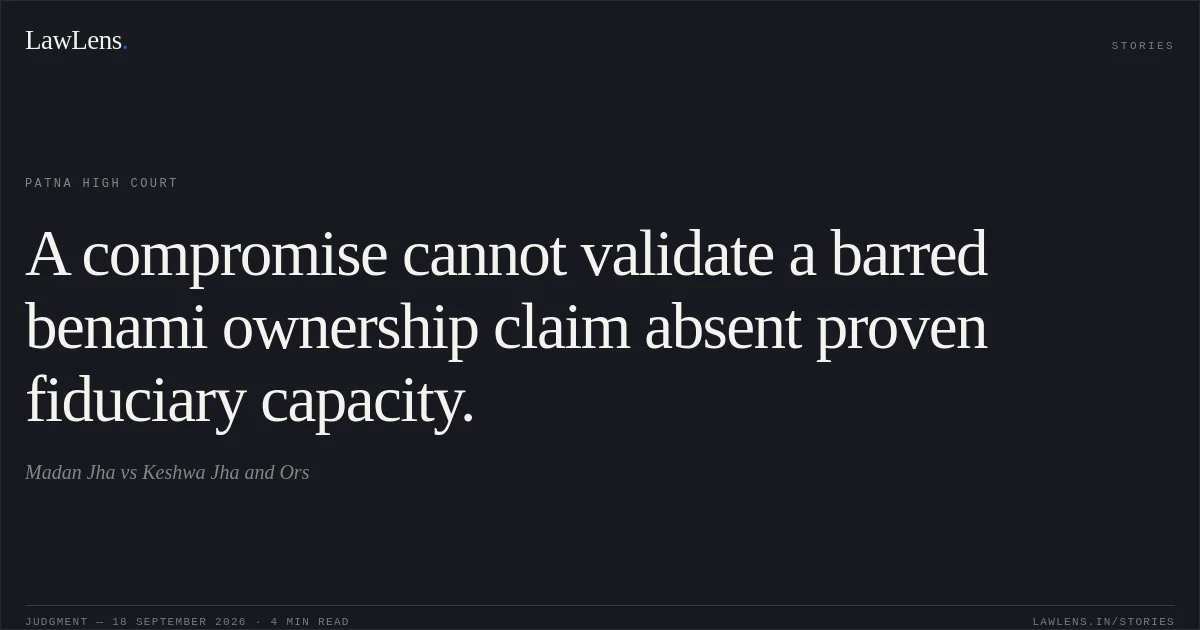
It held that the suit was founded on an unenforceable claim of beneficial ownership in properties standing in the defendants’ names and was barred by Section 4 of the Benami Act; the fiduciary-capacity exception was unavailable on the pleadings and material on record.
Source reference: p. 24–25The compromise dated 5 December 2016 was therefore not a lawful compromise under Order XXIII Rule 3 CPC and could not be recorded merely because all parties had consented to it.
Source reference: p. 21–25The Trial Court’s judgment and decree were affirmed, the first appeal was dismissed, pending interlocutory applications were disposed of, and there was no order as to costs.
Source reference: para. 37–40Acts & Sections Cited
8 provisions across 3 statutes referred to in this judgment. Each provision opens on LawLens.
Code of Civil Procedure, 19081
Indian Trust Act, 18823
Original Court PDF
Madan JhavsKeshwa Jha and Ors
Click to open original judgment
Original judgment, available to read, download and summarize on LawLens.in