Facts
The defendant applied under GA 6 of 2016 seeking, inter alia, a declaration that the terms of settlement dated 29 August 2015 were non est and non-binding, and for recall or setting aside of the consent decree dated 8 September 2015 allegedly passed on the basis of those terms.
Source reference: pp. 2–3The defendant contended that he had signed documents believing them to relate principally to the conveyance of the Howrah property, that the plaintiffs had fraudulently included terms relinquishing his interest in the family dwelling house at 77F, Karaya Road, Kolkata, and that neither he nor his Advocate-on-Record had notice of the matter being listed for mentioning when the decree was passed.
Source reference: pp. 3–7The plaintiffs denied fraud and asserted that the settlement was voluntarily signed at the defendant’s chamber on 29 August 2015, constituted a composite settlement, and that the defendant had subsequently acted in accordance with the decree.
Source reference: pp. 8–10An intervenor stated that, in 2024, the defendant had conveyed the Karaya Road property to the intervenor after representing himself as its sole owner; possession was later disturbed pursuant to orders connected with the proceedings.
Source reference: pp. 12–13The Court considered the application along with connected applications GA 7 of 2024 and GA 8 of 2024. Mediation, directed by an earlier order dated 22 September 2025, failed.
Source reference: p. 13Issues
Whether the defendant’s challenge to the validity of the compromise and the consent decree could be adjudicated by an application before the Court rather than through a separate suit.
Source reference: pp. 13–16Whether the application challenging the compromise decree ought to be placed before the Judge who had recorded the compromise and passed the decree.
Source reference: pp. 15–16Whether the alleged fraud, absence of consent, and non-compliance with the requirements of Order XXIII Rule 3 CPC rendered the compromise and decree invalid.
Source reference: pp. 3–7, 13–15Law Applied
The Court applied Order XXIII Rule 3 CPC, which requires a compromise to be lawful, in writing, signed by the parties, recorded by the Court, and followed by a decree in accordance with the compromise; a compromise that is void or voidable under the Indian Contract Act is not “lawful” for this purpose.
Source reference: pp. 13–15Order XXIII Rule 3A CPC bars a separate suit for challenging a decree on the ground that the compromise underlying it was unlawful.
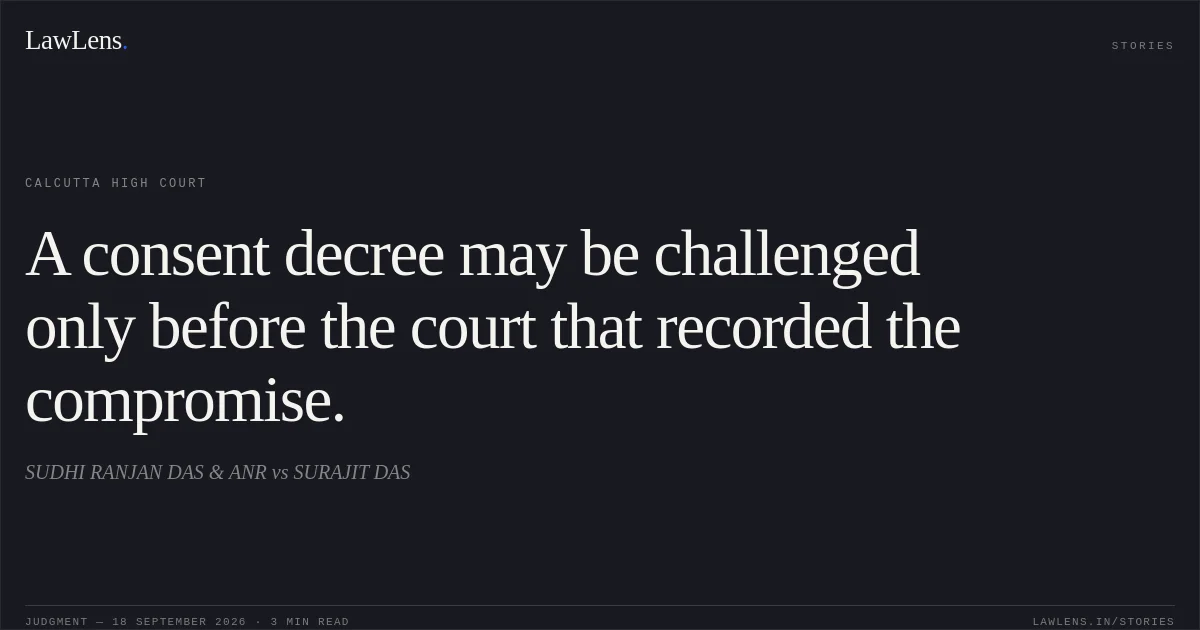
Source reference: p. 15Relying on R. Rajanna v. S.R. Venkataswamy, AIR 2015 SC, the Court held that the remedy of a party disputing a consent decree is to approach the Court that recorded the compromise and establish that no valid compromise existed; that Court must itself determine the validity of the compromise.
Source reference: pp. 15–16A compromise decree is essentially an agreement between the parties receiving the Court’s approval, and the Court cannot impose a compromise upon an unwilling party.
Source reference: pp. 14–15Reasoning
The Court noted that the defendant’s application directly challenged the existence and validity of the alleged compromise on grounds of fraud, lack of consent, concealment, and want of notice.
Source reference: pp. 3–7Under Order XXIII Rules 3 and 3A CPC, such a challenge was required to be determined by the Court that had recorded the compromise, and could not be pursued through an independent suit.
Source reference: pp. 13–16Since the consent decree dated 8 September 2015 had been passed by Justice Arijit Banerjee, the Court considered it appropriate that the application and the connected matters be placed before that Judge for determination of whether there had been a valid and lawful compromise.
Source reference: pp. 15–16The Court therefore refrained from deciding the factual allegations of fraud or the validity of the settlement at this stage.
Source reference: pp. 15–16Holding
The Court held that the challenge to the compromise decree was maintainable before the Court that had recorded the compromise, and that the validity of the alleged settlement had to be decided by that Court in accordance with Order XXIII Rule 3 CPC and the principle in R. Rajanna.
It did not finally adjudicate whether the terms of settlement dated 29 August 2015 or the decree dated 8 September 2015 were fraudulent, void, or binding.
Source reference: no citationGA 6 of 2016, together with connected applications GA 7 of 2024 and GA 8 of 2024, was released from the Court’s list and directed to be placed before the Hon’ble Chief Justice for appropriate orders for listing before Justice Arijit Banerjee.
Source reference: p. 16Acts & Sections Cited
3 provisions across 2 statutes referred to in this judgment. Each provision opens on LawLens.
Bharatiya Nyaya Sanhita, 20232
Code of Civil Procedure, 19081
Original Court PDF
SUDHI RANJAN DAS & ANRvsSURAJIT DAS
Click to open original judgment
Original judgment, available to read, download and summarize on LawLens.in